






Gold (XAUUSD) eased back to around 4,801.59, falling 0.57% on the day, as short-term downside momentum emerged after prices failed to hold above the 4,888.50 resistance area.
The retracement followed a modest improvement in global risk sentiment after US President Donald Trump stepped away from earlier tariff threats towards Europe, which had been linked to Greenland.
Trump indicated that negotiations were close to a resolution and explicitly ruled out the use of force. This helped calm fears of military escalation, reduced demand for safe-haven assets, and prompted profit-taking after gold’s strong rally earlier in the week.
Geopolitical Risks Linger Beneath the Surface
Although headline tensions have eased, uncertainty has not disappeared entirely. European lawmakers have delayed approval of the EU–US trade agreement reached in July, keeping trade-related risks in focus and limiting the extent of the unwind in defensive positions.
Meanwhile, a sharp sell-off in Japanese government bonds, driven by election-related tax cut pledges, has reignited concerns over fiscal sustainability.
Together, these factors have maintained a baseline level of safe-haven demand, helping to cap downside follow-through in gold despite the broader easing in geopolitical risk.
Attention Turns To US Inflation Data
Market focus now shifts to the delayed US PCE inflation report, due later today.
As the Federal Reserve’s preferred inflation measure, the release is likely to influence short-term expectations around monetary policy and real yields, both of which are key drivers for gold prices.
A softer reading could help stabilise bullion following the recent pullback, while an upside surprise may reinforce the current consolidation as markets reassess the timing and scale of potential rate cuts.
Technical Analysis
The slide towards 4,756.01 represented a sharp corrective move, although it was followed by a brief recovery attempt. Even so, prices remain capped below the 20- and 30-day moving averages, pointing to ongoing downside pressure.
Trading volume increased during the latest decline, suggesting a pickup in selling interest.
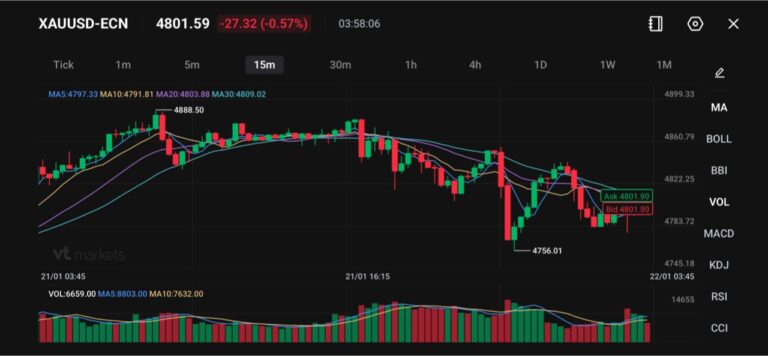
Unless buyers can quickly reclaim the 4,820–4,840 region, gold may remain exposed to further weakness, particularly if risk appetite improves or yields move higher.
In the near term, the technical structure remains fragile. Support is seen around 4,750, while recovery attempts are likely to encounter resistance near 4,850.







