







Key Takeaways
- Gold advanced for a fifth consecutive session, trading near four-week highs.
- Iran’s reported closure of the Strait of Hormuz heightened supply and inflation concerns.
- The US dollar remains firm, yet safe-haven flows continue to support bullion.
- Rising oil prices are heightening inflation risks and complicating expectations for Fed rate moves.
Gold prices extended gains on Tuesday, marking a fifth consecutive session of advances as geopolitical tensions in the Middle East intensified.
Spot gold traded near $5,363 per ounce, while US futures approached $5,377. The rally follows sustained military escalation between the United States, Israel and Iran, with markets increasingly pricing the risk of a prolonged regional conflict.
The safe-haven bid has strengthened as uncertainty around the duration and scope of the conflict remains elevated.
Strait of Hormuz Closure Raises Structural Risk
Iranian media reported that a senior official from the Islamic Revolutionary Guard Corps stated that the Strait of Hormuz has been closed, warning that ships attempting passage would be targeted.
The Strait handles roughly one-fifth of global oil flows. Even temporary disruption significantly tightens energy supply expectations and introduces broader macroeconomic risk.
Oil market stress feeds directly into inflation expectations, which in turn influences real yields — a critical driver for gold pricing.
While the full operational status of shipping lanes remains fluid, the market response reflects heightened sensitivity to energy supply risk.
Gold and the Dollar Rising Together
The US dollar remains near a more than five-week high, reflecting its own safe-haven status.
Although a stronger dollar typically acts as a headwind for gold, that inverse relationship weakens during periods of acute geopolitical stress. Traders often accumulate both assets simultaneously as defensive positioning increases.
This concurrent strength suggests that capital preservation, rather than currency dynamics, is driving flows.
Inflation Pressures and Policy Implications
Escalating oil prices and reduced shipping volumes through the Strait of Hormuz are reinforcing inflation concerns.
If energy prices remain elevated, inflation expectations may rise as markets reassess the timing of Federal Reserve rate cuts.
Gold’s current rally reflects both:
- Immediate geopolitical risk
- Broader concerns around inflation persistence
The interaction between these forces will shape near-term volatility.
Technical Positioning
Gold (XAUUSD) is trading near 5,365, up roughly 0.8% on the session, as the metal continues its steady advance toward the prior high at 5,598.60. The broader daily structure remains firmly bullish, with price maintaining a clear sequence of higher highs and higher lows since the February pullback.
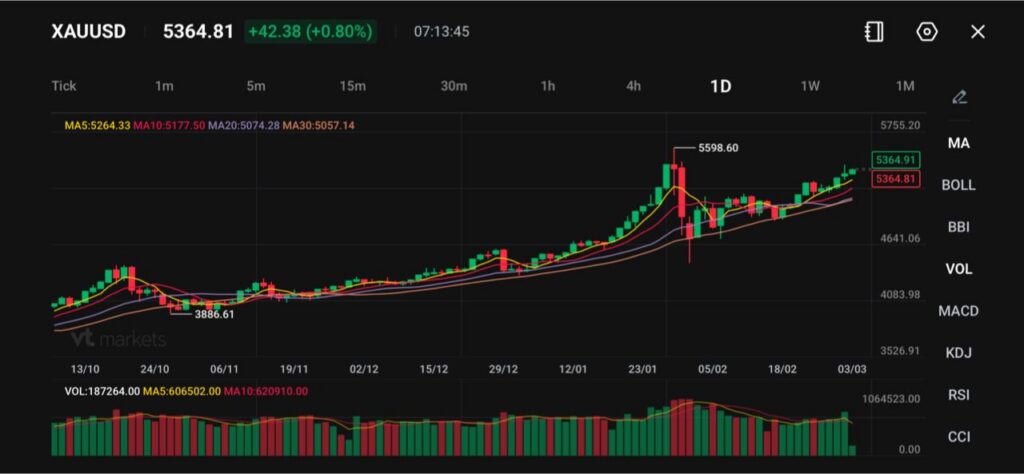
Price is comfortably above the key moving averages. The 5-day (5,264) and 10-day (5,177) are sloping higher, while the 20-day (5,074) and 30-day (5,057) remain well below current levels and trending upward. This alignment confirms strong upside momentum and reinforces the prevailing uptrend.
Immediate resistance sits near the 5,550–5,600 zone, where the previous peak capped gains. A sustained break above 5,600 would confirm fresh bullish expansion and could open the path toward the 5,750 region.
On the downside, initial support is seen around 5,250–5,300, followed by stronger structural support near 5,100. As long as price holds above the 20-day average, the broader bullish structure remains intact, with pullbacks likely to be viewed as corrective rather than trend-changing.
Learn more about trading Precious Metals on VT Markets here.
Frequently Asked Questions
- Why is gold rising for a fifth straight session? Gold is benefiting from sustained safe-haven demand as US-Israel military action against Iran intensifies and uncertainty around the Strait of Hormuz increases.
- How does the Strait of Hormuz affect gold prices? The Strait handles roughly 20% of global oil shipments. Disruption raises oil prices, which can fuel inflation concerns. Higher inflation expectations often support gold by pressuring real yields.
- Why is gold rising even though the US dollar is strong? During periods of heightened geopolitical stress, traders often buy both gold and the US dollar as defensive assets. The typical inverse correlation can weaken under such conditions.
- Could rising oil prices push gold higher? Yes. Sustained increases in energy costs can reinforce inflation expectations and complicate central bank policy decisions, creating a supportive environment for bullion.
- What would limit gold’s upside from here? A credible de-escalation in Middle East tensions, stabilisation in oil markets or a sharp rise in real yields could reduce safe-haven demand and prompt consolidation.
Start trading now – Click here to create your real VT Markets account







