







Key Takeaways
- Oil prices rose as escalating US-Israel strikes on Iran disrupted Middle East energy infrastructure.
- Tanker attacks and continued closure of the Strait of Hormuz are tightening supply expectations.
- Iraq has already cut nearly half its oil production due to export disruptions.
- US naval escort proposals may stabilise shipping routes but have yet to restore market confidence.
Oil prices moved higher on Wednesday as escalating military conflict between the United States, Israel and Iran disrupted energy flows across the Middle East.
Brent crude rose about 1.4% to $82.53 per barrel after closing at its highest level since January 2025 in the previous session. US West Texas Intermediate climbed to around $75.37, marking its strongest settlement since June.
The latest price gains reflect growing concern that regional supply disruptions may intensify if the conflict continues to damage production and export infrastructure.
Export Routes Under Pressure
The Strait of Hormuz remains the central pressure point for global energy markets.
Iranian forces have targeted tankers passing through the waterway, effectively halting traffic for a fourth consecutive day. Roughly one-fifth of the world’s oil and liquefied natural gas flows through the Strait, making even temporary disruption highly significant for global supply chains.
The conflict has already forced producers and shipping operators to reassess logistics across the region.
Iraq Cuts Output as Export Channels Close
Iraq, the second-largest crude producer in OPEC, has reduced output by roughly 1.5 million barrels per day due to limited storage capacity and blocked export routes.
Officials warned that if exports do not resume soon, nearly 3 million barrels per day of production could be shut down entirely within days.
Such a reduction would represent a substantial tightening of global supply, particularly at a time when geopolitical risk is already elevated.
Military Escorts May Stabilise Shipping
US President Donald Trump said the US Navy could begin escorting oil tankers through the Strait of Hormuz if necessary to restore trade flows.
Washington has also directed the US International Development Finance Corporation to provide political risk insurance and financial guarantees for maritime shipping in the Gulf.
While these measures may help reduce shipping risks, market participants remain cautious. Ship owners and analysts have questioned whether military protection alone will be sufficient to restore confidence.
Technical Analysis
Oil prices remain elevated, with UKOUSD (Brent Crude) trading near $82.40, holding close to recent highs after a strong rally from the December low around $58.96. The broader daily structure shows a clear bullish trend, supported by a sequence of higher highs and higher lows since the start of the year.
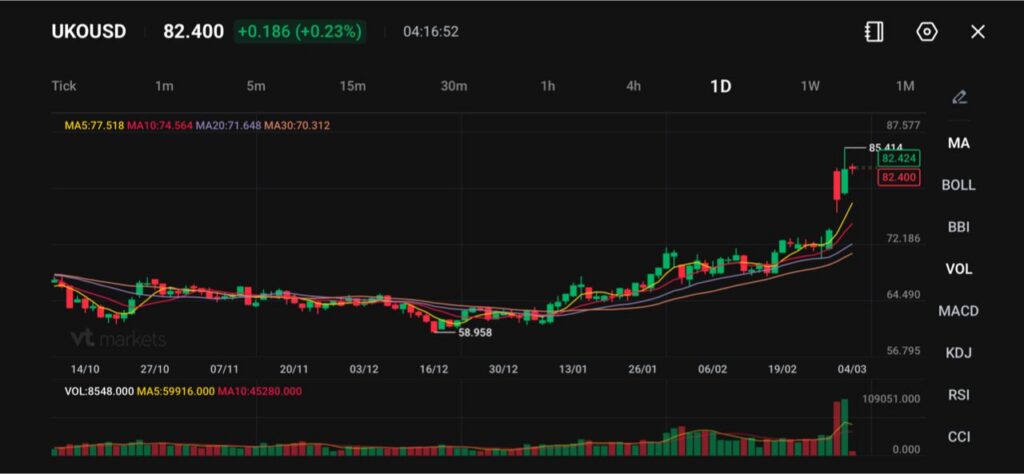
Momentum indicators reinforce the upward bias. The 5-day moving average (77.52) and 10-day (74.56) are sharply rising, while the 20-day (71.65) and 30-day (70.31) remain well below current price levels and continue to trend higher. This wide separation between price and the longer-term averages reflects strong bullish momentum following the recent breakout above the $80 psychological level.
Immediate resistance is located near $85.40, where the latest rally stalled. A decisive break above this zone could extend the move toward $87.50. On the downside, initial support sits around $80.00–$81.00, followed by stronger structural support near $75.00–$77.00, where the short-term moving averages are clustered. As long as prices remain above the $80 region, the near-term outlook remains constructive, though the recent sharp rally may leave room for short-term consolidation before the next directional move.
Global Buyers Seek Alternative Supply
With uncertainty surrounding Middle East shipping routes, major energy-importing countries have begun exploring alternative supply options. India and Indonesia are seeking replacement cargoes, while some Chinese refineries have either reduced operations or brought forward maintenance schedules.
Meanwhile, Saudi Arabia’s Aramco is reportedly attempting to reroute certain exports through the Red Sea to bypass the Strait of Hormuz.
These adjustments illustrate the scale of disruption currently affecting global energy logistics.
Learn more about trading Energies on VT Markets here.
Frequently Asked Questions
- Why are oil prices rising?
Oil prices are increasing due to supply disruptions linked to escalating conflict between the United States, Israel and Iran. Attacks on energy infrastructure and shipping routes have raised concerns about global supply availability. - Why is the Strait of Hormuz so important for oil markets?
The Strait of Hormuz handles roughly 20% of global oil and liquefied natural gas shipments. Any disruption to traffic through the Strait can significantly affect global energy supply and prices. - How much production has Iraq already cut?
Iraq has reduced output by around 1.5 million barrels per day due to storage constraints and blocked export routes. Officials warn that production could fall further if exports do not resume. - Could US naval escorts reopen shipping routes?
US naval escorts may help protect tankers and restore shipping confidence. However, analysts remain uncertain whether military protection alone will be enough to fully normalise traffic. - How are global buyers responding to the disruption?
Several countries are seeking alternative supply sources. India and Indonesia are exploring new import routes, while some Chinese refineries are adjusting operations due to supply uncertainty.
Start trading now – Click here to create your real VT Markets account







