







Key Points
- The yen trades around 157.5 per dollar on Friday, set for a third consecutive weekly decline as the dollar stays firm.
- The US-Israeli offensive against Iran has entered its seventh day, lifting energy anxiety and adding pressure on Japan as an energy importer.
- USDJPY sits near 157.486 (-0.060, -0.04%), with price above key averages: MA5 157.419, MA10 156.620, MA20 155.341, MA30 155.235.
The yen trades around 157.5 per dollar on Friday and remains on track for its third consecutive weekly decline. The driver is simple: traders keep reaching for the reserve currency as the Middle East conflict escalates, and that flow supports the dollar against most majors.
When fear rises, traders often cut exposure to carry trades and rotate into USD cash and short-dated USD assets. That can keep USDJPY elevated even if the pair looks stretched, because safety flows can overpower short-term valuation concerns.
If the conflict headlines keep landing and risk appetite stays shaky, USDJPY can hold near the high-150s and probe higher on spikes in dollar demand. If headlines cool and markets regain confidence, USDJPY may slip back toward recent support zones, but it will likely do so in choppy steps.
Oil Prices Add a Second Headwind for the Yen
The conflict has entered its seventh day, and Tehran has launched a fresh wave of missile and drone strikes across the Gulf. That keeps energy markets nervous and helps hold oil risk premiums in place.
That matters for the yen because Japan relies heavily on energy imports. Higher oil prices can worsen Japan’s trade balance and lift imported inflation. This mix can weaken the yen even when global markets also call it a safe haven, because the import bill becomes a direct drag.
If oil stays bid and shipping risk remains high, the yen can stay under pressure, and USDJPY can remain supported. If oil eases and the energy premium fades, the yen can steady, but the market will still weigh the policy gap between the Fed and the BoJ.
BoJ Signals Patience as War Risks Cloud the Outlook
Bank of Japan Governor Kazuo Ueda warned the conflict could affect Japan’s economy, which strengthens the case for patience on rates. When policymakers face external shocks tied to energy costs and global growth, they often avoid sudden tightening that could hit domestic demand.
This matters for USDJPY because traders price the rate gap. If the Fed stays restrictive while the BoJ stays cautious, the gap can keep supporting USDJPY on dips.
If energy-driven uncertainty persists, the BoJ can lean towards a longer hold, which can leave the yen sensitive to any fresh leg higher in US yields. If inflation in Japan proves sticky and growth holds up, the BoJ may sound firmer later, but traders will likely wait for clearer action before they price a stronger yen trend.
Japan Keeps Intervention on the Table
Japan’s Finance Minister Satsuki Katayama said this week that currency market intervention remains an option, adding that authorities are monitoring the decline “with a strong sense of urgency” and coordinating closely with the US.
That language tends to change trader behaviour. It can reduce appetite for one-way momentum trades because the market knows officials can act if moves become disorderly. It does not force USDJPY down on its own, but it can cap upside follow-through during thin liquidity.
If USDJPY jumps quickly through fresh highs, intervention risk rises, and volatility can increase. If the pair grinds higher more slowly, officials may rely on warnings first, which can still cause sharp pullbacks when positioning gets crowded.
Technical Analysis
The USDJPY pair is trading near 157.49, holding close to the upper range of its recent recovery as the dollar maintains moderate strength against the yen. The pair has rebounded steadily from the late-January lows near 152, gradually rebuilding bullish momentum after the sharp correction from the 159.45 peak earlier this year.
From a technical perspective, price is currently trading above the key short-term moving averages, with the 5-day moving average at 157.42 and the 10-day at 156.62, both trending upward.
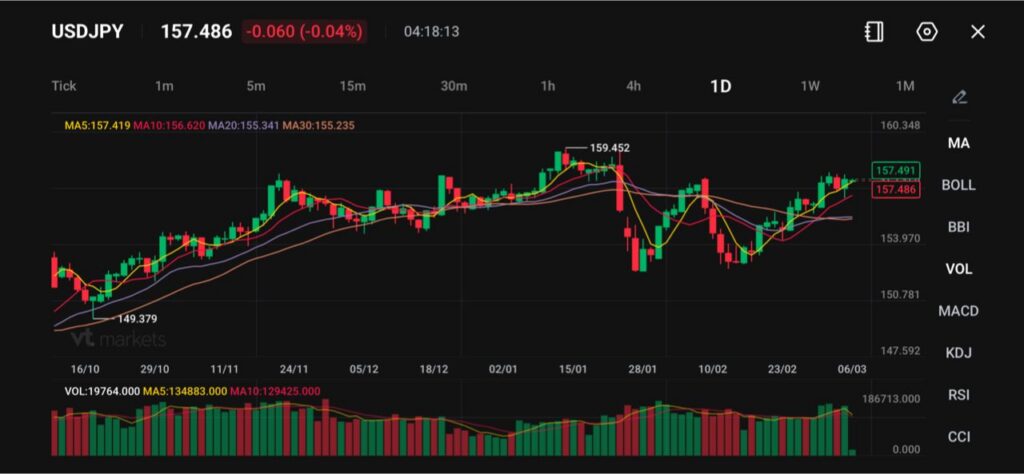
The 20-day (155.34) and 30-day (155.24) averages remain below the current price level, suggesting that the broader bullish structure is intact as the pair continues to form higher lows.
Immediate resistance is located around 158.50–159.45, where the previous rally topped out. A sustained move above this region could open the path toward the 160.00 psychological level.
On the downside, initial support is seen around 156.50–157.00, followed by stronger structural support near 155.00, which aligns closely with the 20-day and 30-day moving averages.
Overall, the technical outlook remains moderately bullish while USDJPY holds above the 155–156 support zone, though price may experience short-term consolidation as it approaches the upper boundary of its recent trading range.
What Traders Should Watch Next
- Whether the conflict remains in escalation mode after day seven, because that drives both the dollar’s haven bid and oil risk.
- Any shift in BoJ tone from Ueda as markets digest the economic hit from higher energy costs.
- Intervention rhetoric from Katayama, especially if USDJPY accelerates rather than trends.
- Price behaviour around 159.452 on the topside, and the moving-average zone around 156.620 to 155.341 on the downside.
Learn more about trading Forex Pairs on VT Markets here.
Frequently Asked Questions (FAQs)
- Why is USDJPY Weakening the Yen Despite Global Risk?
In many crises, the yen strengthens as a safe-haven currency, but this time the dollar is attracting the bulk of defensive flows. Investors often move into the US Treasury markets and dollar liquidity during geopolitical stress. That dynamic keeps USDJPY near 157.5 per dollar even though global risk sentiment is fragile. - How Do Rising Oil Prices Affect the Japanese Yen?
Japan imports most of its energy. When oil prices rise sharply, the country spends more on imports, which can widen the trade deficit. A larger import bill tends to weaken the yen because more yen must be exchanged for foreign currency to pay for energy shipments. - Why Does Monetary Policy Matter So Much for USDJPY?
Currency markets often follow interest rate differentials. If US rates remain higher while the Bank of Japan keeps borrowing costs low, capital tends to move toward dollar assets. That gap can keep USDJPY elevated even if economic conditions in Japan remain stable. - What does a “third consecutive weekly decline” for the Yen indicate?
Three straight weeks of losses often signal sustained pressure rather than a single reaction to headlines. It suggests traders continue to favour the dollar and have not yet found a reason to rebuild large yen positions. - Why Are Japanese Officials Talking About Currency Intervention?
Authorities sometimes step in when exchange rate moves become rapid or disorderly. Finance Minister Satsuki Katayama said intervention remains an option and that officials are watching markets “with a strong sense of urgency”. Statements like this aim to slow speculation and remind traders that the government can act if volatility increases.
Start trading now – Click here to create your real VT Markets account







