







Key Points
- WTI trades near 91.23, up +2.382 (+2.68%), while Brent rebounds above $100 per barrel.
- Risk sentiment remains fragile as Strait of Hormuz disruptions persist and conflict escalates.
- Governments respond with stockpile releases and demand cuts, highlighting supply stress.
Oil prices pushed higher again after a brief pullback, reinforcing how sensitive markets remain to developments in the Middle East.
WTI crude is trading near 91.23, up +2.68%, while Brent crude has climbed back above $100 per barrel, reversing earlier losses. The rebound follows a short-lived relief rally that faded quickly as geopolitical tensions intensified.
The market reaction shows that any dip in oil prices is being treated as temporary, with traders continuing to price in supply risks.
Oil may remain volatile, with upward pressure persisting as long as supply disruptions are unresolved.
Strait of Hormuz Remains the Core Risk
The situation around the Strait of Hormuz continues to dominate the oil narrative. Despite diplomatic signals, there is little evidence of de-escalation.
The strait remains effectively constrained, limiting the flow of crude and LNG through one of the world’s most critical energy corridors.
Iran’s continued missile activity and the lack of confirmed negotiations have kept markets on edge. Even with a short extension to diplomatic timelines, traders are not pricing in a quick resolution.
This sustained uncertainty is preventing oil from correcting meaningfully lower.
If the strait remains restricted, oil prices could reprice higher as global inventories tighten.
Global Response Highlights Supply Stress
Governments are already taking steps to manage the shock.
Japan has announced plans to release oil from joint stockpiles by the end of March, while South Korea is pushing for nationwide energy-saving measures. These actions reflect growing concern over prolonged supply constraints.
Meanwhile, reports that Iranian oil is being offered to Indian refiners at a premium to ICE Brent suggest that even sanctioned supply is being reintroduced under strained conditions.
These developments underline how tight the global energy market has become.
Risk Sentiment Turns Choppy Across Markets
The oil rebound has weighed on broader market sentiment.
Asian equities saw only a modest recovery, while U.S. and European futures declined, reflecting uncertainty over growth and inflation.
At the same time, the U.S. dollar regained strength, and Treasury yields resumed their climb, signalling a shift back toward defensive positioning.
Higher oil prices raise inflation risks, which in turn complicate central bank policy and pressure risk assets.
Continued energy price strength could weigh on equities and support the dollar in the near term.
Technical Analysis
Crude Oil (CL-OIL) is trading near $91.23, up around 2.68% on the session, showing a short-term rebound after the recent pullback from the $119.43 spike high. The move suggests buyers are stepping back in around key support, though the broader structure is still in a cooling phase after the earlier surge.
From a technical perspective, oil remains in an overall uptrend, but momentum has clearly softened. Price is now sitting just below the 5-day MA (94.31) and 10-day MA (94.18), both of which are turning lower and acting as immediate resistance. Meanwhile, the 20-day MA (85.17) and 30-day MA (78.32) remain well below price and continue to slope upward, indicating that the broader bullish structure is still intact.
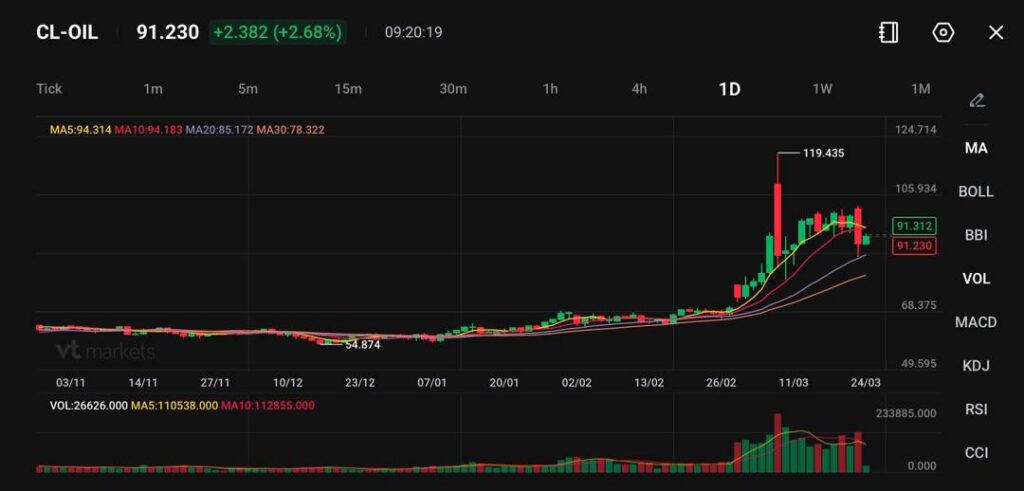
Key levels to watch:
- Support:$90 → $85 → $78
- Resistance:$94–95 → $100 → $105+
The $90 region is proving to be an important near-term support zone. Holding above this level keeps the structure constructive and supports the idea of consolidation rather than reversal. A break below it, however, could trigger a deeper retracement toward the $85 region, where the 20-day average aligns.
On the upside, price needs to reclaim $94–95 to regain momentum. A sustained move above this area would likely open the path back toward $100, followed by the $105–110 zone, though the $119 high remains a distant and strong resistance level for now.
Overall, oil appears to be transitioning from a parabolic rally into a consolidation phase, with buyers defending key support but struggling to reclaim short-term control. The next move will likely depend on whether price can decisively break back above $95 or lose the $90 floor, which would define the next directional leg.
Macro Data and Central Banks in Focus
Beyond geopolitics, markets are also watching incoming economic data.
Upcoming flash PMI readings for the Eurozone, UK, and U.S. will provide insight into how the energy shock is impacting economic activity.
At the same time, Japan’s core inflation slowing below the 2% target adds another layer of complexity for central banks trying to balance growth and inflation risks.
These macro factors will play a key role in shaping expectations for monetary policy in the coming weeks.
What Traders Should Watch Next
Markets remain driven by a mix of geopolitical and macro forces. Key areas to monitor include:
- Developments around the Strait of Hormuz
- Oil price behaviour above the $100 Brent level
- Government responses to energy shortages
- Central bank reactions to inflation risks
- Upcoming PMI data releases
For now, oil’s rebound highlights a market that remains tightly linked to geopolitical developments, with volatility likely to persist as supply risks evolve.
Learn more about trading Energies on VT Markets here.
FAQs
Why Did Oil Prices Rise Again Today?
Oil prices rebounded because geopolitical tensions remain high and supply disruptions through the Strait of Hormuz continue to restrict global energy flows.
Where Are Oil Prices Trading Now?
WTI crude is trading near 91.23, up +2.68%, while Brent crude has climbed back above $100 per barrel.
Why is the Strait of Hormuz So Important for Oil?
The Strait of Hormuz handles roughly 20% of global oil shipments, making it one of the most critical chokepoints for global energy supply.
Is the Oil Rally Likely to Continue?
Oil could remain supported if supply disruptions persist. However, short-term pullbacks may occur as markets react to news and policy responses.
How Are Governments Responding to the Oil Shock?
Countries are releasing strategic reserves and implementing energy-saving measures. Japan plans to release oil from stockpiles, while South Korea is reducing energy usage.
Why Are Markets So Volatile Right Now?
Volatility is driven by uncertainty around the Middle East conflict, fluctuating oil prices, and concerns about inflation and economic growth.
Start trading now – Click here to create your real VT Markets account







