






Key Points
- TSLA trades near 381.56, up +14.34 (+3.91%), after the Terafab announcement.
- Tesla plans $20 billion in equipment spending for 2026, on top of a separate Terafab investment.
- Production is targeted for late 2027, with volume output expected in 2028.
Tesla shares moved higher after Elon Musk unveiled plans for Terafab, a semiconductor manufacturing facility positioned as a cornerstone of a broader AI ecosystem.
TSLA is trading near 381.56, gaining +3.91%, as investors reacted positively to the scale and ambition of the project.
The announcement adds a new dimension to Tesla’s story, shifting part of the narrative from electric vehicles toward infrastructure for artificial intelligence.
The rally reflects optimism around long-term growth, but near-term price action may remain volatile as execution risks are assessed.
$20 Billion Spend Signals Aggressive Expansion
Tesla plans to allocate approximately $20 billion toward new equipment in 2026, a sharp increase from less than $9 billion in 2025. Importantly, Terafab spending sits on top of this figure, implying an even larger capital commitment.
This level of investment highlights Tesla’s intent to secure control over critical components in the AI supply chain, particularly semiconductors.
However, the scale also raises questions around funding, capital allocation, and potential pressure on margins.
Continued investor support will likely depend on clarity around financing and return on investment.
Terafab Targets Unprecedented Scale
The concept behind Terafab centres on extreme scale. Musk aims to produce chips capable of supporting one terawatt of computing demand, equivalent to roughly one billion Nvidia Blackwell chips per year.
A terawatt equals one trillion watts, underscoring how far the project extends beyond current semiconductor manufacturing capabilities.
Initial production is targeted for late 2027, with full-scale output in 2028. This timeline is ambitious, given that typical semiconductor facilities require around three years from construction to production.
Delays are a key risk. Any slippage in the timeline could weigh on sentiment and valuation.
AI Integration Expands Tesla’s Strategic Scope
Terafab is not a standalone project. It forms part of a broader ecosystem involving Tesla, xAI, and SpaceX, following their closer integration earlier this year.
The structure suggests a vertically integrated model where one group designs AI systems, manufactures the chips, deploys them in vehicles and robotics, and processes data via satellite infrastructure.
Musk has indicated that around 80% of Terafab’s chip output could be used in space, where SpaceX would handle AI computation.
This vision extends beyond traditional semiconductor strategies and into a fully integrated AI infrastructure model.
While the concept is expansive, execution across multiple industries introduces complexity that may take years to resolve.
Technical Analysis
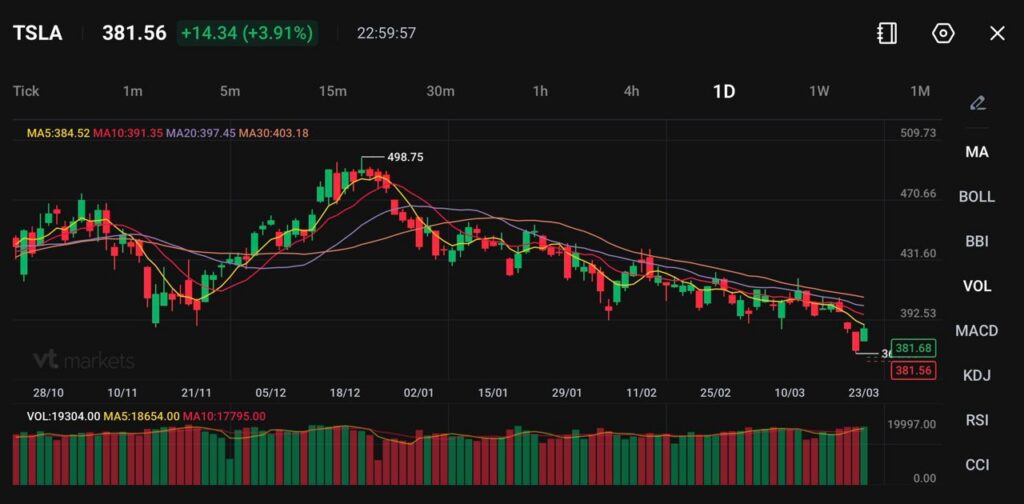
Tesla (TSLA) is trading near 381.56, up around 3.91% on the session, showing a short-term bounce after an extended downtrend that has been in place since the 498.75 peak. Despite the recovery, the broader structure still reflects sustained bearish pressure.
From a technical standpoint, Tesla remains below all key moving averages, reinforcing the dominant downward trend. The 5-day MA (384.52) sits just above current price and is flattening, while the 10-day (391.35), 20-day (397.45), and 30-day (403.18) are all trending lower and stacked above price. This alignment suggests that rallies may continue to face selling pressure unless the structure shifts.
Key levels to watch:
- Support:375 → 360 → 340
- Resistance:385 → 390–400 → 430
The current bounce is approaching immediate resistance around 384–390, where the short-term moving averages cluster. A failure to break and hold above this zone would likely reinforce the ongoing downtrend. On the downside, 375 is acting as near-term support, with a break potentially exposing further weakness toward 360.
Volume has remained relatively steady, without a strong surge in buying interest, which suggests this move may be more of a technical rebound rather than a trend reversal.
Overall, Tesla appears to be attempting to stabilise after a prolonged decline, but the trend remains bearish unless price can reclaim the 390–400 region. A sustained move above that zone would be the first signal of a potential shift in momentum, while rejection could lead to continued downside pressure in the sessions ahead.
What Traders Should Watch Next
Tesla’s next phase will depend on both execution and communication. Key factors include:
- Details on Terafab funding and timelines
- Updates on integration with xAI and SpaceX
- Broader AI infrastructure demand trends
- Tesla’s core EV performance and margins
For now, the market is reacting to vision and scale, but sustained upside will likely require clearer evidence that execution can match ambition.
Create a live VT Markets account today to access our platform features, including market insights and educational content.
FAQs
Why Did Tesla Stock Rise After the Terafab Announcement?
Tesla gained as investors reacted positively to the Terafab chip factory plan, viewing it as a long-term growth driver in AI and semiconductor infrastructure.
What is Terafab?
Terafab is a proposed semiconductor manufacturing facility backed by Tesla, xAI, and SpaceX, aimed at producing chips at an unprecedented scale for AI applications.
How Much is Tesla Planning to Invest?
Tesla plans to spend around $20 billion on equipment in 2026, up from less than $9 billion in 2025, with Terafab costs on top of that.
When Will Terafab Start Producing Chips?
Initial production is targeted for late 2027, with full-scale output expected in 2028, although this timeline is considered ambitious.
What Makes Terafab Different From Other Chip Projects?
The project aims to support one terawatt of computing demand, equivalent to roughly one billion Nvidia Blackwell chips per year, far exceeding current industry norms.
How Does SpaceX Fit Into the Terafab Plan?
SpaceX is expected to use around 80% of Terafab’s chip output, potentially running AI computations in space rather than traditional data centres.
Start trading now – Click here to create your real VT Markets account







