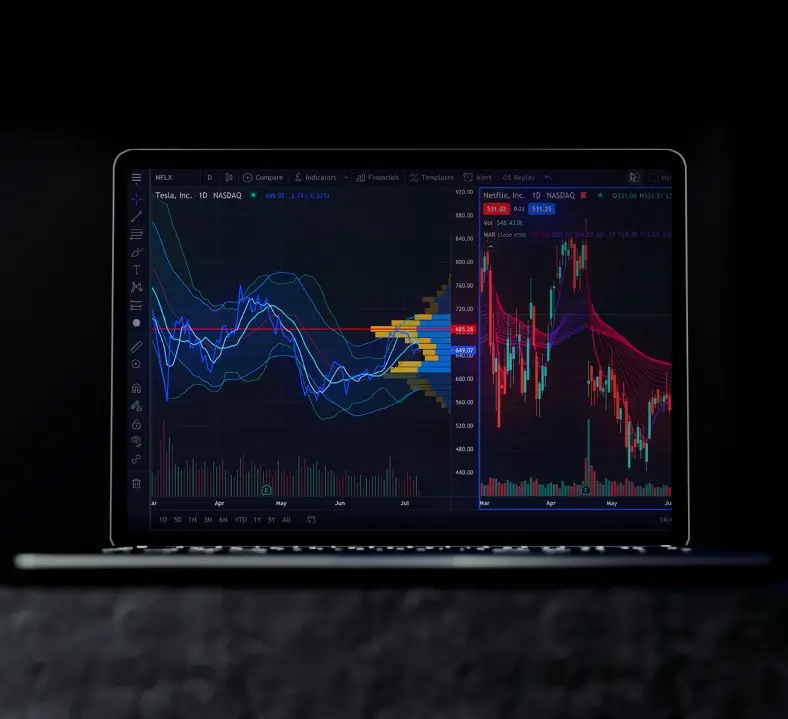
Price action reads the raw price movement directly on the chart. Indicators process the same price data through a formula and display the result as a line or histogram. The core difference is timing. Price moves first, indicators follow. If you want to read the market, it makes more sense to read the source.
Quick Comparison: Price Action Vs Indicators
| Factor | Price Action | Indicators |
| Speed of signal | Immediate | Lagging |
| Learning curve | Steeper at first | Easier to start |
| Chart clarity | Clean and minimal | Cluttered |
| Subjectivity | Moderate | Lower |
| Interpretation in trending markets | Yes | Yes |
| Interpretation in range-bound markets | Yes, with context | Unreliable |
For a more detailed breakdown, jump to this section.
What Is Price Action Trading?
Price action trading means making decisions based on what the price is doing on the chart, nothing else.
You’re looking at how candles form. You’re seeing where price stalls. You’re seeing where it reverses. This shows who controls the market at any moment.
The idea is that everything you need to know about a market is already visible in price. If buyers are stepping in aggressively, you’ll see it in the candles. If the price breaches key levels twice, that’s meaningful.
Not because a formula tells you so, but because you can see it happening in real time.
For CFD traders, this matters.
Markets can move fast. If you wait for an indicator to confirm what price showed a few candles ago, you may miss a good entry. You could even miss the trade!
What Price Action Traders Actually Look At
Candlestick Patterns
Engulfing candles, morning star, and evening star that signal potential reversals or continuation.

Support and resistance levels
Horizontal zones where price has previously reacted, stalled, or reversed
Market structure
The sequence of highs and lows that tells you whether a market is trending, ranging, or breaking down
Break And Retest Setups
Where price breaks a key level and returns to it before continuing
Momentum shifts
Changes in candle size, wick length, or closing position that suggest conviction is changing
What Are Technical Indicators?
Technical indicators are tools that calculate a value based on past price or volume data. The indicators then plot this value visually on your chart.
The most common indicators are RSI (Relative Strength Index), MACD (Moving Average Convergence Divergence), and Bollinger Bands.
Each of them is trying to answer a specific question: Is price overbought or oversold? Is momentum shifting? Is volatility expanding or contracting?

Used selectively, indicators can add structure to your analysis, particularly as a secondary filter before entering a trade. The issue isn’t that they’re wrong. The issue is that they’re a step removed from the actual market.
Why Indicators Lag Price
Here’s the insight that changes how most traders think about this: every single indicator is derived from price.
RSI is calculated from closing prices. MACD is built from moving averages of price. Bollinger Bands are plotted around a moving average of price.
None of them generates new information. They reprocess information that already exists in the raw chart.
That’s what makes them lag by nature. They can only tell you what price has already been done, formatted into a different visual.
Price action is the upstream source. It builds the indicators. When you read the price directly, you’re working with the original data, not a processed summary.
This doesn’t make indicators useless. But it does mean this: if you trust an indicator more than the price, you have it going on backwards.
The 6 Biggest Differences Explained
1. Speed of signal
Price action is immediate. The signal is the candle closing, the level holding, the structure breaking. You see it as it happens.
Indicators, by design, process historical price data before producing an output, which means the signal always arrives after the fact. In fast-moving CFD markets, that delay can be the difference between a clean entry and chasing a move that’s already extended.
2. Learning Curve
Indicators feel easier to start with, and that’s precisely what makes them appealing to newer traders. You attach RSI to a chart, you see a line cross a level, and there’s an immediate sense of structure.
Price action, by contrast, asks you to develop pattern recognition and contextual judgment. These are skills that need nurturing.
3. Chart Clarity
A clean price action chart contains just candlesticks and the levels you’ve drawn.

A chart loaded with indicators quickly becomes visually cluttered. Imagine multiple lines, histograms, bands, and oscillators all competing for attention.
For some traders, that extra data feels reassuring. For most, it creates noise.
4. Subjectivity
Indicators feel objective because they produce a specific number. RSI reads 68.4, not “somewhere around overbought.”
Price action carries moderate subjectivity. Traders will draw levels slightly differently. But the underlying information is unfiltered. With indicators, you’re interpreting data that’s already been processed once.
5. Interpretation in trending markets
Both approaches work in trends. A moving average crossover or MACD holding above its signal line can be useful for staying in a move and avoiding early exits.
Price action gives you the same information faster. Higher highs and higher lows confirm the trend. A break of a prior swing low signals it may be ending. The indicator tells you the same thing, just a bit later.
6 Interpretation in range-bound markets
This is where the gap widens. Price action in a range is straightforward. Buy support, sell resistance, wait for a breakout with conviction. The logic stays consistent.
Indicators break down in ranging conditions. RSI repeatedly tags overbought and oversold without follow-through. MACD crossovers fire false signals in both directions.
Which Should You Use First?
People often frame the price action vs technical indicators debate as an either/or choice. It doesn’t need to be.
But the order you learn them in matters more than most traders realise.
Start with price action. Learn to read structure, identify key levels, and understand what a chart is telling you before you add anything else on top of it. Once you have that foundation, indicators can play a supporting role rather than thinking for you.
The reason this order matters.
If you start with indicators, you end up relying on a layer of abstraction you don’t fully understand.
You see RSI cross 70 and call it overbought, but without understanding the price context around it, that number means nothing. Plenty of strong trending markets will hold RSI above 70 for extended periods and keep running.

Price action gives you the context. Indicators, when used selectively, can help confirm timing or filter out lower-quality setups. That’s a sensible combination. Just don’t let the indicator become the primary signal.
For CFD traders in forex, indices, or commodities, this approach is practical.
It works on all timeframes and instruments. You do not need to reset your tools when market conditions change. Price is price.
Frequently Asked Questions
1. Which indicators work best with price action?
To trade effectively, it is not about which indicators work best, but about avoiding indicators that give the same information. The Golden Rule is to combine indicators from different categories.
If you use the Relative Strength Index (RSI) and Stochastics together, you are just looking at two different versions of bound oscillators.
Instead, combine bound oscillators, like RSI, with a Trend Following Momentum indicator like MACD. This creates confluence, where two different mathematical models agree on a trade setup.
2. Does price action trading apply to all asset classes?
Yes. Price action is universal because it is a visual representation of human psychology, like greed, fear, and indecision, which exists in every market.
3. Can you trade with price action only?
This is often referred to as “naked trading.”
Many professional traders prefer a clean chart because it allows them to focus purely on market structure, support/resistance levels, and candlestick patterns without the noise of lagging indicators.
You only have to be an expert at reading the story the market is telling.
4. Does high-impact economic news disrupt price action trading principles?
Yes and no. While news can cause temporary chaos on a chart, it rarely breaks the long-term price action structure.
Instead, news often acts as a catalyst for a move that the price action was already preparing for.
For example, this is often seen in the “Priced In” phenomenon, where bullish patterns like higher lows or continuation patterns form days before a positive release as “smart money” positions itself. The news then acts as the wind in the sails to break price out of the continuation pattern and continue the previous trend.