






Quantum computing is still years from broad commercial use. Yet governments are already spending a substantial amount to give it weight. The U.S. is putting roughly $2 billion behind the sector, with capital tied to chip manufacturing and quantum components.
What appears to be research funding may be the wider infrastructure planning for a deeper compute stack beneath AI.
National strategies picking up
The U.S. commitment includes around $1 billion for IBM’s quantum-chip manufacturing facility in New York and an additional $375 million for GlobalFoundries to support quantum-component manufacturing. France has also committed €1.5 billion across quantum strategy and microelectronics. These numbers do not look like small research grants. They look more like strategic high-level policy.
Anyone who followed the AI infrastructure cycle will recognise the pattern. Before generative AI became mainstream, the supply chain was already taking shape. GPUs, advanced chips, cloud capacity, data centres, networking equipment, and power demand all became part of the AI trade.
Quantum computing is much earlier in that process but the logic is similar. Governments want domestic capability before the technology becomes commercially important. They are funding the rails before traffic fully arrives.
That does not make every quantum company investable today. It does mean the sector is moving beyond lab research and into long-term infrastructure planning.
Quantum Computing Explained
At its simplest:
- Classical computers use bits (0 or 1)
- Quantum computers use qubits (0, 1, or both at once via superposition)
Qubits can also be linked through entanglement, allowing the state of one to affect another in ways that classical systems cannot easily replicate. This unique way of evaluating an enormous number of possible solutions in tandem enables a meaningful advantage when assessing problems that would take classical hardware years to work through.
That being said, quantum computing will not make every task faster. It is not a better version of a normal computer. They excel in specific domains: chemistry simulation, cryptographic analysis, large-scale optimisation, and certain machine learning tasks.
For most current workloads, especially large-scale AI training and inference, GPUs remain the dominant tool. GPUs like NVIDIA’s H200 Chips or SpaceX’s AI Supercomputer Colossus are still dominantly owned by current AI market leaders.
Quantum computing may become powerful, but its near-term advantage is narrow. The better opportunities may sit with companies building the bridge between today’s classical systems and future quantum capability.
Current Progress in the Quantum field
Today’s quantum devices are often described as NISQ systems, or noisy intermediate-scale quantum computers. The term is technical, but the practical meaning is simple: current machines are useful for experimentation, but not yet reliable enough for broad commercial deployment.
These scalable devices are still limited by error rates, cooling requirements, and qubit counts. But useful quantum computing is not just about physical build; it is about keeping those qubits stable at error rates, cooling requirements, and qubit counts.
The positive shift is that progress is now happening at the hardware-architecture level, not only in theory.
Google’s Willow chip showed advances in quantum error correction and benchmark performance. Microsoft’s Majorana 1 announcement pointed to a possible topological-qubit architecture that could, if validated at scale, offer a more stable route forward. IBM has also laid out a roadmap targeting near-term quantum advantage by the end of 2026 and larger-scale fault-tolerant capability by 2029.
This does not mean commercial quantum computing is around the corner. But it does suggest the sector is moving from isolated lab milestones toward clearer engineering pathways. The challenge is to scale these advances, integrate them into usable systems, and do so without assuming every milestone arrives on schedule.
The hardware story is improving. The commercial timeline remains the open variable
Where Quantum Meets AI
The preparation is utmost. Financial institutions, government agencies, healthcare providers, utilities, and defence contractors all handle data that must remain secure for many years. AI adoption adds to the urgency as witnessed in Okta’s result. As companies create, store, and move more sensitive data, the case for stronger security infrastructure becomes easier to justify.
The most likely path for quantum computing is integration, not sudden disruption.
Hybrid quantum-classical systems allow companies to test quantum capabilities while still relying on existing computing infrastructure. Equal1 and Dell’s RacQ system is one example. It is designed as a rack-mounted quantum-classical system that can sit closer to a standard data-centre setup.
Enterprise buyers do not adopt technology just because it is advanced. They adopt it when it fits into existing workflows, can be supported by vendors, and has a clear reason to be used.
Hybrid systems also create demand for the supporting hardware around quantum computing: control electronics, cryogenic systems, analogue components, signal-processing tools, and high-performance classical compute.
Where quantum innovations and AI cross paths can be comprised into these areas:
- AI improving quantum systems – machine learning to support error correction, calibration, materials research, and system design (happening in the labs)
- Post-quantum cybersecurity – enterprises upgrades encryption before powerful quantum computers can threaten existing systems. (underway in government’s spending)
- Hybrid quantum-classical systems – quantum co-processors for niche, high-value tasks. (emerging infrastructure challenged in current engineering)
- Quantum-enhanced AI workloads – a potential assistant in optimisation or machine-learning processes.
This is where the investment story becomes more grounded. The companies supplying the enabling layer may generate revenue before pure quantum hardware reaches commercial scale.
Markets Getting Ahead
Quantum has the ingredients of a powerful market narrative: national security, AI demand, advanced chips, and long-term computing disruption. That also makes it easy to overprice.
Some pure-play quantum companies are already attracting valuations based on a future market that has not fully formed. Terra Quantum’s reported plan for a Nasdaq listing through a SPAC at a valuation of around $3.5 billion is one example. Its focus on algorithms, security tools, and hybrid systems puts it in a more practical part of the sector, but the valuation still depends on how quickly commercial demand develops.
Hardware timelines remain a risk.
- IBM’s roadmap gives the market useful milestones to track, but timelines can slip.
- Microsoft’s topological-qubit approach could be important, but it still needs broader validation at scale.
- Google’s error-correction progress is meaningful, but commercial usefulness is a separate test.
Costs also matter. Quantum hardware depends on specialised components, extreme cooling, precision manufacturing, and complex control systems. As systems grow, costs may not fall as quickly as investors expect.
That could pressure hardware-focused companies before revenue is large enough to support the spending.
What is moving at VT Markets
VT Markets offer early entires into the movements of markets close to quantum innovations. The near-term opportunity sits in the layers that can benefit before fault-tolerant quantum computers arrive.
Like the AI supply chain build, the cleaner approach is to treat quantum as a stack, not a single trade. The strongest near-term exposure may come from companies enabling the ecosystem before fault-tolerant quantum computers reach commercial scale.
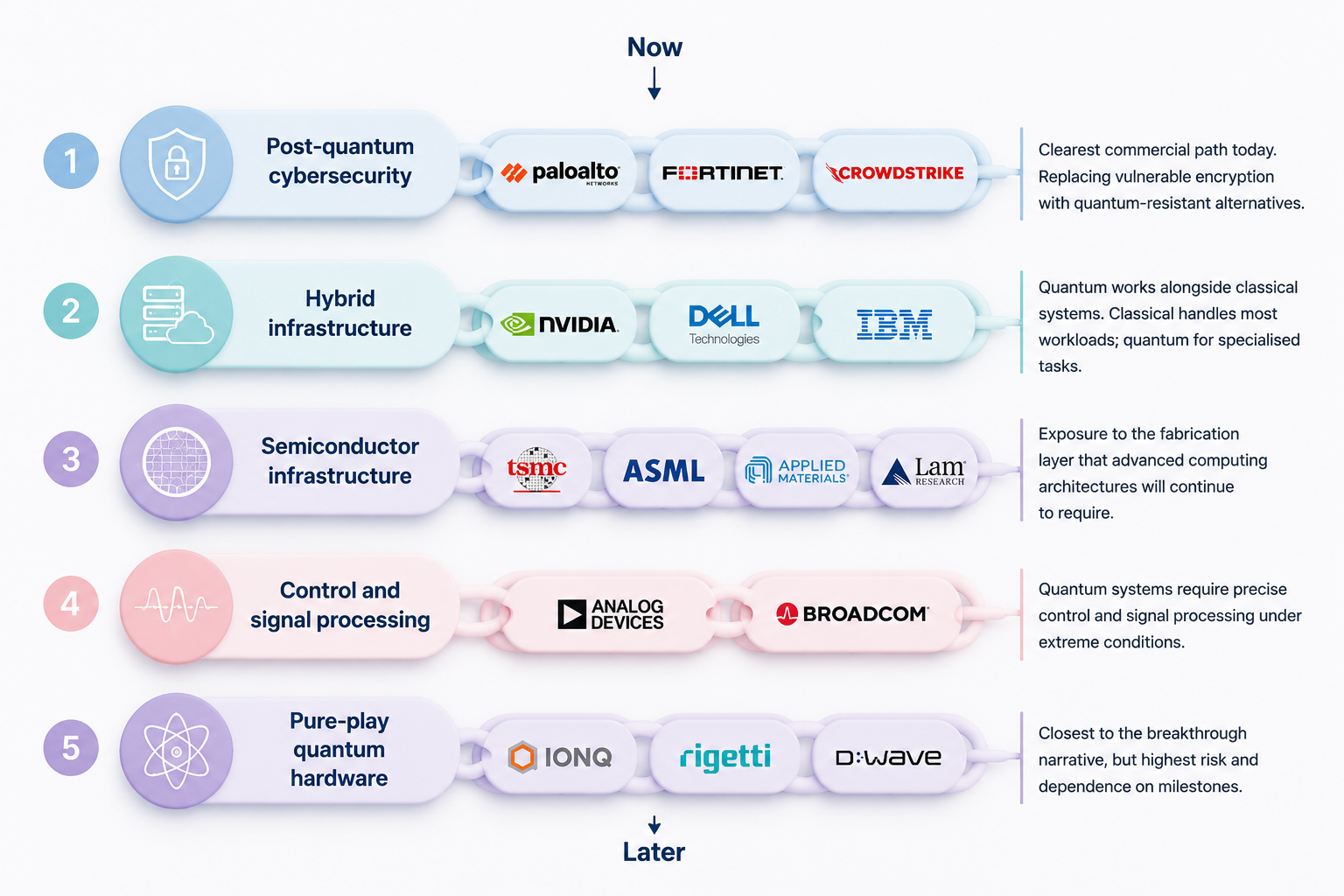
IBM has the most direct public-market exposure through its quantum roadmap and manufacturing role. Nvidia’s relevance is different. It sits on the bridge between quantum processors and classical compute, where simulation, error correction, and system integration will remain important for years.
Cybersecurity names may offer cleaner near-term exposure. Palo Alto Networks, Fortinet, and CrowdStrike are not pure quantum plays, but they sit close to the enterprise security budgets that post-quantum migration could unlock.
Pure-play quantum hardware offers higher potential upside, but also higher execution risk. Buying that layer means underwriting progress in physics, engineering, and manufacturing, not just demand.
Quantum computing is not the next AI in a simple, direct sense. It is more likely to become part of the infrastructure beneath AI, cybersecurity, and advanced computing.
The opportunity is not to assume quantum computers will replace GPUs or transform AI overnight. It is in the layers forming underneath — chip manufacturing, hybrid systems, control hardware, and post-quantum cybersecurity.
Available on our platform, download the VT Markets app to monitor real-time CFD price action on related assets.
The theme is worth watching, but the investable story is selective and the risk is valuation. If quantum stocks price in a fully developed market before the hardware is ready, the trade becomes fragile.
For investors already exposed to AI infrastructure, the practical move is not to chase every quantum headline. It is to understand where quantum exposure already exists in the portfolio, and whether that exposure is intentional.
Ultimately, whether companies can turn technical progress into revenue. The strongest part of the quantum story is not the most futuristic one. It is the part already being built.
Tap for Frequently Asked Questions
What is the link between quantum computing and AI?
Quantum computing is not replacing AI, but it could become part of the infrastructure beneath it. AI can help improve quantum systems through error correction and system design, while quantum processors may later support specialised tasks that are difficult for classical computers.
Will quantum computers replace GPUs?
Not in the near term. GPUs remain the main hardware for AI training and inference. Quantum computers are better suited for narrow problems such as optimisation, simulation, cryptography, and certain scientific workloads.
Why is post-quantum cybersecurity important now?
Companies are preparing because sensitive data stolen today could be decrypted later if powerful quantum computers become available. NIST’s 2024 standards give enterprises a clearer path to upgrade encryption before that risk becomes urgent.
Where does the near-term investment opportunity sit?
The clearer near-term opportunity is in the layers around quantum computing, not necessarily pure quantum hardware. That includes cybersecurity, hybrid quantum-classical systems, semiconductor infrastructure, and control hardware. Learn more about trading CFD Shares on VT Markets here.
What is the biggest risk in the quantum computing theme?
The main risk is timing. Hardware progress is real, but commercial-scale quantum systems still depend on difficult technical milestones. Valuations can become fragile if markets price in breakthroughs before the technology is ready.
Start trading now – Click here to create your real VT Markets account







