







Key Points
- AUD/USD traded at 0.72430, up 0.00063, or 0.09%, after reaching a session high of 0.72482.
- The Aussie rose 0.1% to $0.7243 after climbing 0.7% on Wednesday to a four-year high of $0.7277.
- Markets imply around a 20% chance of an RBA hike in June, a 68% chance by August, and rates near 4.60% almost fully priced for September.
- Australia recorded its first goods trade deficit since 2017, as data-centre imports and fuel shipments surged.
The Australian dollar held near recent highs on Thursday as global risk appetite stayed firm. Hopes for Middle East de-escalation, a cooling in oil prices, and a strong run in global equities helped traders move back into risk-sensitive currencies. The Aussie, often treated as a proxy for global growth and market confidence, rose 0.1% to $0.7243.
AUD/USD climbed 0.7% on Wednesday to a four-year top of $0.7277. The next major barriers sit at the 2022 peaks of $0.72825 and $0.7593. That leaves the pair close to a key breakout zone, but the market still needs follow-through from equities, China demand, and lower oil prices before traders can trust a larger move.
The New Zealand dollar also stayed supported. NZD/USD firmed to $0.5960 after rising 1.1% in the previous session to a two-month high of $0.5991. Immediate support sits at $0.5929, while resistance stands at $0.6012.
Lower Oil Prices Ease Inflation Pressure
A retreat in oil prices helped bonds and risk assets. Lower crude reduces the threat of runaway inflation, which in turn lowers pressure on central banks to keep hiking rates. Australian 10-year yields fell back to 4.921% after hitting a top of 5.087% last week.
This matters for AUD/USD because the Aussie is caught between two forces. Strong risk appetite supports the currency. Higher domestic rates also support it. But if inflation rises too far because of fuel and freight costs, growth can weaken and household pressure can build.
Madison Cartwright, senior geo-economics analyst at CBA, said the US has strong economic, political, and strategic reasons to preserve the ceasefire and seek a negotiated resolution by late May or shortly after. She added that there is no military solution available to the US, making de-escalation the most attractive path. That view has helped markets reduce some of the war premium that had been priced into oil and the US dollar.
RBA Hike Bets Keep The Aussie Supported
The Reserve Bank of Australia has already lifted rates by a total of 75 basis points to 4.35% over its last three meetings. Markets now imply around a 20% chance of another hike in June, a 68% probability of a move in August, and rates of 4.60% are almost fully priced for September.
The RBA has turned more cautious because the global energy shock has made inflation harder to control. The central bank raised its inflation forecasts and downgraded growth and employment expectations. Its updated view points to headline inflation peaking near 5%, economic growth slowing to 1.3% by the end of 2026, and unemployment rising to 4.7%.
This gives the Aussie a yield advantage, but not a clean one. Higher rates can support AUD/USD when growth holds up. They can also become a drag if households, business confidence, and trade weaken. For now, traders are treating RBA tightening as supportive because global risk sentiment has improved.
Trade Data Adds A Domestic Warning
Australia’s March trade data gave the market a reason for caution. The country recorded its first goods trade deficit since 2017, as imports of processing equipment surged with the data-centre buildout. Fuel imports also jumped as the Gulf conflict lifted prices and the Australian government scrambled to secure extra petrol and diesel shipments to meet demand.
Australian Bureau of Statistics data showed the seasonally adjusted goods balance fell by A$6.867 billion in March, leaving a deficit of A$1.841 billion. Exports fell by A$1.214 billion, or 2.7%, while imports rose by A$5.652 billion, or 14.1%, driven by ADP equipment.
The swing to a deficit implies net exports will drag on growth in the quarter. Still, the story is not fully negative. Some of the import surge reflects business investment as data centres get built. That means the trade hit may come with a later productivity and infrastructure boost, especially if AI-linked demand keeps rising.
Technical Analysis
AUDUSD is trading near 0.7243, continuing its gradual climb and pressing into fresh recovery highs as bullish momentum remains intact. The pair has maintained a steady uptrend since rebounding from the late-March lows, with price now testing levels last seen during the earlier January rally.
From a technical standpoint, the structure remains firmly bullish. Price is holding above the 5-day (0.7205) and 10-day (0.7185) moving averages, both of which continue to slope upward and provide immediate support. The 20-day (0.7162) remains below current price and is also trending higher, reinforcing the strength of the broader move.
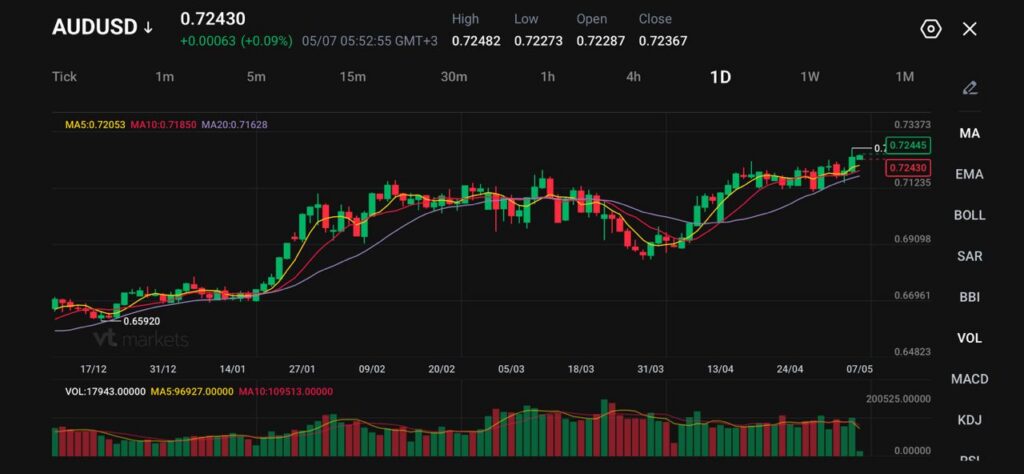
Key levels to watch:
- Support: 0.7205 → 0.7185 → 0.7162
- Resistance: 0.7248 → 0.7280 → 0.7337
Price is now testing the 0.7248 resistance zone, marking the current swing high. A clean break above this level could open the way toward 0.7280, with further upside potential toward 0.7337 if bullish momentum continues to build.
On the downside, 0.7205 is acting as immediate support, aligning with the short-term trend structure. A break below this level could trigger a pullback toward 0.7185, though the broader bullish bias would likely remain intact while price holds above the rising 20-day average.
Overall, AUDUSD remains in a strong upward trend with shallow pullbacks, reflecting continued demand for the Australian dollar as risk sentiment improves. The pair is approaching a key resistance zone, but momentum continues to favour buyers while price remains above short-term support levels.
Cautious Forecast
AUD/USD maintains a constructive bias as long as it holds above 0.72053 and 0.71850. A daily close above 0.72825 would support a push toward 0.73373, especially if equities remain firm, oil continues to ease, and RBA rate-hike expectations remain priced in.
A break below 0.71628 would warn that momentum is fading. The biggest risks are a renewed jump in oil prices, a stronger US dollar, weaker China demand, or signs that Australia’s trade deficit is becoming a wider growth drag rather than an investment-led import surge.
Learn more about trading Forex Pairs on VT Markets here.
Trader Questions
Why Is AUD/USD Holding Near Four-Year Highs?
AUD/USD is holding near four-year highs because global risk appetite has improved, oil prices have cooled, and investors are still pricing in more Reserve Bank of Australia rate hikes.
The Aussie rose 0.1% to $0.7243 after climbing 0.7% on Wednesday to a four-year high of $0.7277.
What Is The Current AUD/USD Price?
AUD/USD is trading at 0.72430, up 0.00063, or 0.09%.
The session high is 0.72482, with a low of 0.72273, an open at 0.72287, and a close at 0.72367.
Why Does Risk Appetite Support The Australian Dollar?
Risk appetite supports the Australian dollar because the Aussie is often used as a proxy for global growth and investor confidence.
When equities rise and geopolitical risks ease, traders tend to buy growth-sensitive currencies such as AUD and NZD.
How Are Middle East Peace Hopes Affecting AUD/USD?
Middle East peace hopes are supporting AUD/USD by easing fears over oil supply disruption, inflation, and wider global growth risks.
CBA’s Madison Cartwright said economic, political, and strategic constraints leave the US strongly incentivised to preserve the ceasefire and seek a negotiated resolution by late May or shortly after.
Why Do Lower Oil Prices Help The Aussie Dollar?
Lower oil prices help the Aussie dollar by reducing inflation pressure and lowering the risk of further aggressive interest-rate hikes.
A retreat in oil prices also helped Australian bonds, with 10-year yields falling back to 4.921% after hitting 5.087% last week.
Start trading now – Click here to create your real VT Markets account







