







Key Points
- AUD/USD traded at 0.71369, down 0.00307, or 0.43%, after reaching a session high of 0.7163.
- RBA Assistant Governor Sarah Hunter warned that higher fuel costs could lift inflation expectations and force tighter policy.
- Australia’s Westpac-Melbourne Institute Consumer Sentiment Index rose 3.5% month-on-month in May to 83, rebounding from April’s 2½-year low of 80.1.
The Australian dollar slipped toward $0.71 on Tuesday as traders cut exposure after the Reserve Bank of Australia sharpened its warning on inflation. AUD/USD traded at 0.71369, down 0.00307, or 0.43%, at 05/19 07:08:18 GMT+3. The session high stood at 0.7163, with a low of 0.71347, an open at 0.71672, and a close at 0.71676.
The move reversed gains from the previous session and showed how quickly the Aussie can lose support when inflation risk returns to the front. The currency had benefited from better risk appetite and firmer local data, but Sarah Hunter’s remarks pushed attention back to the cost of the Middle East conflict.
Hunter said the RBA is watching how the Iran conflict feeds into domestic inflation. The central bank sees the Middle East conflict as an external shock that is lifting global oil and natural gas costs, with direct and indirect effects on Australian prices. Australian petrol prices rose by 36% at their peak, while diesel rose even more and remains well above pre-conflict levels.
RBA Focuses On Inflation Expectations
The RBA’s message is clear: fuel shocks can become more dangerous when inflation is already above target. Hunter said Australia entered the conflict with inflation still above the 2% to 3% target band and with domestic cost pressures already active. That gives oil-driven price increases more room to pass into retail prices, transport costs, construction inputs, groceries, travel, and imported goods.
The central bank now sees headline inflation peaking at 4.8% in the June quarter. Its underlying inflation forecast was also revised higher in the near term, with the oil shock expected to add around 0.4 percentage points to underlying inflation in the March quarter of 2027.
The policy risk sits in expectations. If households and firms expect high inflation to persist, they change wage demands, contracts, and pricing behaviour. Hunter said higher fuel prices could lift and embed inflation expectations, which would make the inflation shock harder to reverse.
That warning puts AUD/USD in a difficult position. Higher rates can support the Aussie through yield. But if tighter policy comes with slower growth, weaker household spending, and lower business investment, traders may treat the currency as a growth-risk trade rather than a rate-support trade.
May Rate Hike Gives the RBA Room to Wait
Minutes from the RBA’s May meeting showed the board discussed either holding rates steady or raising by 25 basis points to 4.35%. The hike fully reversed the policy easing made in 2025. Eight of the nine board members judged the case for a hike was stronger, as inflation risks had risen while the Middle East conflict dragged on.
The board judged financial conditions would probably be somewhat restrictive after the decision. That gives policymakers space to watch how households and businesses respond to the Iran war, higher fuel costs, and tighter borrowing conditions. Markets are still wagering on another hike in August, with that move about 75% priced in. Rates are seen peaking at 4.60%, with some chance of reaching 4.85%.
This leaves the Aussie exposed to two opposing forces. More rate-hike pricing can support AUD/USD if global risk appetite holds firm. A weaker growth outlook can pull the pair lower if consumers start cutting spending or if oil keeps pressure on household budgets.
Consumer Sentiment Recovers, But Stays Weak
Australia’s consumer sentiment improved in May, but the rebound did not signal a healthy consumer backdrop. The Westpac-Melbourne Institute Consumer Sentiment Index rose 3.5% to 83 from 80.1 in April, when the index had slumped 12.5% to its lowest level in more than two years. A reading below 100 shows pessimists still outnumber optimists.
The improvement came partly from the government’s temporary halving of the fuel excise tax, which helped reduce average pump prices by nearly 30¢ per litre since April. That gave households some relief after earlier interest rate hikes and the fuel shock.
The details still look fragile. Family finance assessments recovered, but economic expectations weakened. The “economy, next 12 months” sub-index fell 1.5% to 74.2, while the “economy, next 5 years” index dropped 2.2% to 89.3. Westpac said the combined reading was the weakest since November 2022.
Mortgage pressure also remains high. The Mortgage Rate Expectations Index rose 2.3% to 181.2, a fresh three-year high. Even after three hikes this year, 85% of consumers still expect mortgage rates to rise over the next 12 months, with expectations closer to 90% among mortgage holders.
Technical Analysis
AUDUSD is trading near 0.7137, pulling back after failing to sustain momentum above the recent high around 0.7277. The pair had been building a constructive recovery through April and early May, but the latest decline has pushed price back below key short-term moving averages, signalling a loss of upside momentum.
Technically, the structure is shifting from bullish to neutral-to-bearish in the short term:
- MA5: 0.7185
- MA10: 0.7210
- MA20: 0.7187
Price is now trading below all three averages, while the shorter averages are beginning to roll over. This suggests sellers have regained near-term control after the failed breakout attempt above 0.7270.
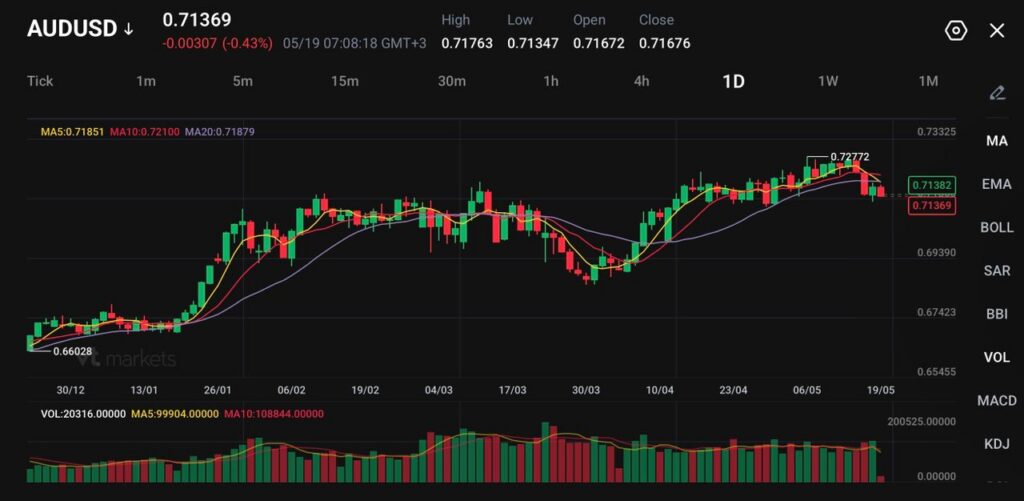
Key levels to watch:
- Immediate support: 0.7135 → 0.7000
- Major support: 0.6930
- Resistance: 0.7185 → 0.7210 → 0.7277
The 0.7135 area is now the first support to watch. A break below this region could expose the 0.7000 psychological level, especially if the US dollar continues to stabilise.
On the upside, AUDUSD needs to reclaim 0.7185–0.7210 to ease downside pressure. Without that move, rallies may remain vulnerable to selling.
Overall, AUDUSD remains in a broader recovery structure, but short-term momentum has weakened. The pair now needs to defend 0.7135 to avoid a deeper corrective pullback.
Cautious Forecast
AUD/USD may stay under pressure while it trades below 0.71879 and 0.72100. A break below 0.71347 would strengthen the downside setup and could pull the pair toward 0.69390, especially if oil prices stay high and RBA warnings keep growth concerns active.
A recovery above 0.72100 would show buyers are returning and could bring 0.7277 back into view. The strongest rebound path needs three signals to align: fuel-price pressure cools, consumer sentiment improves beyond 83, and RBA rate-hike expectations support the Aussie without triggering deeper concern over slower growth.
Learn more about trading Forex Pairs on VT Markets here.
Trader Questions
Why Is AUD/USD Falling Today?
AUD/USD is falling after the Reserve Bank of Australia warned that the Middle East conflict could lift inflation pressure and weaken economic growth.
AUD/USD traded at 0.71369, down 0.00307, or 0.43%, after reaching a session high of 0.7163.
What Is The Current AUD/USD Price?
AUD/USD traded at 0.71369.
The session high stood at 0.7163, with a low of 0.71347, an open at 0.71672, and a close at 0.71676.
Why Did The Australian Dollar Reverse Earlier Gains?
The Australian dollar reversed earlier gains after RBA Assistant Governor Sarah Hunter warned that higher inflation expectations could create a risk for the economy.
Her comments shifted attention back to energy prices, the Iran war, and the risk that inflation stays above the RBA’s target for longer.
How Is The Middle East Conflict Affecting AUD/USD?
The Middle East conflict is affecting AUD/USD through energy prices and inflation expectations.
Higher oil and fuel costs can raise transport, food, freight, and business costs. That can weaken household spending and pressure economic growth, even if higher rate expectations support the currency for a time.
What Did The RBA Say About Inflation?
The RBA warned that persistently higher inflation expectations pose a risk to the economy.
Sarah Hunter said policymakers are focused on stopping inflation expectations from becoming entrenched above target. If expectations stay too high, the RBA may need tighter policy, which could slow activity more sharply.
Start trading now – Click here to create your real VT Markets account







