







Key Points
- AUDUSD trades at 0.71328, up 0.00069 (+0.10%), after touching 0.71340 and building on a recent one-month high.
- Bond yields eased, with Australia’s 3-year yield at 4.607% and the 10-year yield at 4.932%, as lower oil prices reduced inflation fear.
- Markets are watching Australian labour data, with consensus looking for 20,000 new jobs in March and an unemployment rate of 4.3%.
The Australian dollar is staying bid because the market has shifted back toward risk after oil prices pulled lower and ceasefire hopes improved sentiment. AUDUSD is trading near 0.71328, after testing 0.71340, and remains close to the recent one-month peak. The move has come alongside stronger equities, softer energy prices, and a weaker US dollar backdrop.
That mix suits the Aussie. It tends to perform well when growth fear fades, commodities stay orderly, and traders step out of defensive dollar positions. The latest dip in oil has reduced some of the inflation shock that had been weighing on global risk assets through late March.
A cautious near-term view still favours support for AUDUSD while risk appetite holds up and crude stays off the highs.
Lower Oil Eases Pressure
The recent energy shock created a difficult backdrop for the Australian dollar. Higher oil prices had lifted global inflation risk, increased rate uncertainty, and made traders more defensive. Once hopes of peace talks pulled Brent down toward the mid-$94 area and US crude toward the low $90s, the pressure started to ease.
That helped bonds recover and gave yield-sensitive currencies some breathing room. Australia’s 3-year government yield fell 2 basis points to 4.607%, while the 10-year yield dropped 2 basis points to 4.932% after an earlier 7-basis-point decline.
Lower yields did not hurt the Aussie in this case because they reflected falling inflation stress rather than collapsing growth expectations.
The market is effectively treating the oil pullback as a net positive for Australia at this stage. It lowers imported inflation pressure without yet signalling a broader global downturn.
AUDUSD Technical Outlook
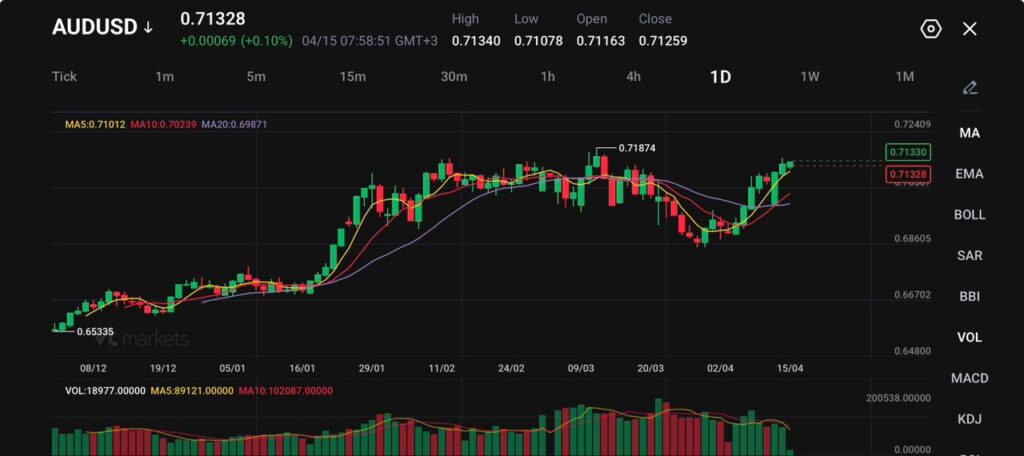
AUDUSD is trading near 0.7133, pushing higher and approaching the upper end of its recent range after a clean rebound from the early April lows.
Price action shows improving bullish momentum, with the pair climbing steadily and now testing levels just below the prior swing high around 0.7187. The structure suggests buyers are regaining control, though price is nearing a key decision zone.
From a technical standpoint, the trend is shifting back into a bullish recovery phase. Price is holding firmly above the 5-day (0.7101) and 10-day (0.7023) moving averages, both of which are sloping upward and providing near-term support.
The 20-day (0.6987) sits below as a stronger base, reinforcing the shift in short-term sentiment from bearish to constructive.
Key levels to watch:
- Support: 0.7100 → 0.7020 → 0.6985
- Resistance: 0.7150 → 0.7187 → 0.7240
The pair is now pressing into the 0.7150–0.7187 resistance zone. A sustained break above this area would likely open the path toward 0.7240, with momentum potentially accelerating if the breakout holds.
On the downside, 0.7100 is acting as immediate support. A move below this level could trigger a pullback toward 0.7020, though this would likely remain corrective unless the broader structure weakens.
Overall, AUDUSD is showing renewed bullish momentum within a recovering structure, with price testing key resistance. The next move hinges on whether buyers can clear the 0.7187 high or if the pair stalls and rotates back into consolidation.
What Traders Should Watch Next
The next move depends on whether the risk-on mood holds and whether Australian jobs data validates the yield story. If oil stays lower, global equities remain firm, and employment beats expectations, AUDUSD can keep pressing toward 0.71874.
If talks around Iran stall or labour data disappoints, the pair may slip back toward the low 0.70s instead.
Learn more about trading Forex Pairs on VT Markets here.
Trader Questions
Why Is AUDUSD Holding Near A One-Month High?
AUDUSD is staying firm because lower oil prices have improved risk sentiment, eased inflation fear, and reduced demand for the US dollar as a defensive trade. The pair was recently near 0.7131 to 0.7133 after reaching a one-month high around 0.7147.
Why Does Falling Oil Help The Australian Dollar?
Lower oil prices reduce the inflation shock that had been pushing markets into defensive positioning. That supports equities, helps bonds recover, and makes risk-linked currencies like the Aussie more attractive again. Australia’s 3-year yield fell to 4.607% and the 10-year yield to 4.932% as oil retreated.
Why Didn’t Lower Bond Yields Hurt AUDUSD?
In this case, falling yields reflected easing inflation stress rather than a collapse in growth expectations. That allowed the Aussie to benefit from better sentiment even as Australian bond yields moved lower.
How Important Are Iran Peace Talks For AUDUSD Right Now?
They matter a lot because they are shaping oil prices and overall risk appetite. Hopes that talks could resume in Pakistan helped push oil below $100 a barrel and supported the broader rally in risk assets and pro-cyclical currencies.
What Is Supporting The Aussie Beyond Global Risk Sentiment?
The rates backdrop is still helping. Markets continue to see the Reserve Bank of Australia as relatively firm compared with some peers, and the labour market has stayed resilient enough to keep yield support in the conversation.
Start trading now – Click here to create your real VT Markets account







