






The US dollar continued to weaken on Thursday after the Federal Open Market Committee (FOMC) delivered a policy message that proved far more dovish than markets had expected.
Although the Fed cut rates by 25 basis points as widely anticipated, it was the accompanying guidance and Chair Jerome Powell’s remarks that set off a fresh wave of dollar selling and renewed appetite for risk-oriented assets.
Markets had already factored in the rate reduction, but many traders had assumed the Fed would strike a firmer, more hawkish tone. Instead, policymakers signalled a shift towards greater accommodation heading into 2026.
This adjustment encouraged markets to rethink the trajectory of monetary policy, with Fed funds futures now pointing to two further cuts in 2026, double the Fed’s median projection of one.
The reaction in currency markets was swift. The US Dollar Index (USDX) fell to an intraday trough of 98.18, its lowest reading since late October. The euro advanced beyond $1.17, the yen strengthened to 155.64, and the pound rallied to a one-and-a-half-month high at $1.3391.
Also weighing on the greenback was the Fed’s announcement of a $40 billion Treasury bill purchase programme starting on 12 December, aimed at easing liquidity strains.
Both the scale and timing of the move surprised traders, reinforcing the perception that the central bank is easing more proactively than previously assumed.
Technical Analysis
The US Dollar Index has retreated to 98.18, extending its steady pullback from the late-November peak near 100.85. Despite remaining within a broader uptrend from the September low at 95.82, recent trading behaviour points to waning momentum.
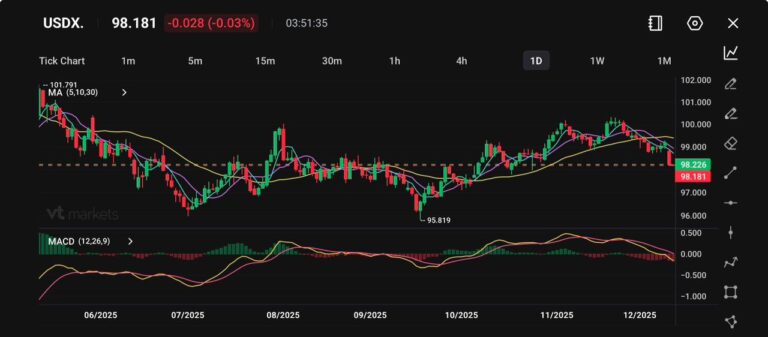
The index is now approaching support around the 98.00–98.20 region, a key band that served as resistance in October and support at the start of November.
A decisive break beneath this area could pave the way for a decline towards 97.50, or even a revisit of the 96.80–95.80 range if selling pressure intensifies.
The MACD has slipped below its signal line and is moving towards the zero level, signalling strengthening bearish momentum. Short-term moving averages (5, 10, 30) have also turned lower and shifted into a bearish configuration.
Cautious Outlook
With the Fed’s dovish turn now cemented and fresh liquidity measures due to begin next week, the dollar may find it difficult to regain traction in the near term.
A sustained break below the 98.00 threshold would likely reinforce negative sentiment and extend downside momentum heading into the year’s final weeks.







