







Key Points
- USDX traded at 98.988, up 0.050, or 0.05%, after reaching a session high of 99.033.
- The dollar index last traded near 99.045, after dipping 0.2% on Thursday.
- The dollar is on track to end the week 0.3% lower, snapping two weeks of gains.
- A proposed US-Iran deal would extend the ceasefire for 60 days and lift shipping restrictions through the Strait of Hormuz.
The US dollar held steady on Friday, but it remained on track for a weekly decline as traders priced a lower geopolitical risk premium. USDX traded at 98.988, up 0.050, or 0.05%, at 05/29 08:55:02 GMT+3. The session high stood at 99.033, with a low of 98.885, an open at 98.930, and a close at 98.938.
The dollar index was largely rangebound near 99.045, after dipping 0.2% on Thursday. It is heading toward a 0.3% weekly loss, which would end a run of two weeks of gains. Reports that the US and Iran had reached an agreement to extend the ceasefire and ease shipping restrictions through the Strait of Hormuz reduced demand for the dollar as a safe haven.
The deal still needs President Donald Trump’s approval. If confirmed, it would extend the truce for another 60 days and allow traffic to flow through the waterway while negotiators address harder issues, including Iran’s nuclear programme.
De-Escalation Pressures The Dollar
The dollar’s latest weakness reflects a shift in market psychology. Traders had bought the dollar during the Iran war because oil disruption, shipping risk, and inflation fears supported defensive flows. A ceasefire extension would reduce that need.
Oil futures fell more than 1% on Friday and were on track for their steepest weekly decline since early April. Brent fell $1.04 to $92.67 a barrel, while WTI dropped $1.26 to $87.64. For the week, Brent was down 10.5% and WTI was down 9.2%.
That oil decline weakens part of the dollar’s support. Lower crude reduces inflation pressure, eases global growth fears, and encourages traders to rotate into risk-sensitive currencies. The euro traded flat near $1.1642, the pound held near $1.3435, and the Australian dollar was slightly higher at $0.7165.
The New Zealand dollar gained more traction, rising 0.4% to $0.5960, close to its strongest level in more than two weeks, after the Reserve Bank of New Zealand governor signalled earlier and steeper rate hikes were likely.
Fed Risk Still Limits Dollar Downside
The dollar is weaker on peace hopes, but the decline remains controlled because US inflation is still hot. US inflation rose at its fastest pace in three years in April, driven by earlier energy price gains from the Iran war. That reinforced expectations that the Federal Reserve will keep interest rates unchanged well into next year.
The PCE price index rose 3.8% year-on-year, while core PCE rose 3.3%. Energy prices rose 5.5% month-on-month, though that was below March’s 20.9% surge. Personal spending rose 0.5%, but personal income was flat, and the savings rate dropped to 2.6%, its lowest since June 2022.
That gives the dollar a floor. If inflation stays above target, Fed officials may resist any move toward easing. If oil keeps falling, rate-hike fears could cool, but the market still needs more than one week of lower energy prices before pricing a full policy relief cycle.
Technical Analysis
The US Dollar Index continues to consolidate just below the 99.00 mark, with momentum stalling after it rebound from May lows.
- Current Price: 98.99
- MA5: 99.00
- MA10: 99.11
- MA20: 98.68
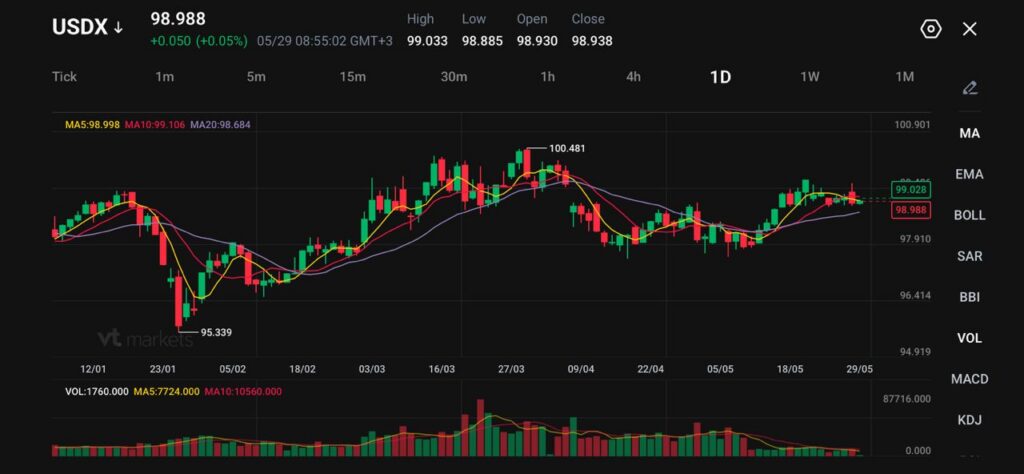
Price is trading between the short-term moving averages, reflecting a market that lacks a clear directional catalyst. The MA20 remains upward sloping and sits beneath price, suggesting the broader recovery from the 97.50–98.00 area remains intact despite recent hesitation.
Markets are balancing resilient US economic data against expectations that the Federal Reserve could still ease policy later in the year. This has kept the dollar trapped in a relatively narrow range rather than establishing a stronger trend.
Immediate resistance remains near 99.20–99.40, followed by the March high around 100.50. On the downside, support sits at 98.70, with stronger protection around 97.90–98.00.
The near-term bias remains neutral-to-bullish while the index holds above the MA20, though a decisive break above 99.40 may be needed to revive stronger upside momentum.
Cautious Forecast
USDX may stay rangebound while it trades between 98.684 and 99.106. A break above 99.106 would support another move toward 100.481, especially if the ceasefire deal stalls or US inflation keeps Fed policy restrictive.
A break below 98.684 would point to deeper dollar weakness and bring 97.910 into view. That downside path would need three signals to align: Trump approves the 60-day ceasefire extension, oil continues its weekly decline, and Fed rate expectations ease as energy-led inflation pressure fades.
Learn more about trading Indices on VT Markets today.
Trader Questions
Why Is The US Dollar Lower This Week?
The US dollar is lower this week because reports of a potential US-Iran ceasefire extension reduced safe-haven demand. The dollar index was on track to fall 0.3% for the week, snapping two weeks of gains.
What Is The Current USDX Price?
USDX traded at 98.988, up 0.050, or 0.05%. The session high was 99.033, with a low of 98.885, an open at 98.930, and a close at 98.938.
Why Did The Dollar Lose Momentum?
The dollar lost momentum as traders priced a lower geopolitical risk premium. A proposed deal would extend the US-Iran ceasefire for 60 days and ease shipping restrictions through the Strait of Hormuz.
How Could A US-Iran Ceasefire Deal Affect USDX?
A US-Iran ceasefire deal could pressure USDX by reducing demand for safe-haven dollar exposure. If the deal lowers oil prices and inflation fears, traders may expect less pressure on the Federal Reserve to stay restrictive.
Why Does The Strait Of Hormuz Matter For The Dollar?
The Strait of Hormuz matters for the dollar because disruption there can lift oil prices and inflation risk. When energy risk rises, investors often buy the dollar for safety and rate support.
Start trading now – Click here to create your real VT Markets account







