







Key Points
- EUR/USD traded at 1.1604, down 0.0090, or 0.08%, near its weakest level since early April.
- Euro area business activity contracted in May, with the composite PMI falling to 47.5 from 48.8.
- German data offered some support, with Q1 GDP confirmed at 0.3% and Ifo business sentiment rising to 84.9.
- Money markets are pricing at least two ECB rate hikes before year-end as energy-led inflation pressure builds.
EUR/USD traded near $1.16 on Friday as traders weighed weak euro area activity data against firmer German indicators and a still-hawkish European Central Bank outlook.
On the chart, EUR/USD traded at 1.1604, down 0.0090, or 0.08%, at 05/22 11:40:54 GMT+3. The session high stood near 1.16193, with a low of 1.1608, an open near 1.16164, and a close near 1.16164.
The euro’s weakness reflects a difficult mix. Growth data is softening, inflation risk is rising, and the dollar remains supported by Fed rate-hike expectations. The euro can gain from ECB hike pricing, but weaker activity data makes that support less clean.
Eurozone PMI Points To Stagflation Risk
The main pressure came from Thursday’s PMI data. The euro area economy unexpectedly contracted in May at the fastest pace since late 2023, with the composite PMI falling to 47.5 from 48.8. The reading sits below the 50 line that separates expansion from contraction.
The weakness came as war-driven living costs weighed on demand. S&P Global warned that the survey’s price gauges point to inflation running close to 4% in the coming months. That creates a classic stagflation problem for the ECB: growth is weakening, but inflation pressure is still moving in the wrong direction.
That backdrop keeps EUR/USD under pressure. A weak PMI print hurts the growth side of the euro story, while high inflation reduces the ECB’s room to support the economy.
ECB Hike Bets Limit Euro Downside
ECB policy expectations are stopping EUR/USD from falling more sharply. Money markets are pricing at least two ECB rate hikes before year-end as energy costs feed into inflation and businesses face higher input prices.
The European Commission has also warned that the Middle East conflict is set to slow eurozone growth while pushing inflation higher. It now sees euro area GDP growth slowing to 0.9% in 2026, while inflation is projected at 3.0%, up from a previous estimate of 1.9%.
This creates a two-sided euro trade. Higher ECB rates can support the currency through yields. Slower growth can weaken it if traders begin to price a deeper downturn. For now, the euro is struggling because the growth hit is becoming clearer while inflation remains too high for the ECB to relax.
Iran Talks And The Dollar Set The Wider Tone
US-Iran talks remain a key driver for EUR/USD through oil, inflation, and the dollar. US Secretary of State Marco Rubio said there were “some good signs” in talks, but Tehran’s uranium stockpile and control over the Strait of Hormuz remain major obstacles.
A credible deal could lower oil prices, ease inflation pressure, and weaken the dollar. That would help EUR/USD stabilise. A breakdown in talks would likely keep oil elevated, lift global rate expectations, and support the dollar through both yield and safe-haven demand.
The Strait of Hormuz remains central to this trade. The longer energy disruption lasts, the more pressure builds on European consumers, industry, and ECB policy.
Technical Analysis
EURUSD is trading near 1.1607, continuing its gradual pullback after failing to hold above the mid-May highs. The pair now trades below its short-term moving averages, signalling weakening momentum.
- MA5: 1.1621
- MA10: 1.1663
- MA20: 1.1691
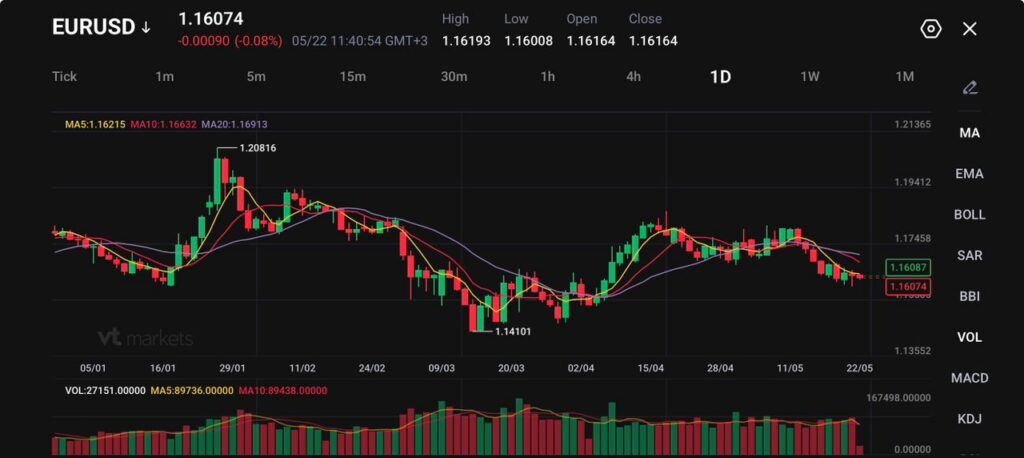
Price remains under all three averages, keeping the near-term bias tilted lower. The key level to watch is 1.1600. A break beneath that support could expose 1.1550 and potentially the March low region near 1.1410.
Resistance sits around 1.1660–1.1690, where the moving averages are now clustered. EURUSD would need to reclaim that zone to stabilise sentiment.
Fundamentally, softer eurozone growth expectations and a firmer US dollar continue weighing on the pair. Traders remain focused on ECB policy expectations versus resilient US yields and economic data.
For now, EURUSD maintains a short-term bearish bias while price remains below the moving average cluster.
Cautious Forecast
EUR/USD may stay under pressure while it trades below 1.16215 and 1.16913. A break below 1.1608 would strengthen the downside case and bring 1.14101 into view, especially if US-Iran talks stall and the dollar stays firm.
A recovery above 1.16913 would show buyers are returning and could bring 1.17458 back into focus. The stronger bullish path needs three signals to align: euro area PMI data stabilises above 47.5, German sentiment continues to improve, and Iran talks lower oil-linked inflation risk enough to weaken the dollar.
Learn more about trading Forex Pairs on VT Markets here.
Trader Questions
Why Is EUR/USD Falling?
EUR/USD is falling because weak euro area PMI data has raised concern over growth, while the US dollar remains supported by Fed rate-hike expectations. EUR/USD traded at 1.1604, down 0.0090, or 0.08%, near its weakest level since early April.
What Is The Current EUR/USD Price?
EUR/USD traded at 1.1604. The session high was 1.16193, with a low of 1.1608, an open near 1.16164, and a close near 1.16164.
Why Is The Euro Near Its Weakest Level Since April?
The euro is near its weakest level since early April because the euro area economy unexpectedly contracted in May. The composite PMI fell to 47.5 from 48.8, marking the fastest contraction since late 2023.
What Does The Eurozone PMI Show?
The eurozone PMI shows that business activity contracted in May. A reading below 50 signals contraction. The latest composite PMI at 47.5 points to weaker demand, higher costs, and slower growth across the euro area.
Why Is Eurozone Inflation Still A Concern?
Eurozone inflation remains a concern because war-driven living costs are feeding into prices. S&P Global warned that the PMI data points to inflation nearing 4% in the coming months. That keeps pressure on the European Central Bank to stay hawkish.
Start trading now – Click here to create your real VT Markets account







