







Key Points
- XAUUSD trades at 4,790.96, down 41.56 (-0.86%), after hitting 4,814.37 and dipping to 4,737.11.
- Spot gold fell to $4,794.21, while June futures dropped to $4,813.70 as the dollar and Treasury yields moved higher.
- The renewed closure of the Strait of Hormuz and the seizure of an Iranian cargo ship pushed oil higher again, reviving inflation fears and weakening demand for non-yielding gold.
Gold prices have declined as the market returns to the macro pattern that defined the initial phases of the US-Iran conflict. Oil prices are on the rise, the dollar is gaining strength, and bond yields are increasing. This combination clearly creates a challenging short-term environment for bullion, even with heightened global tensions. Spot gold now stands at $4,794.21, while June futures have adjusted to $4,813.70.
The current situation presents an opportunity to focus on the inflationary pressures affecting the market rather than solely on the demand for safe-haven assets.
Traders are closely monitoring the potential impact of a renewed energy crisis, which could lead to higher interest rates lasting longer than anticipated.
This scenario may ultimately challenge gold prices, highlighting the importance of understanding these dynamics in the context of market trends and conflict developments.
Oil and the Dollar Are Doing the Damage
The main pressure point is the return of energy stress. Hormuz has closed again, marine traffic remains constrained, and the market is treating the latest seizure of an Iranian cargo ship as a sign that the ceasefire may fail before it properly stabilises. That has pushed crude higher and brought inflation worries back into the foreground.
At the same time, the dollar has firmed as traders moved back toward defensive dollar exposure. A stronger dollar makes bullion more expensive for non-dollar buyers, while higher Treasury yields increase the opportunity cost of holding a non-yielding asset. Gold can handle one of those headwinds for a while. It struggles more when both arrive together.
Inflation Expectations Take Priority
The market is now viewing gold less as a hedge against crises and more as an asset sensitive to interest rates. This shift is significant. Rising energy prices are once again influencing inflation expectations, leading traders to lower their hopes for more lenient monetary policy.
Earlier reports about the conflict had already caused a substantial increase in US inflation and gasoline price expectations, and the recent surge in oil prices now poses a risk of reinforcing that trend.
That leaves gold in an awkward position. It still benefits from long-run inflation hedging demand, but in the short run it loses support when inflation pushes yields and the dollar higher faster than traders add to bullion exposure.
Physical Demand Falls Short
There is also not much help coming from jewellery demand. High prices curbed festival buying in India, while investment demand improved only modestly. That tells you the market is not yet seeing a broad physical bid strong enough to absorb macro pressure.
Silver, platinum, and palladium have also declined, indicating a broader adjustment in precious metals rather than just a gold shift. The market is readjusting across the board due to stronger dollar dynamics and renewed worries that the ceasefire may be collapsing.
XAUUSD Technical Outlook
XAUUSD is trading near 4791, easing slightly as price continues to move sideways following its recovery from the 4098 low. The broader structure shows a stabilisation phase, with gold struggling to build momentum after reclaiming the mid-range. Recent candles reflect indecision, with price repeatedly testing but failing to break cleanly above nearby resistance.
From a technical standpoint, the market is range-bound with a mild bearish tilt in the short term. Price is hovering just below the 5-day (4809) and 10-day (4772) moving averages, which are flattening and beginning to act as dynamic resistance.
The 20-day (4662) remains below as a support base, suggesting the downside is still contained unless that level breaks.
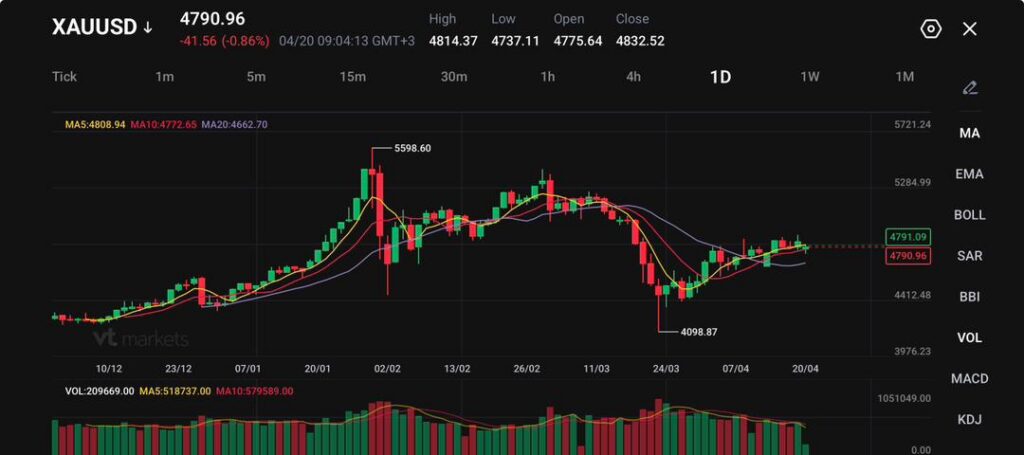
Key levels to watch:
- Support: 4770 → 4660 → 4410
- Resistance: 4815 → 4900 → 5050
Gold is currently sitting just under the 4815 resistance zone. A move back above this level could shift momentum and open a push toward 4900. However, repeated rejection here keeps the upside capped for now.
On the downside, 4770 is acting as immediate support. A break below this level could lead to a deeper pullback toward 4660, which aligns with the 20-day moving average and a key structural support.
Overall, XAUUSD is consolidating within a tight range, with neither buyers nor sellers in clear control. The next move will likely be driven by a break of 4815 resistance or 4770 support, which should give clearer direction for the short-term trend.
What Traders Should Watch Next
The next move depends on whether the breakdown in the ceasefire becomes more severe and whether oil keeps climbing. If Hormuz stays shut and crude continues rising, the dollar and yields may remain firm enough to keep gold under pressure.
If tensions ease again and energy prices pull back, bullion can stabilise quickly because the broader chart is still not broken.
Learn more about trading Precious Metals on VT Markets here.
Trader Questions
Why Did Gold Fall Even Though Geopolitical Tensions Rose Again?
Gold fell because the market focused more on the inflation and rate channel than on the safe-haven channel. A stronger dollar, firmer Treasury yields, and higher oil prices made bullion less attractive in the short term, even as US-Iran tensions worsened. Spot gold was recently down 0.7% to $4,794.21, while June futures fell 1.3% to $4,813.70.
Why Does A Stronger Dollar Pressure Gold Prices?
Gold is priced in dollars, so a firmer dollar makes bullion more expensive for buyers using other currencies. That usually weakens demand at the margin and can push prices lower, especially when yields are rising too.
Why Are Higher Oil Prices Hurting Gold Instead Of Helping It?
Higher oil prices are reviving inflation fears and pushing yields higher. Gold can act as an inflation hedge over time, but in the near term it often struggles when inflation drives interest rates and the dollar up faster than investors add to bullion exposure.
What Role Did The Strait Of Hormuz Play In Gold’s Move?
The renewed closure of the Strait of Hormuz pushed oil prices higher and brought the inflation shock back into focus. The market has treated that as a reason to buy dollars and reprice yields, which has weighed on gold.
Why Is Gold Not Acting Like A Classic Safe Haven Right Now?
The market is treating gold more as a rates-sensitive asset than a pure crisis hedge. When war risk lifts oil, and oil lifts inflation expectations, the immediate effect can be higher yields and a stronger dollar, both of which work against bullion.
How Much Has Gold Fallen Since The Conflict Started?
Gold has fallen about 8% since the US and Israel launched strikes on Iran in late February, according to the latest market coverage. That reflects how much higher-for-longer rate fears have outweighed the usual safe-haven bid.
Start trading now – Click here to create your real VT Markets account







