






Gold prices eased slightly on Friday but continued to hover near a seven-week high, buoyed by rising expectations that the Federal Reserve will maintain its easing cycle into next year.
Spot gold slipped 0.3% to $4,278.41, pulling back modestly after reaching $4,381.32 on Thursday, its strongest level since late October. US gold futures mirrored the move, declining 0.3% to $4,302.10. Even so, bullion remains on course for an impressive weekly gain of around 1.8%.
The Fed’s 25-basis-point cut on Wednesday was accompanied by dovish remarks from Chair Jerome Powell, who reiterated a data-dependent approach while acknowledging that inflation is still somewhat elevated.
Although the dot plot indicates only one additional cut in 2026, markets continue to price in two.
Technical Analysis
Gold is holding firm just below record territory, trading at $4,278.41 with a very slight intraday decline of 0.04%. The setup remains constructive, with prices consolidating within a narrow band under the $4,381.32 high recorded in November.
Short-term moving averages (5-, 10-, and 30-day) continue to trend upwards in a bullish formation, and the recent daily closes above $4,270 suggest that buying interest is still strong.
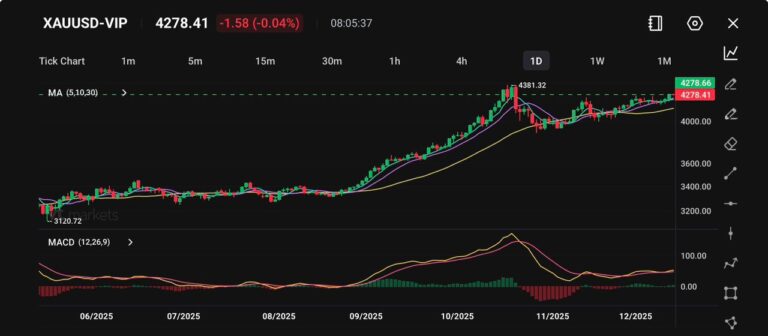
The MACD histogram has turned green again, with the signal lines beginning to converge — hinting at a possible resurgence in bullish momentum.
Support is located around $4,200, with stronger support near $4,050, while resistance remains capped at the all-time high.
A clean break above $4,300 could open the door to a move towards the $4,450–$4,500 region. For now, the overall trend remains positive, with gold appearing to coil for another potential advance.
Cautious Outlook
With gold remaining resilient despite bouts of profit-taking, the near-term bias stays tilted to the upside. Should the Fed maintain its dovish tone and broader data continue to point towards a softening labour market, gold could attempt to retest the $4,380–$4,400 zone. However, a stronger-than-expected payrolls figure may postpone such a move.







