







Key Points
- Gold rose modestly to $4,700.80 per ounce, reflecting a 1.9% gain for the week.
- Crude oil prices surged, with Brent crude rising by 1.4% to $101.47 per barrel and WTI crude gaining 1.2% to $95.93 per barrel, driven by renewed hostilities and concerns over oil supply disruptions.
- The US Dollar Index (DXY) remains strong around 98.00
- NFP data due today will further influence market expectations on Fed policy.
Gold saw a modest rise, trading at $4,700.80 per ounce, with a 1.9% gain for the week.
Despite this, the US-Iran conflict has dampened earlier hopes for a peaceful resolution, adding uncertainty to the market. While gold managed to edge higher, the stronger US dollar and rising interest rates continue to pressure its performance.
Since the conflict began, concerns surrounding the Strait of Hormuz and rising energy prices have added to gold’s challenges, amplifying inflation fears and limiting gold’s appeal.
Geopolitical Tensions and Oil Prices Impacting Gold
Gold investors are closely monitoring the US-Iran conflict and oil price fluctuations, as both impact inflation expectations and the Federal Reserve’s policy outlook. The Strait of Hormuz remains a key point of concern.
Oil prices recently saw volatility, with Brent crude falling 1.2% to $100.06 per barrel and WTI crude dropping 0.28% to $94.81 per barrel. This followed initial optimism over a US-Iran agreement, but tensions resurfaced after reports of explosions near Bandar Abbas, Iran.
The US military may soon resume its operations to escort commercial ships through the Strait of Hormuz, following the lifting of restrictions by Saudi Arabia and Kuwait. These nations have reopened their airspace and military bases to the US, enabling the resumption of the “Project Freedom” mission.
As energy prices rise, inflation fears are intensifying, prompting the Federal Reserve to adopt a more cautious stance on rate cuts, putting further pressure on gold. The precious metal tends to struggle in an environment of rising inflation and higher interest rates.
NFP Back in focus
With geopolitical volatility ongoing, US economic data, particularly the Nonfarm Payrolls (NFP) report, is now in focus. The NFP report will play a crucial role in shaping expectations for the Federal Reserve’s monetary policy. Early indicators, such as Initial Jobless Claims of 200K (better than the expected 205K), point to a positive employment outlook.
The US Dollar Index (DXY) remains firm around 98.00, reflecting strong USD positioning ahead of the NFP release. The forecast is for 62,000 jobs to be added in April, with the unemployment rate expected to hold steady at 4.3%.
Positive labor data suggests the NFP may surprise to the upside, likely supporting the US dollar and putting additional pressure on gold.
Technical Outlook
Technically, gold remains stable, trading near the $4,700 level. However, it faces resistance at $4,715, and immediate support is at $4,680. If gold can break through this resistance, it may push toward $4,750. On the downside, a move below $4,680 could lead to a pullback toward $4,650.
The moving averages in the chart is aligning for a bullish trend and in MACD, the signal line and histogram is also above the 0 level which indicates bullish momentum remains strong.
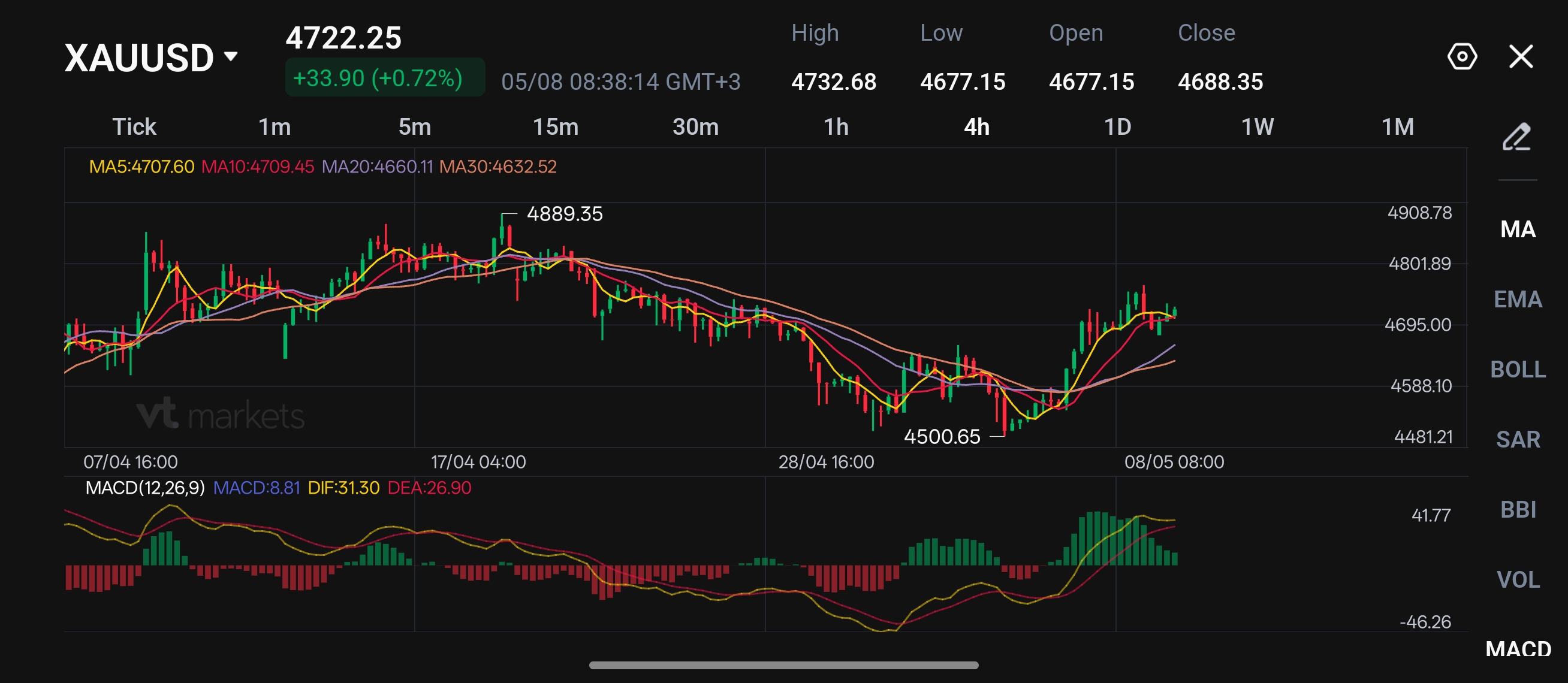
Key Levels to Watch:
- Support: $4,680 → $4,650 → $4,600
- Resistance: $4,715 → $4,750 → $4,800
Gold’s next movement will likely depend on the NFP report, geopolitical developments, and inflation data. The Fed’s stance on rate hikes will be crucial in determining gold’s price trajectory over the coming weeks.
What Traders Should Watch Next
Traders should closely monitor the upcoming Nonfarm Payrolls (NFP) report, as it will influence market expectations for the Federal Reserve’s monetary policy.
A stronger-than-expected NFP could further bolster the US dollar, putting additional pressure on gold. Conversely, a weaker report might ease some of the upward momentum for the dollar, providing potential support for gold.
In addition to the NFP data, traders should stay alert to developments in the US-Iran conflict, especially any changes regarding the Strait of Hormuz. Escalating tensions could push oil prices higher, leading to renewed inflation fears. These inflationary pressures, along with potential shifts in the Fed’s stance, would likely keep gold under pressure in the short term.
Learn more about trading Precious Metals on VT Markets here.
Trader Questions
Why Is Gold Struggling Despite Geopolitical Tensions?
Gold has faced challenges due to the stronger US dollar and rising interest rates. While geopolitical tensions, such as the US-Iran conflict, generally support gold as a safe-haven asset, inflation concerns and higher bond yields have reduced its appeal. These factors have outweighed gold’s typical demand during times of geopolitical instability.
How Do Rising Oil Prices Affect Gold?
Rising oil prices drive inflation, which can lead to expectations of higher interest rates and a stronger US dollar. Both of these factors put pressure on gold. While gold is often seen as an inflation hedge, it struggles when inflation expectations lead to tightening monetary policy and a stronger dollar.
What Role Does the US-Iran Conflict Play in Gold’s Performance?
The US-Iran conflict has introduced significant market uncertainty, particularly around the Strait of Hormuz, a critical oil shipping route. The potential for oil supply disruptions, combined with rising energy prices, fuels inflation concerns. These concerns contribute to higher interest rate expectations, which limit gold’s price potential.
Why Is the US Dollar Impacting Gold’s Price?
Gold is priced in US dollars, meaning a stronger dollar makes it more expensive for foreign buyers, thus lowering demand. Additionally, as the US dollar strengthens, expectations for higher interest rates rise, which reduces gold’s appeal as a non-yielding asset. A stronger dollar typically moves inversely to gold.
What Should Traders Watch for in the Upcoming NFP Report?
The Nonfarm Payrolls (NFP) report will be key in shaping Federal Reserve policy expectations. A stronger-than-expected report could lead to a stronger US dollar, putting pressure on gold. On the other hand, a weaker-than-expected NFP may ease the dollar’s strength and provide support for gold, especially if inflation fears persist.
Start trading now – Click here to create your real VT Markets account







