






Asian equities moved higher following a firm rebound in US technology shares, while encouraging US economic figures provided additional support to Wall Street.
The Nasdaq 100 advanced by 0.8%, with the S&P 500 adding 0.6%, helping to steady market sentiment after recent swings linked to concerns over artificial intelligence-driven earnings disruption.
The MSCI Asia Pacific Index posted gains for a second consecutive session. Markets in Australia and Japan rose, and South Korea’s main index reached a fresh record high.
Activity across parts of the region was subdued, however, as mainland China, Hong Kong and Taiwan remained closed for the Lunar New Year holiday.
The recovery in US technology stocks suggests investors are revisiting earlier anxieties surrounding AI-related profit pressures. Some institutional participants have started selectively rebuilding positions after the recent correction.
Firm US Data Underpin Risk Appetite
Confidence was further supported by solid US economic releases. Industrial production recorded its strongest rise in January, orders for business equipment in December exceeded expectations, and housing starts climbed to their highest level in five months.
Together, these indicators point to sustained growth momentum at the outset of 2026.
Nonetheless, bond markets signalled a degree of caution. A $16 billion auction of 20-year US Treasuries met with tepid demand, and Treasury prices weakened during the New York session. The dollar index rose 0.5% on Wednesday, although it edged lower against most Group-of-10 currencies during Asian trading hours.
Technical Analysis
The NAS100 is trading near 24,900, holding modest gains but remaining confined within a broader consolidation range after failing to retake the late-January highs around 26,300.
Daily price action appears uneven, with a series of lower highs forming since the recent peak, indicating that upward momentum has moderated.
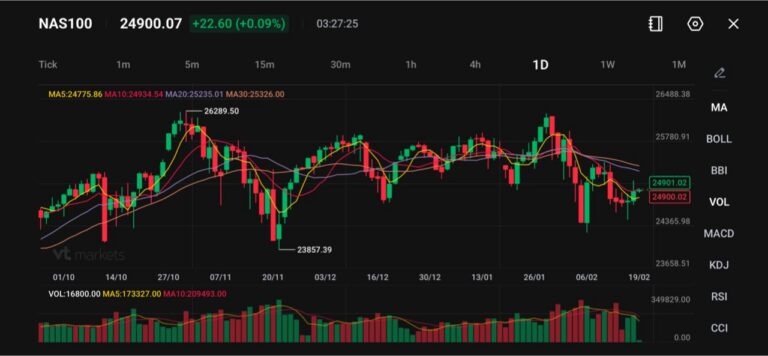
The index is currently positioned just beneath the 20-day moving average (25,235) and the 30-day moving average (25,326), while the shorter-term 5-day (24,776) and 10-day (24,934) averages are flattening.
This configuration points to a neutral-to-soft bias, as the market struggles to generate sustained upside continuation. Immediate resistance lies within the 25,200–25,300 range, where several moving averages converge. Near-term support is located around 24,350, followed by the November swing low region near 23,850.
A clear break above 25,300 would indicate a revival of bullish momentum and reopen the route towards 26,000 and higher. Conversely, an inability to reclaim that area may leave the index range-bound, with downside pressure building should 24,350 fail to hold.
Cautious Outlook
While resilient US economic data continue to underpin risk assets, rising yields and uneven bond demand suggest markets remain attentive to inflation and policy uncertainties. The next decisive move is likely to depend on whether economic strength can persist without triggering renewed inflationary pressures.







