







Key Points
- NG-C trades at 2.693, down 0.017 (-0.63%), after a high of 2.705 and a low of 2.689.
- US working gas in storage stood at 1,970 Bcf for the week ending April 10, which was 108 Bcf above the five-year average of 1,862 Bcf.
- LNG feedgas flows have stayed strong at around 18.9 bcfd in April, but mild weather and elevated inventories are still capping the upside.
US natural gas remains under pressure because the domestic supply-demand balance still looks soft. Futures are hovering near $2.69 to $2.70 per MMBtu, close to the lowest levels since late 2024, even after a recent five-session bounce.
The market has tried to build support from lower production and strong LNG flows, but those positives have not been strong enough to override the larger storage and weather story.
That is the key point. Natural gas is not lacking bullish inputs altogether. It is just facing a much heavier bearish weight from mild spring conditions and comfortable inventories.
Output Cuts Fall Short
Production has eased meaningfully in recent weeks. Average output fell by about 3.9 bcfd over the past 15 days to roughly 108.2 to 108.3 bcfd, which marked an 10- to 11-week low depending on the series used. That decline has been one of the main reasons prices stopped falling in a straight line.
In a tighter market, a drop of that size would likely have triggered a stronger rally. This time, it has only slowed the decline because inventories remain comfortable and weather has not generated the kind of heating or cooling demand that would really tighten balances.
A cautious near-term view still says production weakness can stabilise prices, but it may not be enough to drive a durable breakout unless demand improves as well.
LNG Strength Meets Capacity Constraints
LNG feedgas demand has also remained supportive. Flows to the major US export plants have climbed to around 18.9 bcfd in April, up from about 18.6 bcfd in March and close to record territory. US LNG exports hit an all-time high in March as plants ran above nameplate capacity and new units came online.
That matters because LNG has been one of the few consistent sources of demand growth in the US gas market. The problem is that the market already knows this. When export terminals are already running hard, the upside from “strong LNG” diminishes unless there is additional capacity or domestic supply falls further.
That is why gas can still feel heavy even with near-record feedgas flows. The bullish export story is real, but it is not new enough to overwhelm loose domestic fundamentals.
Storage Is Still The Bigger Story
Storage remains the cleanest reason the market cannot sustain much upside. The latest EIA data showed inventories at 1,970 Bcf, which is 126 Bcf higher than last year and 108 Bcf above the five-year average. That leaves stocks roughly 6% above the five-year norm, and other market summaries have described the overhang as around 7% depending on the cut-off week used.
That is a comfortable starting point for the injection season. When storage enters spring above average and the weather stays mild, traders do not need to price scarcity. They price how quickly the system can keep refilling.
This is what keeps every rally attempt contained. Strong LNG flows and lower output help, but ample stocks make it hard for the market to panic higher.
Weather Turns Against Bulls
Forecasts have also moved in an unhelpful direction for price. The market had earlier found some support from cooler expectations, but the latest outlook points to warmer conditions across parts of the Midwest and near-normal temperatures through early May. That reduces heating demand and limits the power-sector burn needed to tighten balances meaningfully.
At this time of year, weather does not need to be extremely warm to weigh on gas. It only needs to stay mild enough to prevent either strong late-season heating demand or early cooling demand from appearing.
That keeps the market stuck in the soft middle of the seasonal window.
Read more about oil as an inflation hedge from our expert analysts here.
NG-C Technical Outlook
Natural gas (NG-C) is trading near 2.69, hovering just above recent lows as the market continues to drift lower following the sharp rejection from the 5.69 peak earlier in the year. Price action has flattened in recent sessions, but the broader structure still reflects a persistent downtrend with weak recovery attempts.
From a technical standpoint, the bias remains bearish but stabilising in the very short term. Price is trading below the 20-day moving average (2.80), which continues to slope downward and caps upside attempts. The 5-day (2.69) and 10-day (2.67) are clustered tightly around current levels, indicating a lack of strong momentum and a market that is trying to base after an extended decline.
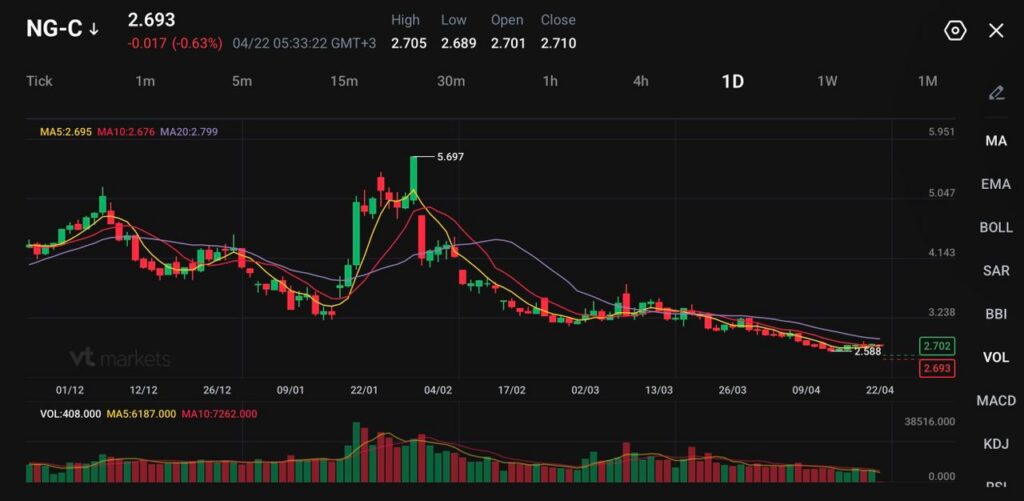
Key levels to watch:
- Support: 2.58 → 2.50 → 2.30
- Resistance: 2.70 → 2.80 → 3.00
The market is currently consolidating just above the 2.58 support zone, where selling pressure has begun to slow. A break below this level would reinforce the broader downtrend and could expose 2.50 next.
On the upside, 2.70 acts as immediate resistance. A move above this level could trigger a short-term rebound toward 2.80, but any recovery is likely to face selling pressure unless price can reclaim and hold above the 3.00 handle.
Overall, natural gas remains under pressure with signs of exhaustion rather than reversal. The near-term focus is on whether price can hold above 2.58 to form a base, or if continued weakness drives another leg lower.
What Traders Should Watch Next
The next move depends on whether lower production keeps deepening and whether the weather turns hot enough to increase power demand. The weekly storage figures will remain the most important check on whether the market is truly tightening or just pausing before another soft spell.
If inventories keep building above normal and temperatures stay mild, natural gas may stay pinned near the current lows. If output slips further and weather turns more supportive, the market can try to build above $2.80 again.
Learn more about trading Energies on VT Markets here.
Trader Questions
Why Is US Natural Gas Still Trading Near $2.70?
Natural gas remains under pressure because mild spring weather and comfortable storage levels are outweighing the support from lower production and strong LNG exports. Prices recently traded around $2.66 to $2.69 per MMBtu, keeping the market close to its recent lows.
Why Didn’t Lower Gas Production Trigger A Bigger Rally?
Output has fallen to roughly 108.2 bcfd, which is supportive, but inventories are still high enough to absorb that supply drop for now. When storage starts the injection season above normal, production weakness alone often is not enough to drive a sustained breakout.
How Strong Are LNG Exports Right Now?
Feedgas flows to the major US LNG export plants have been running around 18.9 bcfd in April, near record territory and above March’s 18.6 bcfd pace. That is helping demand, but the market has already been pricing strong LNG flows for some time.
Why Aren’t Strong LNG Flows Enough To Lift Prices More?
Because the domestic market still looks loose. Export demand is strong, but inventories remain above average and weather has not been cold or hot enough to tighten balances meaningfully. That leaves the LNG story supportive, but not dominant.
How High Are Storage Levels Right Now?
Working gas in storage stood at 1,970 Bcf for the week ending April 10, which was 126 Bcf above the same time last year and 108 Bcf above the five-year average of 1,862 Bcf.
Start trading now – Click here to create your real VT Markets account







