







Key Points
- Nikkei225 traded at 65,182.15, up 1,903.45, or 3.01%, after reaching a session high of 65,425.15.
- The benchmark Nikkei 225 broke above 65,000 for the first time on Monday, while thin holiday trading amplified the move.
- Oil prices plunged more than 5% after Trump said US-Iran talks were moving in an “orderly and constructive manner”.
- Gold still rose above $4,560, adding roughly 1%, showing that traders are not fully abandoning safety hedges.
Japan’s Nikkei 225 broke through the 65,000 mark for the first time on Monday, rallying more than 3% as traders priced a lower risk of an oil-driven shock to the global economy. The benchmark index touched a record 65,409, while the broader Topix climbed 1.2%.
On the platform chart, Nikkei225 traded at 65,182.15, up 1,903.45, or 3.01%, at 05/25 09:20:25 GMT+3. The session high stood at 65,425.15, with a low of 63,750.15, an open at 63,750.15, and a close at 63,278.70.
Global stocks surged while oil and the US dollar slipped as markets reacted to the prospect of a deal to end the Iran war, though uncertainty over when the Strait of Hormuz would reopen kept some caution in place. Japan’s energy-import dependence gives the Nikkei a sharper sensitivity to oil relief than many other developed markets.
Oil Relief Gives Japan A Clear Tailwind
Japan imports the overwhelming majority of its energy, and a large share moves through the Strait of Hormuz. When that waterway shuts or becomes dangerous, Japan faces higher fuel costs, wider import bills, and stronger inflation pressure. When those risks ease, Japanese equities can respond quickly.
The latest rally followed comments from Donald Trump that negotiations with Iran were progressing in an “orderly and constructive manner”. He also said US representatives were told “not to rush into a deal”, which kept traders from pricing a full resolution too quickly.
Oil traders still reacted hard. Crude prices plunged more than 5%, reversing part of the rally caused by the blockade on Iranian ports and the effective closure of the Strait of Hormuz earlier this year. The strait carries roughly a fifth of global oil supply, so even a partial reopening would ease pressure across fuel, shipping, and inflation-sensitive sectors.
AP reported that US crude dropped to $92.25 while Brent fell to $99.38 after Trump said Iran peace talks were progressing.
That shift helps Japan on several fronts. Lower oil reduces import costs, eases margin pressure for manufacturers, supports household spending, and lowers the odds that imported inflation forces a sharper Bank of Japan response.
Thin Holiday Trading Amplifies The Move
The rally also came during thin holiday conditions. Markets in Hong Kong and South Korea were closed, while US markets were offline for Memorial Day. Lighter liquidity can exaggerate price swings, especially when a major macro catalyst hits at the start of the week.
That explains part of the sharp move. Traders reacted to oil relief, AI optimism, and a softer dollar, but the holiday backdrop likely made the rally look more dramatic than it might have during a full global session.
Still, the move had logic behind it. Asian economies remain exposed to energy prices, and Japan sits near the front of that risk. When oil fell, stocks tied to domestic margins, consumer spending, and export competitiveness all received a cleaner macro backdrop.
Gold Holds A Safety Bid
Gold’s move showed that markets have turned more optimistic, not fully relaxed. Even as stocks surged and oil cooled, gold prices edged higher above $4,560 early Monday, adding roughly 1% as traders kept hedges in place.
Gold rose more than 1% as the dollar and oil eased on US-Iran deal prospects, with spot gold reaching $4,557.46 per ounce and US gold futures at $4,558.80.
That mixed behaviour captures current sentiment well. Traders are buying risk again, but they still expect volatility. One Truth Social post appeared to move oil by more than 5%, stocks by around 3%, and, in market terms, blood pressure by 20%. The joke lands because the market remains heavily headline-driven.
Technical Analysis
Nikkei 225 surged above 65,000, climbing over 3% as easing geopolitical fears and softer oil concerns boosted risk appetite across Japanese equities.
- Current Price: 65,182
- MA5: 62,463
- MA10: 62,451
- MA20: 61,601
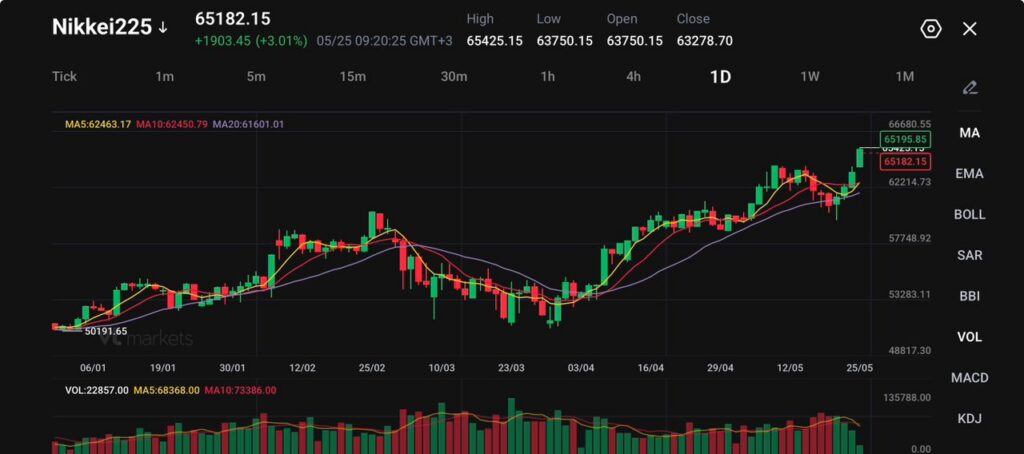
The index has broken decisively above the previous resistance zone near 63,800, with all short-term moving averages sloping sharply higher. Momentum remains firmly bullish after buyers defended the 62,000 region earlier this month.
Japan’s rally has been amplified by falling oil anxiety. As a major energy importer heavily reliant on Middle East shipping routes, easing fears around the Strait of Hormuz gave the Nikkei an extra lift.
Immediate resistance now sits near 66,500, while support has shifted higher toward 64,000–63,800. A sustained hold above breakout levels could keep momentum intact into the coming sessions.
The broader trend remains bullish while price stays above the rising MA cluster and global risk sentiment holds steady.
Cautious Forecast
Nikkei225 keeps a bullish short-term bias while it holds above 62,463.17 and 61,601.01. A break above 65,425.15 would support a move toward 66,680.55, especially if oil remains below recent stress levels and US-Iran talks keep moving forward.
A drop below 62,450.79 would warn that thin holiday liquidity exaggerated the rally. The next move will likely depend on whether the Strait of Hormuz reopening becomes real, whether oil stays lower after its 5% drop, and whether Japanese traders continue treating lower energy costs as worth several trillion yen in market value.
Learn more about trading Indices on VT Markets today.
Trader Questions
Why Did The Nikkei 225 Break Above 65,000?
The Nikkei 225 broke above 65,000 for the first time as lower oil prices eased fears of an energy-driven inflation shock. Nikkei225 traded at 65,182.15, up 1,903.45, or 3.01%, after reaching a session high of 65,425.15.
What Is The Current Nikkei225 Price?
Nikkei225 traded at 65,182.15. The session high was 65,425.15, with a low of 63,750.15, an open at 63,750.15, and a close at 63,278.70.
Why Are Japanese Stocks Rising?
Japanese stocks are rising because oil prices fell sharply after Trump said US-Iran negotiations were progressing in an “orderly and constructive manner”. Lower oil helps Japan by reducing import costs, easing inflation pressure, and improving the outlook for corporate margins.
Why Does Lower Oil Support The Nikkei?
Lower oil supports the Nikkei because Japan imports most of its energy. When crude prices fall, Japanese companies face lower fuel, shipping, and production costs. Households also gain some relief from energy-led inflation.
How Much Did Oil Prices Fall?
Crude prices plunged more than 5% after Trump’s comments on Iran talks. The drop reversed part of the earlier rally caused by the blockade on Iranian ports and the effective closure of the Strait of Hormuz.
Start trading now – Click here to create your real VT Markets account







