







Key Points
- Nikkei225 traded at 60,604.15, down 854.00, or 1.39%, after reaching a session high of 61,632.65.
- The Nikkei fell 0.64% to 60,429.76 by the midday break, after rising more than 1% earlier.
- The broader Topix rose 0.37% to 3,840.7, helped by value shares and stronger Japan growth data.
- NVIDIA earnings on Wednesday now sit at the centre of the next move for Japan’s chip and AI-linked stocks.
Japan’s Nikkei share average reversed early gains on Tuesday as traders sold technology heavyweights after overnight weakness in US tech stocks. The Nikkei fell 0.64% to 60,429.76 by the midday break, after rising more than 1% earlier in the session.
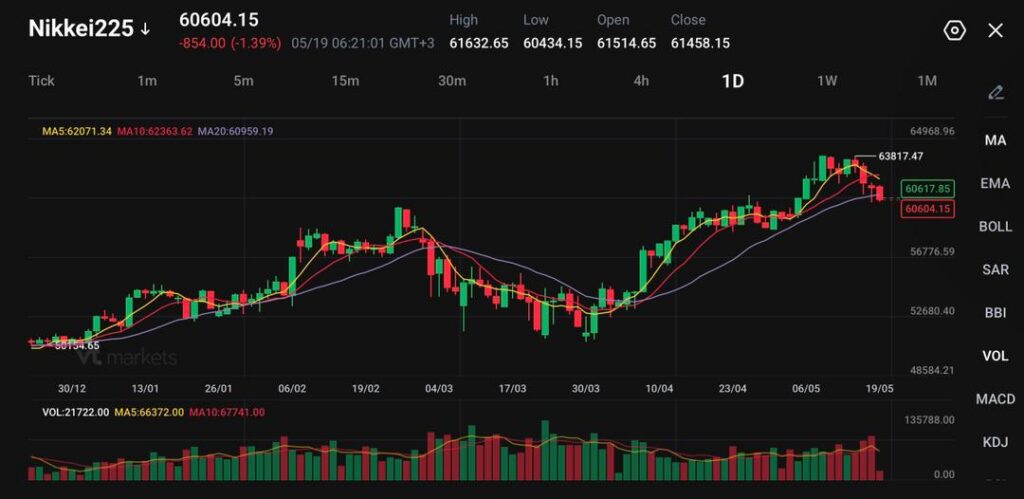
The index is now on course for a fourth straight session of losses. On the platform chart, Nikkei225 traded at 60,604.15, down 854.00, or 1.39%, at 05/19 06:21:00 GMT+3. The session high stood at 61,632.65, with a low of 60,434.15, an open at 61,514.65, and a close at 61,458.15.
The broader Topix moved in the opposite direction, rising 0.37% to 3,840.7. That split shows a rotation rather than a full exit from Japanese equities. Traders cut exposure to growth and AI-linked names, but they still bought value shares, banks, and domestic demand plays.
NVIDIA Earnings Drive The Tech Pullback
US technology weakness set the tone. The Nasdaq and S&P 500 closed lower on Monday as traders took profit in technology stocks. NVIDIA, the world’s most valuable company, is scheduled to report results on Wednesday and was the S&P 500’s biggest index-point drag on Monday, falling 1.3%.
That pressure moved quickly into Japan’s chip supply chain. Advantest fell 4.76%, dragging the Nikkei lower the most. SoftBank Group slipped 3.56%, Tokyo Electron lost 2.96%, and Kioxia fell 4.24%.
Fibre optic cable makers also came under pressure. Fujikura dropped 5.75%, while Furukawa Electric fell 7.6%.
NVIDIA’s earnings now act as the next major risk event. Strong results could help Japan’s chip and AI-linked names stabilise. Weak guidance, or cautious commentary around AI demand, margins, or China exposure, could extend the pullback in the Nikkei’s technology leaders.
Japan Growth Data Supports Value Shares
Japan’s domestic data gave the market a better base under the surface. The economy grew faster than expected in the first quarter, with real GDP rising an annualised 2.1%, above the 1.7% forecast. On a quarter-on-quarter basis, GDP grew 0.5%, while private consumption and capital expenditure both rose 0.3%. Net external demand added 0.3 percentage point to growth.
That data pushed traders toward economically sensitive stocks. Topix’s value share index rose 0.62%, while the growth stock index gained only 0.1%. Bank shares also strengthened, with Mitsubishi UFJ Financial Group and Mizuho Financial Group climbing more than 3% each.
The rotation shows traders are not abandoning Japan. They are changing what they want to own. Domestic demand, banks, and value stocks are gaining support as tech stocks face a valuation test ahead of NVIDIA.
Breadth Looks Better Than The Headline Index
Market breadth was stronger than the Nikkei’s decline suggests. Of more than 1,600 stocks on the Tokyo Stock Exchange’s prime market, 70% rose, 28% fell, and 1% traded flat.
That breadth points to a narrow pullback led by technology heavyweights. The Nikkei carries high sensitivity to selected chip and growth names, so weakness in Advantest, SoftBank, Tokyo Electron, Kioxia, Fujikura, and Furukawa Electric can outweigh broader gains elsewhere.
This gives the market a mixed message. The headline index looks weak, but the underlying participation still shows demand for Japanese equities. If tech selling slows, the broader market may help the Nikkei stabilise.
Energy Risk Still Clouds The Outlook
The GDP data confirmed that Japan entered the quarter with better momentum, but the next phase looks harder. The Iran war and the closure of the Strait of Hormuz have raised energy costs and could weigh on Japan’s growth from the second quarter onward. Higher energy prices threaten household spending, business margins, and inflation expectations.
That creates a difficult policy mix. Stronger GDP keeps pressure on the Bank of Japan to consider tighter policy. Higher oil prices raise imported inflation and weaken purchasing power. Tech stocks then face a double test from both global AI sentiment and domestic macro pressure.
For the Nikkei, the best near-term setup would require calmer oil prices, a steady yen, and NVIDIA results that keep the AI cycle intact.
Technical Analysis
The Nikkei 225 has pulled back sharply to around 60,604, snapping part of the aggressive April-May rally after failing to sustain momentum above the recent high near 63,817. Despite the sharp red candle, the broader structure still leans bullish while the index remains above the rising 20-day moving average.
Technically, the move looks more like a correction within an uptrend rather than a full trend reversal, at least for now.
Key moving averages:
- MA5: 62,071
- MA10: 62,364
- MA20: 60,959
The short-term picture has weakened considerably. Price has now broken below both the 5-day and 10-day moving averages, while sitting almost directly on top of the 20-day average. That makes the current zone extremely important.
The recent rally from late March was exceptionally strong, with buyers driving the Nikkei from roughly 51,000 to nearly 64,000 in just over a month. Moves of that magnitude often trigger profit-taking once momentum slows, especially around psychological resistance levels.
Key levels to monitor:
- Immediate support: 60,000 → 60,900
- Major support: 58,000 → 57,700
- Resistance: 61,800 → 62,400
- Major resistance: 63,800 → 65,000
The candle structure near the highs also suggests momentum exhaustion. Several sessions showed smaller-bodied candles and rejection wicks near the peak before sellers stepped in aggressively. That often reflects institutions reducing exposure after an extended run.
A major driver behind the Nikkei rally had been the weaker yen, improving export competitiveness for Japanese manufacturers and technology firms. However, recent volatility in USDJPY and rising speculation around potential intervention or policy adjustment from Japanese authorities has started creating uncertainty for equities.
At the same time, global risk appetite has softened slightly as traders reassess the pace of Federal Reserve easing expectations and monitor US bond yields. Japanese equities remain heavily tied to overseas capital flows and semiconductor sentiment, particularly through large index components tied to AI and chip demand.
Volume has risen during the recent pullback, which matters. Stronger selling volume suggests this is more than just passive drift lower. Buyers now need to defend the 20-day moving average relatively quickly to maintain the bullish structure.
If the Nikkei stabilises above 60,000–60,900, the broader uptrend could remain intact with scope for another attempt toward the 63,800 highs. A decisive break below the 20-day average, however, would likely expose a deeper retracement toward 58,000 and potentially the mid-April breakout zone.
For now, the index still holds a cautiously bullish medium-term structure, but short-term momentum has clearly cooled after an overheated rally phase.
Cautious Forecast
Nikkei225 may stay under pressure while it trades below 60,959.19 and 62,071.34. A break above 62,363.62 would show that buyers are returning and could bring 63,817.47 back into view.
A move below 60,434.15 would deepen the correction and expose 56,776.59, especially if NVIDIA earnings disappoint or US tech selling continues. The strongest recovery path needs three signals to align: NVIDIA results calm AI worries, value-share demand remains firm, and Japan’s stronger GDP data offsets concern over energy costs.
Learn more about trading Indices on VT Markets today.
Trader Questions
Why Did The Nikkei 225 Fall Today?
The Nikkei 225 fell as technology heavyweights tracked overnight weakness in US tech stocks. The index dropped 0.64% to 60,429.76 by the midday break, after rising more than 1% earlier in the session.
On the chart, Nikkei225 traded at 60,604.15, down 854.00, or 1.39%.
What Is The Current Nikkei225 Price?
Nikkei225 traded at 60,604.15, with a session high of 61,632.65 and a low of 60,434.15.
The index opened at 61,514.65 and closed at 61,458.15.
Why Are Japanese Tech Stocks Under Pressure?
Japanese tech stocks are under pressure because investors are taking profit in AI and semiconductor-linked names before Nvidia’s earnings.
Advantest fell 4.76%, SoftBank Group slipped 3.56%, Tokyo Electron lost 2.96%, and Kioxia dropped 4.24%.
Why Do NVIDIA Earnings Matter For The Nikkei?
NVIDIA earnings matter for the Nikkei because Japan’s chip and AI-linked stocks often follow US semiconductor sentiment.
NVIDIA fell 1.3% on Monday and was the S&P 500’s biggest index-point drag. Its results on Wednesday could decide whether traders return to AI-linked names or extend the sell-off.
Why Did The Topix Rise While The Nikkei Fell?
The Topix rose because investors bought value shares and domestic-demand stocks, even as technology heavyweights dragged the Nikkei lower.
The Topix gained 0.37% to 3,840.7, while the Nikkei fell 0.64% by the midday break.
Start trading now – Click here to create your real VT Markets account







