







Key Points
- Nikkei falls to its lowest level since early February as geopolitical tensions intensify
- Technology stocks lead the selloff, with SoftBank and chipmakers under pressure
- Rising oil prices and global uncertainty drive traders toward safer assets
Japan’s Nikkei 225 slid to a one-month low on Wednesday as traders moved away from risk assets amid intensifying conflict in the Middle East.
The index fell sharply during afternoon trading, dropping as much as 4.7% before stabilising near 54,000, marking its third consecutive session of losses. The broader Topix index also declined more than 4%, reflecting broad-based selling across the Japanese market.
The downturn comes as escalating military action between the United States, Israel and Iran unsettles global markets and pushes traders to reassess exposure to equities.
Volatility Signals Rising Market Anxiety
Market volatility increased alongside the equity selloff.
Japan’s Nikkei Volatility Index rose to its highest level since August 2024, indicating stronger demand for protection against further stock-market declines.
Rising volatility typically reflects growing investor uncertainty, particularly during periods of geopolitical tension and macroeconomic instability.
Oil Prices Add to Market Pressure
Escalating conflict in the Middle East has also pushed oil prices higher, further weighing on risk sentiment.
Higher energy prices can raise inflation concerns and increase costs for businesses, particularly in energy-importing economies such as Japan. The surge in crude prices following the latest military strikes has therefore added another layer of pressure on global equity markets.
Technical Structure
Japan’s Nikkei 225 has come under renewed selling pressure, with the index trading near 53,926, down roughly 2.3% on the session as the recent rally from late December shows signs of exhaustion. The index has retreated sharply from the recent high around 60,077, breaking below short-term momentum levels and signalling a potential corrective phase.
Technically, price has slipped below the 5-day moving average (56,797) and 10-day (57,287), indicating a deterioration in near-term momentum.
The index is now approaching the 20-day average (57,110) from below, while the 30-day average (55,913) sits slightly above the current price zone. This compression of moving averages suggests that the recent uptrend is losing strength and could transition into a period of consolidation or deeper pullback.
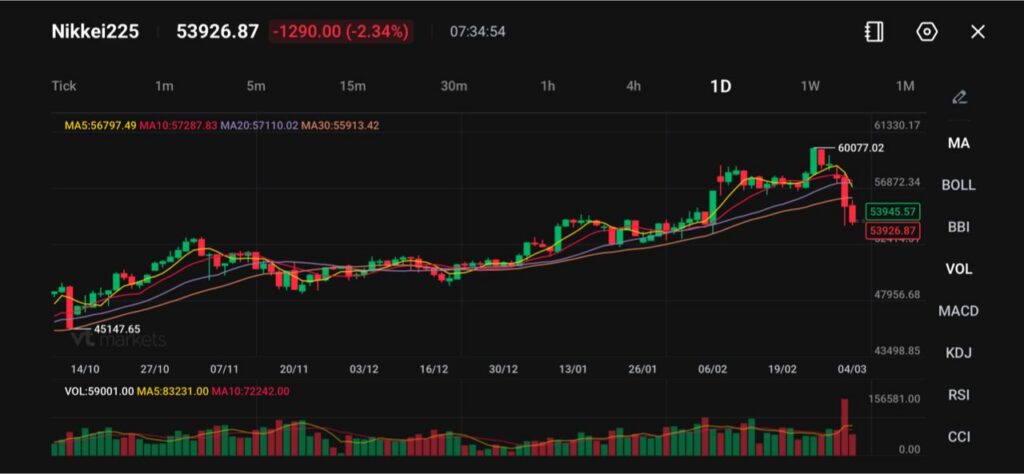
Immediate support is seen around the 53,500–54,000 region, where the current decline is attempting to stabilise. A break below this zone could expose further downside toward 52,000, with broader structural support closer to the 50,000 psychological level. On the upside, the 56,800–57,000 area now acts as the first resistance, followed by stronger resistance near 60,000, where the previous rally stalled.
Unless the index can reclaim the 57,000 level in the near term, the bias may remain tilted to the downside, with investors likely to remain cautious following the sharp reversal from recent highs.
Market Implications
The Nikkei’s sharp fall highlights how quickly global macro risks can shift investor positioning.
Escalating geopolitical tensions, rising oil prices and increased market volatility are currently outweighing domestic drivers for Japanese equities. Until global sentiment stabilises, the index may remain sensitive to external developments shaping broader financial markets.
Learn more about trading Energies on VT Markets here.
Frequently Asked Questions
- Why is the Nikkei falling today?
The Nikkei is declining due to a global risk-off move triggered by escalating conflict between the United States, Israel and Iran, which has increased geopolitical uncertainty. - Why are Asian stocks reacting strongly to the conflict?
Asian markets, particularly Japan and South Korea, had previously outperformed global equities. During periods of heightened uncertainty, investors often take profits in stronger markets first. - Why are technology stocks leading the decline?
Technology stocks tend to be more sensitive to shifts in investor sentiment and economic expectations. When risk appetite weakens, high-growth sectors often experience larger declines. - What role are oil prices playing in the selloff?
Rising oil prices increase inflation risks and raise costs for businesses and consumers. This can negatively affect economic growth expectations and pressure equity markets. - What does the rise in the Nikkei volatility index mean?
A higher volatility index indicates that investors are buying protection against potential market declines, signalling increased uncertainty and risk aversion.
Start trading now – Click here to create your real VT Markets account







