






Key Points
- Nikkei 225 trades at 58,836.15, down 853.90 (-1.43%), after reaching 59,201.15 and staying close to the recent record zone.
- The cash index previously closed at 58,824.89, while the Topix ended at 3,777.02, as AI-linked stocks kept supporting sentiment.
- Wall Street’s S&P 500 and Nasdaq recently closed at fresh records as lower oil briefly improved risk appetite before Middle East tension returned.
Japanese equities are still trading near the top of the range because traders are giving more weight to AI momentum and earnings support than to the latest swings in Middle East headlines.
The Nikkei remains close to the all-time high zone reached last week, even after the latest session slipped back from the intraday peak. That tells you buyers are still willing to stay involved rather than rush out on every geopolitical setback.
The market is effectively splitting into two time frames. In the short run, Iran-related headlines keep creating noise.
In the medium term, traders still see a supportive backdrop from global tech leadership, earnings resilience, and broad AI demand. That balance has kept the Nikkei elevated instead of triggering a deeper unwind.
A cautious near-term view still favours two-way trade rather than a clean breakout while the geopolitical backdrop remains unstable.
AI Theme Still Dominant
The strongest support is still coming from AI-linked names and heavyweight tech exposure. SoftBank and Lasertec were among the stronger performers in the move higher, which fits the broader theme that has been driving Japan’s market for months.
Traders are still treating large-cap AI and semiconductor exposure as the cleanest growth trade available, especially while US indices remain near record highs.
That support is important because it broadens beyond one stock or one sector. When AI optimism is strong enough to lift chip names, large-cap index heavyweights, and sentiment toward future earnings, the Nikkei gets a stronger base than it would from a narrow defensive rotation.
That is also why the market has absorbed recent oil and war headlines better than it might have earlier in the year. Growth leadership has stayed intact.
Wall Street Drives Japan Strength
US markets are reinforcing that tone. The S&P 500 and Nasdaq recently posted their third straight record closes as falling oil briefly improved investor confidence after Iran said it would open the Strait of Hormuz. That external lead continues to matter for Japan, especially when the Nikkei is already leaning on tech and AI names for direction.
The problem is that the external backdrop has become less stable again. Renewed US-Iran tension and the latest disruption around Hormuz have pushed oil higher and made global markets wobblier. Stock futures came under pressure again as the ceasefire looked increasingly fragile and shipping through Hormuz remained uncertain.
That leaves Japanese equities in a tug-of-war. US tech strength helps. Oil and geopolitical volatility pull the other way.
AI Optimism Meets Oil Risk
The Nikkei’s current shape makes sense when seen through that lens. Lower oil and stronger US tech help the index rebuild toward the highs. Renewed conflict and supply disruption stop traders from fully committing to a clean upside extension.
Japan remains heavily exposed to imported energy, so oil still matters more for this market than for many other equity benchmarks. If crude stays under control, traders can keep focusing on earnings and AI. If oil starts rising hard again, margin pressure and imported inflation move back to the front of the story very quickly.
That is why the Nikkei can stay strong without fully breaking out. The bullish case is still there, but it is sharing space with a live macro risk.
Nikkei 225 Technical Outlook
Nikkei 225 is trading near 58,836, pulling back after testing the recent high around 60,077, with price now showing signs of short-term exhaustion following a strong rally.
The latest move lower reflects profit-taking near the top of the range, as momentum begins to slow after an extended push higher.
From a technical standpoint, the trend remains bullish overall but softening in the near term. Price is still holding above the 20-day (55,356) moving average, which continues to slope upward and supports the broader uptrend.
However, the 5-day (59,017) and 10-day (57,758) are now flattening, with price slipping just below the shorter-term average, suggesting a pause or mild correction is underway.
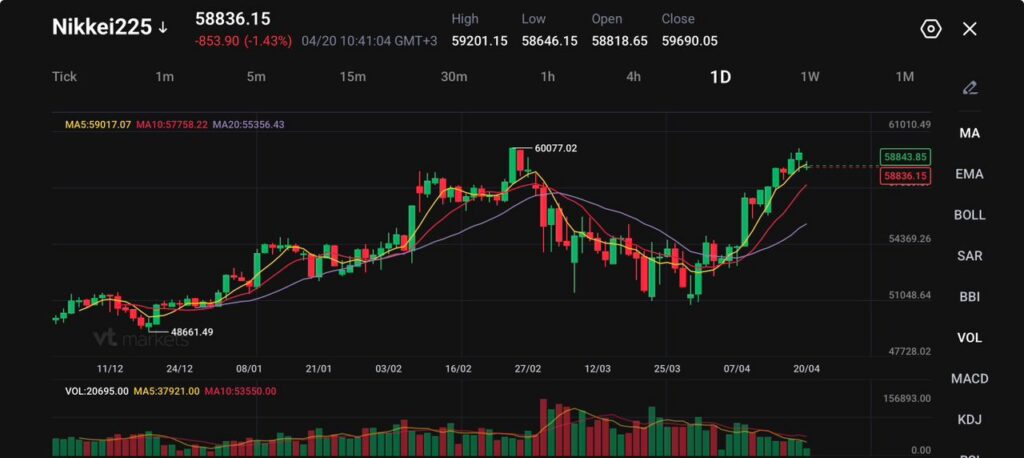
Key levels to watch:
- Support: 58,000 → 57,750 → 55,350
- Resistance: 59,000 → 60,077 → 61,000
The index is currently testing the 58,000–58,800 zone, which is acting as immediate support. A sustained break below this region could lead to a deeper pullback toward 57,750, where the 10-day moving average sits.
On the upside, 59,000 is now acting as near-term resistance. A move back above this level would suggest buyers are regaining control and could open another attempt toward the 60,077 high.
Overall, the Nikkei remains in a strong uptrend with a developing pullback, as the market consolidates gains near recent highs. The next move will depend on whether support holds around 58,000 or if the correction extends further before buyers step back in.
What Traders Should Watch Next
The next move depends on whether AI leadership keeps overpowering macro stress. Watch the behaviour of SoftBank, Lasertec, and other chip-linked names, but also keep an eye on oil. If Wall Street stays firm and crude does not re-accelerate, the Nikkei can keep leaning toward the highs. If Hormuz headlines worsen and oil climbs sharply again, the index may slip back into a more defensive consolidation.
Learn more about trading Indices on VT Markets today.
Trader Questions
Why Is The Nikkei 225 Still Trading Near Record Highs?
The index has stayed elevated because traders are still prioritising AI-driven earnings optimism and Wall Street strength over the latest swings in Middle East headlines. The Nikkei recently closed at 58,824.89, still near the record intraday zone reached last week.
Why Are AI Stocks So Important For The Nikkei Right Now?
AI-linked names are carrying a large share of sentiment. Stocks such as SoftBank Group and Lasertec were among the stronger gainers, showing that traders are still leaning into semiconductors, AI infrastructure, and related earnings growth.
How Much Is Wall Street Influencing Japanese Stocks?
A lot. The S&P 500 and Nasdaq recently posted fresh record closes, and that has helped support Japanese equities, especially the tech-heavy and AI-linked parts of the Nikkei.
Why Hasn’t The Middle East Crisis Knocked The Nikkei Lower More Aggressively?
The market is balancing two forces. AI optimism and earnings support are keeping buyers involved, while oil and geopolitical risk are creating short-term volatility. That has produced more of a tug-of-war than a full risk-off unwind.
Why Does Oil Matter So Much For The Nikkei?
Japan imports most of its energy, so higher crude prices can quickly raise input costs, worsen imported inflation, and pressure margins. That makes the Nikkei more sensitive to oil swings than many other major equity indices.
Start trading now – Click here to create your real VT Markets account







