







Key Points
- Nikkei225 traded at 62,603.15, down 1,201.69 points, or 1.88%, after touching a session high of 63,789.15.
- The Nikkei 225 fell 0.5% to close at 62,417.88 after earlier rising to 63,385.04.
- The Topix climbed 0.3% to 3,840.93, showing broader market support outside the more geopolitically exposed Nikkei.
- Konami rose 10.25%, Japan Tobacco gained 6.85%, Ajinomoto rose 9.3%, Sony surged 8.3%, while Nintendo fell 8.44%.
Japan’s Nikkei 225 touched a record high early on Monday, then turned lower as Middle East risk overpowered strong earnings and technology optimism. The benchmark Nikkei 225 fell 0.5% to close at 62,417.88 after earlier rising to 63,385.04. The broader Topix, which is less exposed to geopolitical swings, climbed 0.3% to 3,840.93.
The move shows a market that still wants to buy Japan’s earnings story, but is becoming more careful near record territory.
Wall Street hit record highs on Friday, led by artificial intelligence-related stocks such as Nvidia and SanDisk, and that optimism carried into Tokyo. Chipmaker Kioxia rose 3.26% on Monday after surging 22% last week.
The problem is that geopolitical risk has moved back into the centre of the trade. US President Donald Trump rejected Iran’s response to a peace proposal, reducing hopes for a fast end to the conflict that has pushed up global energy costs. Trump called Iran’s offer “TOTALLY UNACCEPTABLE,” while Brent crude rose as traders priced renewed pressure around the Strait of Hormuz.
AI and Earnings Still Support Japanese Equities
Japan’s earnings story remains strong enough to prevent a broader sell-off. Konami Group jumped 10.25% and Japan Tobacco gained 6.85% after both companies posted strong earnings late on Friday. Ajinomoto rose 9.3%, while Sony surged 8.3%.
There were also more gainers than losers in the Nikkei, with 132 advancers against 89 decliners. That breadth is important. It suggests the market decline came from pressure on selected heavyweights rather than a full retreat from Japanese equities.
Rising capital investment in AI-related sectors and expectations for strong demand remain positive for shares. This keeps Japan tied to the global AI cycle, especially through semiconductors, data-centre infrastructure, electronics, and automation.
The cautious forecast is that earnings-linked buying may continue on dips, especially in companies with clear AI or pricing-power exposure. However, the index may struggle to sustain fresh highs if oil prices rise again and pressure global consumer sentiment.
Middle East Risk Hits Confidence
The Middle East conflict is now the main threat to the rally. Higher energy prices can squeeze Japan because the country depends heavily on imported fuel. A stronger oil shock can lift input costs for manufacturers, pressure household spending, and weigh on margins.
AP reported that oil jumped more than 3% after Trump rejected Iran’s response to a ceasefire proposal, with Brent crude at $104.89 per barrel and US crude at $99.15. The report also said the Strait of Hormuz remained largely closed and the US naval blockade stayed in place.
This matters for Japan because higher oil can hurt the same consumer and industrial confidence that earnings optimism depends on. It also complicates the Bank of Japan’s policy outlook. If inflation stays firm because of energy, the market may start to price less patience from policymakers.
US Consumer Sentiment Adds Another Warning
The Nikkei also faced pressure from weak US consumer data. Higher gasoline prices dragged US consumer sentiment to a record low in early May, raising concern that the oil shock is starting to hit households.
That matters because Japan’s exporters rely on resilient global demand. If US consumers pull back, the benefit from AI investment may not fully protect the wider market. Technology and chip-linked names can still rise, but consumer-facing and cyclical sectors may become more exposed.
Nintendo showed that stock-specific pressure remains active. The company fell 8.44% after hiking prices on its Switch 2 video-game console. That drop highlights a broader issue for consumer stocks: higher costs can force companies to raise prices, but investors may punish them if demand looks at risk.
Technical Analysis
The Nikkei 225 has pulled back sharply from fresh highs near the 64,000 region, with the index now trading around 62,603 after a steep intraday rejection. Despite the heavy red candle, the broader trend still remains bullish for now, as price continues to hold comfortably above the rising medium-term moving averages.
The recent rally has been extremely aggressive. Since early April, the Nikkei has climbed from below 52,000 to above 63,000 in just over a month, leaving the market vulnerable to profit-taking and short-term exhaustion. The current drop looks more like a momentum reset than a confirmed trend reversal at this stage.
Technically, the structure remains constructive:
- MA5: 62,247
- MA10: 60,725
- MA20: 60,019
The moving averages are still positively stacked, with the short-term averages holding well above the 20-day line. That usually reflects a strong underlying uptrend, even during periods of volatility.
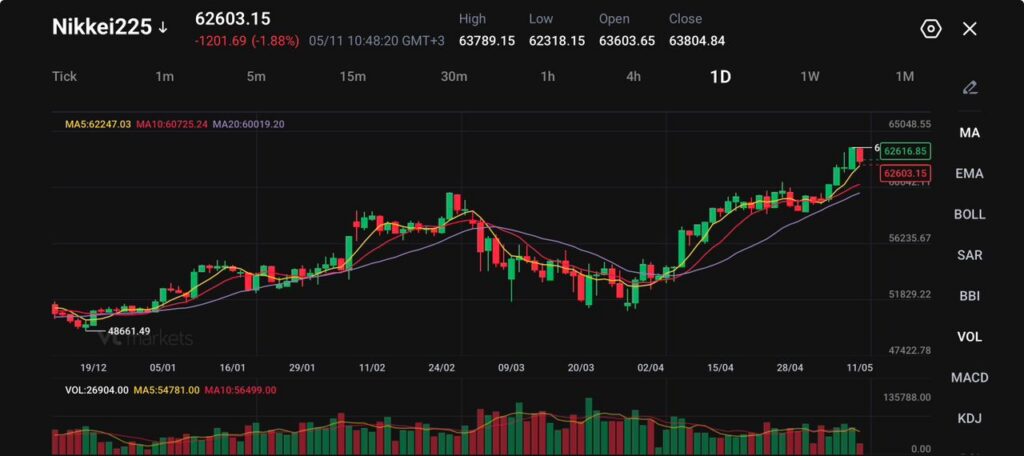
Key levels to watch:
- Immediate support: 62,200 → 60,700
- Major support: 60,000 psychological region
- Resistance: 63,800 → 65,000
The area around 62,200–62,000 is important because it lines up closely with the rising 5-day average and the breakout zone from last week. If buyers defend this region, the index may attempt another push higher toward the recent highs.
However, if selling accelerates below 60,700, the Nikkei could enter a deeper retracement phase back toward the 60,000 handle, where the 20-day average may become the next major support zone.
The broader macro backdrop still favours Japanese equities. A softer yen over recent months, continued AI-driven semiconductor demand, and persistent foreign inflows into Japanese stocks have all supported the rally. The chart also continues to reflect strong momentum in export-heavy sectors and chip-linked names.
That said, the size of the recent move means volatility is likely to stay elevated. Markets rarely move vertically forever, and the current candle suggests traders are beginning to lock in gains near record territory.
For now, the Nikkei still carries a bullish medium-term bias, but short-term momentum is beginning to cool after the explosive April breakout.
Market Implications
The Nikkei’s pullback does not break the bullish story, but it exposes how sensitive record-level equities are to energy shocks. AI investment, strong earnings, and solid breadth remain supportive. The Topix rising 0.3% while the Nikkei fell 0.5% also shows that domestic and broader Japanese equities still have underlying demand.
The risk is that oil-driven inflation begins to challenge the earnings story. If energy costs stay high and US consumer sentiment remains weak, investors may become more selective. Companies tied to AI infrastructure may keep outperforming, while consumer and import-cost-sensitive names may face more pressure.
The cautious forecast favours a choppy range while Nikkei225 holds above 62,247.03. A break below that level could pull the index toward 60,725.24 and 60,019.20. A recovery above 63,789.15 would put the record high back in play, but a stronger move may need lower oil prices, firmer US sentiment, and continued earnings upgrades.
Learn more about trading Indices on VT Markets today.
Trader Questions
Why Did The Nikkei 225 Fall After Hitting A Record High?
The Nikkei 225 fell because Middle East risk outweighed strong earnings and AI-related optimism.
The benchmark Nikkei 225 fell 0.5% to close at 62,417.88 after earlier rising to 63,385.04. On the chart, Nikkei225 traded at 62,603.15, down 1,201.69 points, or 1.88%.
What Is The Current Nikkei225 Price?
Nikkei225 traded at 62,603.15, down 1,201.69 points, or 1.88%.
The session high was 63,789.15, with a low of 62,318.15, an open at 63,603.65, and a close at 63,804.84.
Why Is Middle East Risk Pressuring Japanese Stocks?
Middle East risk is pressuring Japanese stocks because higher energy costs can hurt Japan’s import-heavy economy.
US President Donald Trump rejected Iran’s response to a peace proposal, reducing hopes for a quick end to the conflict. That raised concern over global energy prices, inflation, and consumer demand.
Why Did The Topix Rise While The Nikkei Fell?
The Topix rose because broader Japanese market demand remained more stable than the Nikkei’s price-weighted heavyweights.
The Topix climbed 0.3% to 3,840.93, while the Nikkei fell 0.5%. This suggests investors did not fully exit Japanese equities, but became more selective near record highs.
Start trading now – Click here to create your real VT Markets account







