







Key Points
- WTI trades at 106.402, up 7.579 or 7.67%, after printing a session high of 106.707.
- Trump said the US has enough gas and oil to handle the shock, but Moody’s says higher prices will still hit growth and inflation.
- Supply disruption is still driving the market. Brent above $107 after Trump’s Iran speech and said US clean fuel exports rose to a record 3.11 million bpd in March.
Oil is trading like a supply shock is still in force. WTI sits at 106.402, up 7.67%, and the chart shows buyers stepping back in after the latest pullback. The market is not questioning whether the US can produce oil. It is pricing the cost of a global disruption that keeps freight, fuel, and input prices high even when domestic supply is available.
That is why Trump’s claim that the US has plenty of gas and oil has not settled the market. The US is better positioned than major energy importers, but oil is priced globally.
When shipping lanes are impaired and replacement flows stretch across longer routes, businesses and consumers still pay more.
Domestic Supply Does Not Cancel Global Price Pressure
US fuel exports hit a record in March as Europe and Asia rushed to replace the disrupted Middle East supply. Clean petroleum product exports rose to 3.11 million barrels per day, up from 2.5 million bpd in February. Europe took 414,000 bpd, Asia took 224,000 bpd, and Africa took 148,000 bpd.
That supports one part of Trump’s argument. The US does have barrels to sell. It also shows why Moody’s pushback carries weight. Export strength helps global buyers, but it also tightens the domestic balance and keeps prices elevated. US fuel exports became politically sensitive as gasoline moved above $4 per gallon and diesel approached $5.50.
The immediate issue is cost, not scarcity. Businesses do not need to run out of fuel for growth to slow. They only need to pay enough more for fuel, freight, chemicals, and transport to cut margins and delay spending.
Inflation Pressure and Slower Growth Can Arrive Together
That is the hard part of this setup. Higher oil pushes inflation up while also dragging on activity. Moody’s Analytics argued that the US is not exposed in the same way as countries that cannot produce oil domestically, but it still cannot avoid the economic damage from disrupted supply chains and higher costs. That is the exact mix that revives stagflation fears.
Brent rose above $107, stocks fell, and the dollar strengthened as investors priced a longer disruption and a tougher inflation path.
That backdrop explains why oil above $106 carries more weight than the reassuring line that the US has enough supply. Domestic output can cushion the blow. It cannot erase the inflation premium while the wider system is still under stress.
Technical Analysis
CL-OIL is trading near 106.40, extending its aggressive upside move after a strong breakout from the consolidation phase around the mid-$90s. Price has surged sharply from the late-February base, with momentum accelerating into the recent spike toward 119.43, before entering a period of controlled consolidation just below current highs.
The latest price action shows buyers stepping back in, with the market attempting to push higher again after holding firm above key short-term levels.
From a technical standpoint, the trend remains firmly bullish. Price is trading well above all major moving averages, with the 5-day (102.55) leading higher and the 10-day (97.29) and 20-day (94.96) trailing beneath, all sloping upward. This alignment reflects strong trend continuation, while the recent consolidation above the $100 handle suggests the market is building a base for a potential next leg higher rather than showing signs of reversal.
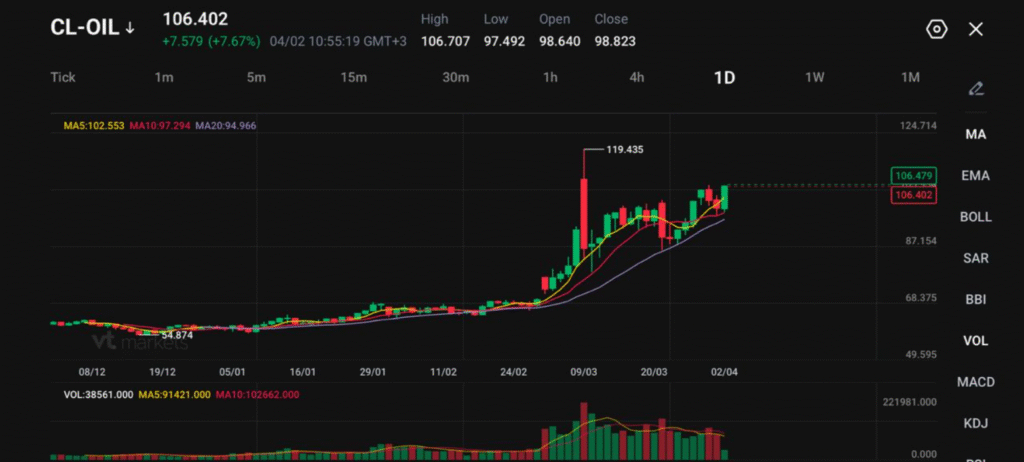
Key levels to watch:
- Support: 102.50 → 100.00 → 97.30
- Resistance: 106.70 → 110.00 → 119.40
The immediate focus is on the 106.50–107.00 zone, which aligns with recent highs. A sustained break above this area could open the path toward 110.00, with further upside potential if momentum builds.
On the downside, 102.50 acts as first support, reinforced by the rising 5-day average. A break below this level would likely trigger a deeper pullback toward 100.00, though such a move would still be considered corrective within the broader uptrend.
Overall, oil remains in a strong uptrend with higher highs and higher lows intact. The current consolidation appears constructive, and unless price slips back below the $100 region, the bias remains tilted to the upside as the market continues to price in supply-side risks and sustained demand.
What Traders Should Watch Next
The next move depends on whether the market sees more real relief in fuel flows or just more confidence talk. Physical trade is adjusting through record US exports and rerouted supply, but prices remain high because the system is still strained.
Watch Brent’s reaction above $107, watch whether US product exports stay near the March record, and watch how quickly fuel costs feed into broader inflation measures. If transport and energy prices keep rising, oil can stay high even without another headline shock.
Learn more about trading Energies on VT Markets here.
Trader Questions
Why Are Oil Prices Still Rising Even Though The US Has Plenty Of Supply?
US supply helps cushion the shock, but oil is priced in a global market. When shipping routes are disrupted and freight costs rise, domestic production does not stop higher global prices from feeding into US fuel and input costs.
What Did Trump Say About The Energy Situation?
Trump said the US has plenty of gas and oil, along with supply from Venezuela, and argued the economy is well prepared to handle the current disruption.
Why Do Analysts Still See Risks For The US Economy?
Higher oil prices still raise transport, logistics, and operating costs for businesses and consumers. That can slow growth even if the US does not face an outright fuel shortage.
How Do Higher Oil Prices Affect Inflation?
Oil feeds into petrol, diesel, shipping, aviation, and manufacturing costs. When those costs rise, broader inflation tends to follow, especially if the move lasts more than a few weeks.
Why Can Growth Slow Even If The US Produces Its Own Oil?
Domestic production reduces vulnerability, but it does not shield the economy from globally higher prices. Companies still pay more for fuel and supply chains still get more expensive.
Start trading now – Click here to create your real VT Markets account








