







Key Points
- CL-OIL traded at 102.594, up 1.477, or 1.46%, after reaching a session high of 104.294.
- At 0800 BST, Brent crude was up 1.8% at $111.17 a barrel, while WTI was 2.2% higher at $107.71.
- Trump warned Iran that “the clock is ticking” and said “time is of the essence”, while reports said the US and Israel may resume joint attacks as soon as this week.
- A drone strike caused a fire near the UAE’s Barakah nuclear plant, adding a new layer of regional energy-security risk.
Oil prices rose again as the market moved back into war-risk pricing. CL-OIL traded at 102.594, up 1.477, or 1.46%, at 05/18 10:12:35 GMT+3. The session high reached 104.294, with a low of 101.502, an open at 101.502, and a close at 101.117.
The broader oil market also pushed higher. At 0800 BST, Brent crude was up 1.8% at $111.17 a barrel, while West Texas Intermediate was 2.2% higher at $107.71.
The trigger came from a harder US tone on Iran. President Donald Trump said on Truth Social on Sunday: “For Iran, the clock is ticking, and they better get moving, fast, or there won’t be anything left of them.” He added: “Time is of the essence.” Trump warned Iran to act “fast” after efforts to end the US-Israeli war with Iran stalled.
That language pulled traders away from hopes of a quick peace deal. The market is now pricing a higher risk that the ceasefire breaks, military action resumes, and the Strait of Hormuz stays shut for longer.
Strike Reports Lift The Supply Premium
Weekend reports said the US and Israel are preparing to resume joint attacks on Iran as soon as this week. According to the New York Times, citing two Middle East officials, Washington and Tel Aviv are engaged in “intense preparations” for a potential return to hostilities.
Those officials reportedly described the preparations as the most serious since the ceasefire brokered by Pakistan in April was established. That is the key shift for crude. A ceasefire can cap panic buying if traders believe diplomacy is moving. Preparations for renewed strikes do the opposite.
Trump’s warning to Iran has reinforced concern that the conflict could move back into a more active military phase, delaying any normalisation of traffic through the Strait of Hormuz.
That keeps shipping risk at the centre of the oil trade. If Hormuz remains closed, Brent and WTI can hold a higher risk premium even when demand concerns appear elsewhere.
UAE Drone Strike Adds A New Flashpoint
Prices also gained after a drone strike caused a fire near the UAE’s Barakah nuclear plant over the weekend. UAE officials said the plant remained safe, radiological safety levels were unaffected, and there were no injuries. The International Atomic Energy Agency said emergency diesel generators were powering the affected unit and called for maximum military restraint near nuclear facilities.
The incident sharpened the regional risk profile. The UAE’s nuclear facility sits outside the usual oil-route narrative, but any attack near critical infrastructure can quickly raise the market’s fear of wider escalation.
More upside could follow at the start of the week after fresh cracks appeared in the Middle East ceasefire. She pointed to the drone attack at the UAE nuclear facility and warned that the situation could escalate in the coming days.
Her broader point is clear: the Strait of Hormuz remains closed, the US and Iran are no closer to a peace deal, and Trump’s rhetoric has not yet broken the deadlock.
Inflation Risk Spreads Beyond Oil
Higher crude prices are now feeding into wider market stress. If WTI stays near $107 and Brent holds above $111, the market will keep watching fuel, freight, airline, transport, and consumer costs.
The inflation channel is already active. The oil shock has raised concerns that central banks may need to stay tighter for longer while risk assets become more exposed to any fresh escalation. Brooks described the situation as the biggest oil supply crisis in history and warned that risky assets may remain vulnerable to a deeper sell-off if the market underprices an extreme scenario.
Traders have not fully priced a bearish risk-asset outcome, while the Strait of Hormuz could still reopen. The ceasefire also remains formally in place, even with breaches. That leaves oil caught between two opposing forces: a possible diplomatic relief move if Hormuz reopens, and a sharp upside shock if hostilities resume.
Technical Analysis
WTI crude oil is trading around $102.59, extending its recovery from the early May lows while holding comfortably above the key psychological $100 handle. The broader structure remains constructive after oil stabilised from the sharp correction that followed the April peak near $119.42.
Technically, momentum has started turning positive again:
- MA5: 100.04
- MA10: 98.93
- MA20: 99.07
The short-term moving averages have crossed back above the 20-day average, which suggests bullish momentum is rebuilding after several weeks of sideways consolidation. Price is now trading above all three major short-term averages, reinforcing the recovery structure.
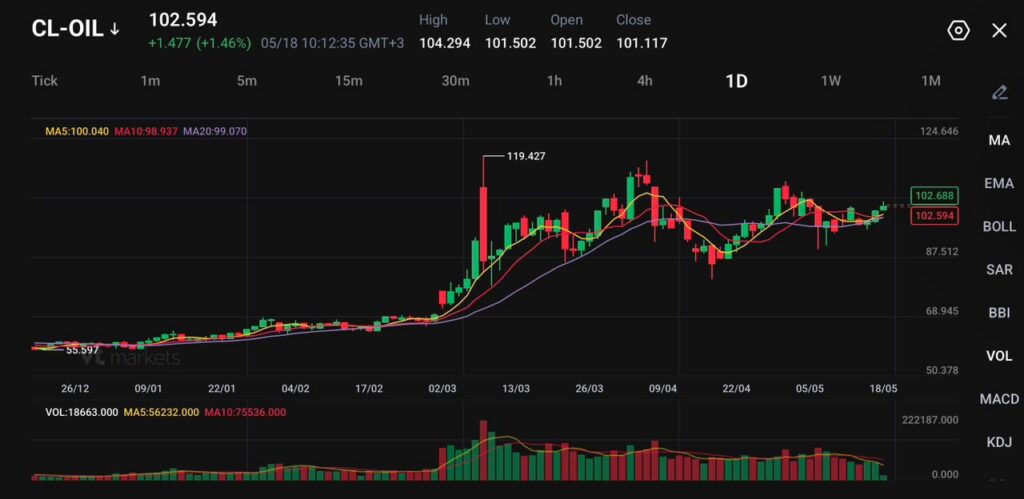
Key levels to watch:
- Immediate resistance: 103.50 → 106.00
- Major resistance: 110.00 → 119.42
- Support: 100.00 → 98.00
- Major support: 94.00 → 87.50
The recent price action shows oil repeatedly finding buyers near the $97–99 zone, establishing a relatively firm base during May. Buyers have gradually regained control since the failed breakdown earlier in the month.
From a structure standpoint, crude appears to be building a higher-low formation beneath the broader April highs. That typically signals accumulation rather than exhaustion, especially while the moving averages continue curling upward.
Fundamentally, geopolitical risk remains the dominant driver behind oil’s resilience. Traders continue pricing in supply disruption concerns across the Middle East, while shipping security and export stability remain key market sensitivities. At the same time, stronger seasonal demand expectations heading into the Northern Hemisphere summer are helping support prices above $100.
The market is also reacting to broader inflation expectations. Persistently elevated crude prices continue feeding concerns that global central banks may struggle to cut rates aggressively, particularly if energy inflation starts filtering back into consumer prices.
Volume has moderated compared with the explosive March rally, which suggests the market is currently consolidating gains rather than entering a fresh speculative spike. However, the ability to reclaim and hold above the short-term averages keeps upside pressure intact.
If WTI can establish daily closes above $103.50–106.00, the market may begin targeting another move toward the $110–115 region. Conversely, a break back below $100 would weaken the short-term bullish structure and expose support near $97 and the 20-day moving average.
For now, oil maintains a moderately bullish bias while price holds above the $98–100 support cluster, with geopolitical developments likely remaining the primary catalyst for volatility.
Cautious Forecast
CL-OIL keeps a bullish short-term bias while it holds above 100.040 and 98.937. A move above 104.294 would support a test of 105.968, especially if strike preparations continue and Hormuz remains closed.
A break below 98.937 would weaken the rebound and suggest traders are fading the latest escalation risk. The strongest upside path needs three signals to align: Brent holds above $111, US-Iran talks stay deadlocked, and fresh military or shipping incidents keep the Strait of Hormuz closed.
Learn more about trading Energies on VT Markets here.
Trader Questions
Why Are Oil Prices Rising Today?
Oil prices are rising because traders are pricing in renewed military risk around Iran and the Strait of Hormuz. Reports that the US and Israel may resume joint attacks on Iran as soon as this week have pushed a fresh supply-risk premium into crude.
At 0800 BST, Brent crude was up 1.8% at $111.17 a barrel, while WTI was 2.2% higher at $107.71.
What Is The Current CL-OIL Price?
CL-OIL traded at 102.594, up 1.477, or 1.46%.
The session high stood at 104.294, with a low of 101.502, an open at 101.502, and a close at 101.117.
Why Is The Strait Of Hormuz Important For Oil Prices?
The Strait of Hormuz is a key global oil transit route, so any closure can tighten supply and lift crude prices quickly.
If traffic through the strait cannot normalise, traders may keep pricing higher shipping costs, longer delays, and a stronger risk premium in Brent and WTI.
How Is Trump’s Warning To Iran Affecting Oil?
Trump’s warning has lifted oil prices by raising fears that the Iran conflict could return to an active military phase.
He said on Truth Social: “For Iran, the clock is ticking, and they better get moving, fast, or there won’t be anything left of them.” He also said: “Time is of the essence.”
Are The US And Israel Preparing New Attacks On Iran?
Weekend reports said the US and Israel are preparing to resume joint attacks on Iran as soon as this week.
According to the New York Times, citing two Middle East officials, the US and Israel are in “intense preparations” for a possible return to hostilities.
Start trading now – Click here to create your real VT Markets account







