






Key Points
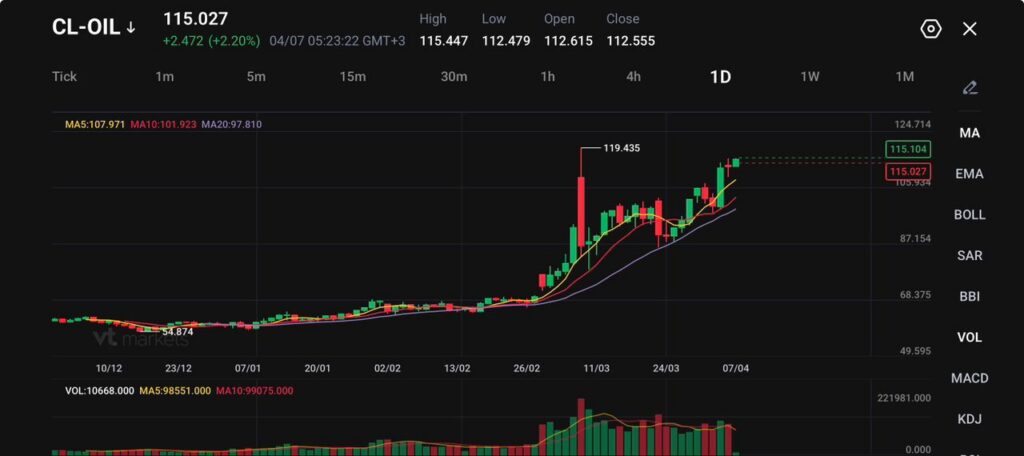
- CL-OIL trades at 115.027, up 2.472 (+2.20%), after printing a session high of 115.447.
- Brent crude rose 0.4% to $110.19, while WTI futures climbed 0.8% to $113.31 as traders waited for Tuesday’s deadline.
- The Strait of Hormuz still carries about one-fifth of the world’s oil and natural gas supply, keeping the market focused on physical disruption rather than diplomacy alone.
Crude is still trading like supply risk has not eased. CL-OIL is holding above 115, and the broader futures market stayed firm as traders waited for Trump’s Tuesday deadline for a deal with Iran.
Brent held near $110.19 and WTI near $113.31, which kept the market in the upper end of the recent war-driven range.
The price action shows that the market is not willing to remove the risk premium ahead of an event that could escalate again within hours. Traders have seen enough failed diplomacy and partial relief headlines over the past month to keep paying for protection until Hormuz flows are clearly safer.
A cautious near-term view still favours elevated prices while the deadline remains live and the shipping picture stays unclear.
Hormuz Still Sets the Tone
The market is still trading the Strait of Hormuz first and everything else second. The route carries about 20% of global oil and natural gas supply, so any restriction there quickly feeds into shipping rates, insurance costs, and prompt crude pricing.
Iran has signalled that it wants a lasting outcome rather than a temporary ceasefire, and pressure to reopen the waterway has not yet produced a breakthrough.
That leaves physical supply as the main variable. A market can tolerate aggressive rhetoric for a while. It reacts much more sharply when the main export artery for Gulf energy stays constrained.
That is why oil has stayed firm even when equities have tried to stabilise. The market still lacks a credible path to normal flows.
Equities Waver While Oil and the Dollar Stay Firm
Broader risk sentiment reflects the same hesitation. Asian equities moved in mixed fashion, with MSCI Asia-Pacific ex-Japan up 0.4%, while the Nikkei slipped 0.2%. At the same time, US stock futures fell 0.55%, showing traders were still reducing risk rather than fully buying the truce story.
The dollar also stayed supported. The dollar index held around 100.06, while the euro traded at $1.1538 and USDJPY hovered near 159.91, close to the level that keeps Tokyo sensitive to intervention risk.
That pattern is consistent with a market still pricing inflation pressure and slower growth together. Oil remains high enough to keep that stagflation mix in focus.
Inflation Risk is Starting to Show Up in US Data
The macro backdrop has started to absorb the energy shock. US services-sector growth slowed in March, while business prices paid rose at the fastest pace in more than 13 years, giving markets an early read on how the Iran war is feeding inflationary pressure.
That helps explain why traders are no longer pricing Fed cuts this year. Oil at these levels does not just hit fuel bills. It feeds into logistics, chemicals, transport, and broader input costs. Once that happens, central banks lose flexibility quickly.
A cautious forecast still points to tighter financial conditions if crude remains around current levels into the next inflation prints.
Technical Analysis
CL-OIL is trading near 115.03, continuing its strong upward trajectory after the sharp breakout from the late-February base. Price action shows sustained bullish momentum, with the market pushing steadily higher following the surge toward 119.43, and now consolidating just below that recent peak.
The structure remains clean, with higher highs and higher lows forming, indicating buyers are still in firm control.
From a technical standpoint, the trend remains firmly bullish. Price is trading well above all key moving averages, with the 5-day (107.97) leading the move higher, followed by the 10-day (101.92) and 20-day (97.81), all sloping upward in strong alignment. This reflects a persistent trend strength, while the current consolidation above the $110 region suggests the market is continuing to build rather than showing signs of exhaustion.
Key levels to watch:
- Support: 110.00 → 105.90 → 101.90
- Resistance: 115.50 → 119.40 → 124.70
The immediate focus is on the 115.50 area, which is acting as short-term resistance. A clean break above this level could open the path toward a retest of 119.40, with further upside potential if momentum accelerates.
On the downside, 110.00 is the key psychological and structural support. A break below this level could trigger a pullback toward 105.90, though such a move would likely remain corrective within the broader uptrend.
Overall, oil remains in a strong uptrend with consolidation at elevated levels. As long as price holds above the $110 zone, the bias stays firmly to the upside, with the market positioning for a potential continuation move toward recent highs.
What Traders Should Watch Next
The next move depends on whether the deadline produces a real reopening path for Hormuz or another escalation headline. Brent and WTI are already trading at levels that keep inflation fears alive, while the dollar and rates market continue to price that stress into the macro outlook.
If the deadline passes without progress and the waterway stays constrained, oil can keep pressing toward the recent highs.
If a deal emerges and traffic begins to normalise, the market can unwind part of the premium quickly, but it will likely need proof in flows rather than promises.
Learn more about trading Energies on VT Markets here.
Trader Questions
Why is Oil Still Holding Above $110?
Oil is holding high because traders still see a real risk of further disruption to Gulf energy flows while the Iran deadline remains unresolved. Brent was recently quoted at $110.19 and WTI at $113.31 in the wider futures market, which shows the risk premium is still firmly in place.
Why Does The Iran Deadline Matter So Much For Oil Prices?
A fixed deadline forces the market to price a near-term escalation risk. If no deal is reached and the Strait of Hormuz stays constrained, traders have to assume supply disruption could last longer and push prices higher.
Why is the Strait of Hormuz So Important for Crude?
The Strait carries about one-fifth of the global oil and natural gas supply, so even a partial disruption can lift freight costs, insurance premiums, and prompt crude prices very quickly.
Why Has Oil Stayed Firm Even Though Talks Are Still Happening?
The market is no longer reacting to diplomacy alone. It wants proof that energy flows will normalise. Until shipping risk clearly falls, traders are reluctant to strip out the premium from crude.
How Are Higher Oil Prices Affecting Broader Markets?
Higher crude prices are feeding inflation fears, tightening financial conditions, and keeping pressure on equities and central banks. Markets have already started pricing slower growth and firmer inflation together, which is why stagflation concerns keep resurfacing.
Why is the Dollar Staying Supported Alongside Oil?
The dollar is holding firm because investors are still using it as the main haven trade while the conflict remains live. The dollar index was recently around 100.06, which shows traders are still leaning defensive rather than moving fully back into risk assets.
Start trading now – Click here to create your real VT Markets account








