


 Insights
  VT
VT 





The US Dollar Index (USDX) fell beneath 97.8 on Wednesday, surrendering a portion of the prior session’s advance as renewed doubts over trade policy weighed on the currency.
During his State of the Union speech, President Donald Trump gave no signal that tariff measures would be relaxed. Instead, he voiced confidence that overseas governments would comply with trade agreements and floated the idea that tariffs might ultimately substitute income taxes.
This week, the United States introduced a temporary 10% universal tariff, with reports suggesting the White House intends to increase it to 15%. The move follows the Supreme Court’s decision to strike down Trump’s reciprocal tariff proposal.
The absence of clear policy direction has injected additional volatility into foreign exchange markets.
Federal Reserve Policy Outlook And Implications For The Dollar
Recent remarks from Federal Reserve officials continue to support a pause in interest rate adjustments.
Susan Collins indicated that keeping rates at current levels appears appropriate in light of a strengthening US labour market and lingering inflation concerns.
Thomas Barkin similarly remarked that monetary policy is suitably calibrated to address prevailing economic risks.
Nevertheless, markets are still pricing in roughly three quarter-point reductions this year, creating a disconnect between central bank guidance and investor expectations.
This gap is restraining any sustained upward momentum in the dollar.
Technical Analysis
The Dollar Index is presently trading at 97.626 (-0.19%), positioned close to its short-term moving averages.
Key technical levels:
MA5: 97.702
MA10: 97.363
MA20: 97.209
MA30: 97.402
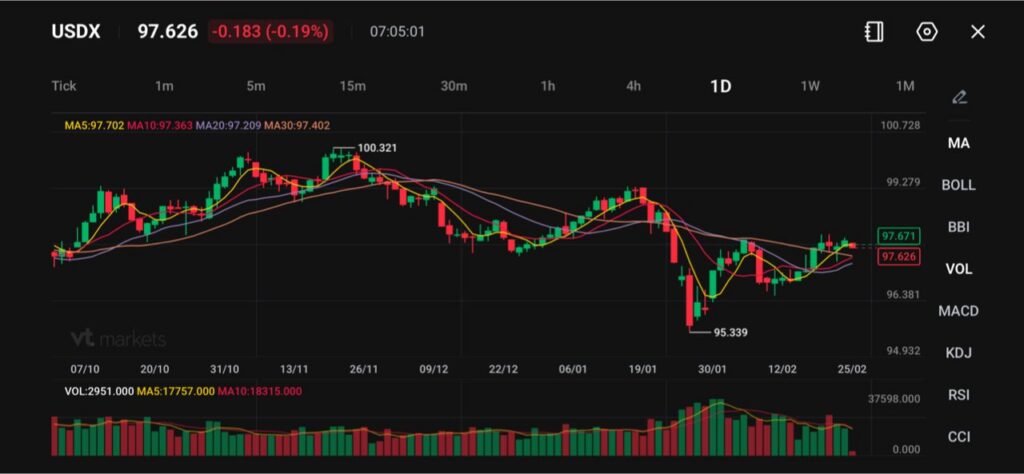
Price action remains capped beneath the psychologically significant 98.00 mark. Immediate resistance is located around 99.30, with the 100.32 swing high beyond that.
On the downside, first support is seen at 96.38, while stronger support stands at 95.34, the recent trough.
A sustained move below 97.00 may accelerate bearish momentum towards the 96.00 area.
The Impact Of Tariffs On The US Dollar
Trade-related uncertainty is once again emerging as a structural headwind for the currency.
Elevated tariffs can:
– Restrict global trade activity
– Intensify domestic inflationary pressures
– Complicate the Federal Reserve’s timeline for rate reductions
Although tariffs might, in theory, underpin the dollar through higher inflation and interest rates, inconsistent policy signals tend to undermine investor confidence, prompting diversification away from US-denominated assets.
US Dollar Outlook: What Lies Ahead For USDX?
The US Dollar Index remains confined within a range, though downside risks persist.
In the near term, a move above 98.00–98.50 would indicate a revival in bullish momentum, while a decline beneath 96.50 could open the path towards the 95.30 low.
The next meaningful directional trigger is likely to stem from US inflation data, labour market data and tariff clarity.
Unless forthcoming economic data strongly reinforces the case for postponing rate cuts, the dollar may find it difficult to establish a durable upward trend.
For the moment, USDX appears caught between trade policy uncertainty and the Federal Reserve’s cautious stance.







