







Key Points
- USD/JPY traded at 158.51, down 0.18, or 0.14%, after reaching a session high of 159.097.
- The yen hovered near 159 per dollar, close to the 160 area that triggered intervention in late April and early May.
- Markets now price more than a 50% chance of a Fed rate hike in December, while the BOJ’s June 15 to 16 meeting is back in focus.
- Japan’s economy grew an annualised 2.1% in Q1, above the 1.7% forecast, strengthening the case for a BOJ hike.
The Japanese yen traded near 159 per dollar on Wednesday, keeping markets alert for another round of intervention from Tokyo. USD/JPY traded at 158.51, down 0.18, or 0.14%, at 05/20 06:44:15 GMT+3. The session high stood at 159.097, with a low of 158.835, an open at 159.026, and a close at 159.069.
The pair remains close to the 160 zone that prompted Japanese authorities to intervene in late April and early May. Traders are now testing how much weakness Tokyo will tolerate before stepping back into the market.
The dollar still holds the stronger macro hand. The dollar traded near a six-week high as inflation fears tied to the Iran war lifted Fed rate-hike expectations. The yen remained near intervention levels around 159, while markets priced more than a 50% chance of a Fed hike in December.
Fed Hike Bets Keep The Rate Gap Wide
USD/JPY continues to draw support from the US rate outlook. The Iran war has kept oil prices high, disrupted energy flows, and reignited inflation pressure. That has shifted market pricing away from rate cuts and toward the risk of renewed Fed tightening.
The dollar index stood at 99.306, up more than 1% in May, while Brent crude held around $110.8 per barrel. Higher oil keeps inflation risk alive and gives the Fed less room to ease policy.
That rate gap keeps pressure on the yen. US yields remain high, while the Bank of Japan is still moving gradually. Unless US inflation cools or Treasury yields retreat, traders may keep buying USD/JPY on dips.
BOJ Hike Risk Limits Yen Selling
Japan’s side of the trade is no longer one-way. Strong domestic data has strengthened the case for another Bank of Japan rate hike.
Japan’s economy expanded at an annualised 2.1% in Q1, beating the 1.7% forecast. On a quarter-on-quarter basis, GDP grew 0.5%, above the expected 0.4% rise. Private consumption and capital expenditure both rose 0.3%, while net external demand added 0.3 percentage point to growth.
That data gives the BOJ more room to act. A stronger economy can absorb higher borrowing costs more easily than a weak one. It also gives policymakers a stronger case to defend the yen through rates, not only intervention.
US Treasury Secretary Scott Bessent has also voiced support for BOJ independence and Japan’s stronger fundamentals. Markets are pricing an 80% chance of a BOJ hike from 0.75% to 1% at the June 15 to 16 meeting.
Intervention Risk Returns Near 160
Tokyo has already shown it is willing to act. Several officials have suggested there may be no limit to how often Japan can intervene if currency moves become disorderly.
The yen has surrendered a large part of the gains triggered by recent intervention. That keeps traders cautious near 160, even as the dollar remains supported.
Intervention can force sharp intraday moves, but it rarely changes the trend without support from rates. If the Fed stays hawkish and the BOJ hesitates, USD/JPY may keep recovering after each intervention shock. If the BOJ hikes in June and signals more tightening, the yen could hold a stronger floor.
Oil Keeps Japan Under Pressure
The Middle East conflict adds another problem for Japan. High oil prices hurt the yen because Japan relies heavily on imported energy. Higher fuel costs worsen the trade balance, lift import prices, and squeeze household spending.
The Iran war has already disrupted energy markets and closed the Strait of Hormuz, keeping oil elevated. That gives the dollar a haven and inflation advantage, while Japan faces higher import costs.
This creates a difficult policy mix for Tokyo. A weaker yen raises import inflation. Higher oil adds more price pressure. A BOJ hike could support the yen, but it could also cool growth if households and firms start to feel the strain.
Technical Analysis
USDJPY is trading around 158.85, stabilising after the sharp intervention-style selloff earlier in May that briefly dragged the pair below 156.00. The rebound from those lows has been relatively steady, but momentum is now slowing again as the pair struggles beneath the broader resistance zone near 159.00–160.70.
Technically, the pair remains in a fragile recovery structure:
- MA5: 158.78
- MA10: 158.01
- MA20: 158.19
Price is still trading above the 10-day and 20-day moving averages, which keeps the short-term bias slightly constructive. However, the latest candles show hesitation just under the recent recovery highs, suggesting buyers are losing momentum as USDJPY approaches a heavier resistance cluster.
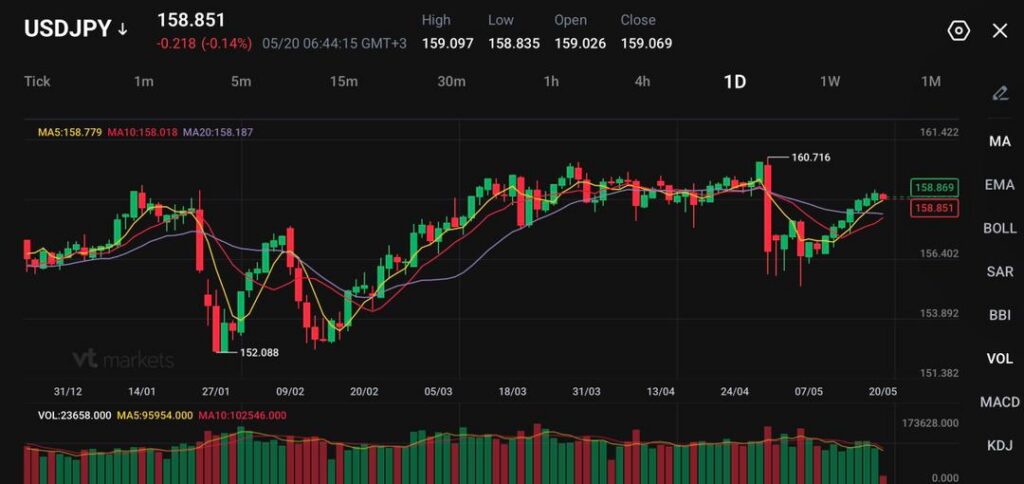
Key levels to watch:
- Immediate resistance: 159.00 → 160.70
- Major resistance: 161.40
- Support: 158.00 → 156.40
- Major support: 153.90 → 152.00
The 160.70 level remains extremely important. That zone previously triggered aggressive downside volatility and continues to represent a likely pressure point for Japanese authorities if the yen weakens too quickly again.
From a structure perspective, USDJPY is now trading in a narrower recovery range after the violent breakdown earlier in the month. The rebound has lacked the same aggressive momentum seen during March and April, which may indicate caution among buyers ahead of potential intervention risks.
Fundamentally, the pair continues balancing two competing forces:
- Higher US yields and delayed Federal Reserve easing continue supporting the dollar.
- Persistent concerns over yen weakness and possible Japanese intervention continue limiting upside momentum.
Markets are also watching the Bank of Japan closely. Even modest shifts in rhetoric around bond purchases, inflation, or policy normalisation could quickly strengthen the yen if traders perceive a more hawkish stance developing.
Volume has eased compared with the intervention-driven selloff, which suggests the market is currently consolidating rather than entering a fresh breakout phase.
If USDJPY can regain traction above 159.00, another test of 160.70 becomes likely. However, repeated failures beneath that zone could trigger renewed profit-taking and expose the pair back toward 158.00 and potentially 156.40.
For now, the broader trend still favours dollar strength, but upside momentum is becoming increasingly constrained as traders remain cautious around intervention risk and Japanese policy sensitivity near the 160 handle.
Cautious Forecast
USD/JPY keeps a mildly bullish bias while it holds above 158.187 and 158.018. A break above 159.097 would support another move toward 160.716, where intervention risk could rise sharply.
A drop below 158.018 would weaken the short-term setup and shift focus toward 156.402. The next move depends on three forces: Fed hike pricing, BOJ signals ahead of the June 15 to 16 meeting, and whether Tokyo decides that a return toward 160 requires another round of yen buying.
Learn more about trading Forex Pairs on VT Markets here.
Trader Questions
Why Is USD/JPY Near 159?
USD/JPY is near 159 because the yen remains under pressure from broad US dollar strength, higher US Treasury yields, and rising expectations for a Federal Reserve rate hike later this year.
USD/JPY traded at 158.51, down 0.18, or 0.14%, after reaching a session high of 159.097.
What Is The Current USD/JPY Price?
USD/JPY traded at 158.51.
The session high stood at 159.097, with a low of 158.835, an open at 159.026, and a close at 159.069.
Why Is The Yen Under Pressure?
The yen is under pressure because the US dollar remains supported by inflation fears, higher Treasury yields, and Fed rate-hike expectations.
The prolonged Middle East conflict has kept oil prices elevated, which has also hurt the yen because Japan depends heavily on imported energy.
Why Is The 160 Level Important For USD/JPY?
The 160 level is important because it previously triggered intervention by Japanese authorities in late April and early May.
If USD/JPY moves closer to 160, traders may become more cautious about another round of yen-buying intervention from Tokyo.
Could Japan Intervene Again To Support The Yen?
Japan could intervene again if USD/JPY moves sharply toward 160 or if yen weakness becomes disorderly.
Several Tokyo officials have suggested there may be no limit to how often authorities can step into the foreign exchange market if needed.
Start trading now – Click here to create your real VT Markets account







