







Key Points
- USDCNH trades at 6.88362, down 0.00544 (-0.08%), while the offshore yuan edges firmer around 6.88 per dollar.
- China’s composite PMI fell to 51.5 in March from 55.4 in February 2026, with manufacturing at 50.8 versus 52.1 and services at 52.1 versus 56.7.
- The yuan is set for a weekly gain after four straight weekly losses, helped by hopes that pressure on the Strait of Hormuz may ease.
The offshore yuan edged higher on Friday, with USDCNH at 6.88362, as traders trimmed some of the safe-haven demand that had pushed the dollar higher through the Middle East crisis. The immediate shift came from improving sentiment around the Strait of Hormuz. Iran and Oman may begin monitoring transit through the waterway, which gave markets a reason to ease back from the most defensive positions.
That does not mean the risk has gone away. The market is still treating the Strait as a live threat to energy flows. The move in the yuan reflects a softer dollar tone and a little more confidence that the worst-case supply shock may not deepen straight away.
A cautious path from here still depends on shipping. If the Strait stays open enough to reduce oil panic, USDCNH can keep drifting lower. If the route tightens again, the dollar may regain support quickly.
China’s PMI Data Limits the Upside
The yuan’s gains have run into a softer domestic growth signal. The figures you shared showed China’s composite PMI at 51.5 in March, down from 55.4 in February 2026. The slowdown was broad, with manufacturing at 50.8 versus 52.1 and services at 52.1 versus 56.7.
Weaker domestic demand and slower export momentum have added to the downturn of private-sector and industrial services.
That leaves the currency in a narrow balance. Better sentiment around Hormuz supports the yuan. Softer Chinese activity keeps that support from becoming a stronger trend.
External Diplomacy Is Doing Part Of The Work
The broader backdrop has become more multipolar. India and the Philippines are reportedly negotiating with Tehran on vessel safety, while China and Pakistan are pushing their own diplomatic framework. That matters for the yuan because Beijing is not only exposed to oil prices.
It also has a direct interest in keeping trade lanes functional and freight costs contained.
China is one of the largest importers of oil moving through Hormuz, but it is also better placed than many peers to absorb some disruption through diverse supply sources, large inventories, and state-directed controls.
That gives the yuan some resilience when markets calm, but it does not turn the currency into a clean winner. China can absorb stress better than some importers, yet it still pays a growth cost when energy and logistics stay expensive.
Technical Analysis
USDCNH is trading near 6.8836, holding within a tight consolidation range after a prolonged downtrend from the 7.07 highs.
Price action shows the pair attempting to stabilise following the sharp decline into the 6.82 low, with recent candles reflecting indecision rather than strong directional conviction. The market is now moving sideways, suggesting a pause in bearish momentum as traders assess the next macro driver.
From a technical standpoint, the broader structure still leans bearish. Price remains capped below the key moving averages, with the 5-day (6.8896) and 10-day (6.8956) acting as immediate resistance, while the 20-day (6.8910) continues to flatten, signalling a loss of trend strength but not yet a reversal.
The inability to reclaim and hold above these levels keeps downside pressure intact, even as short-term momentum stabilises.
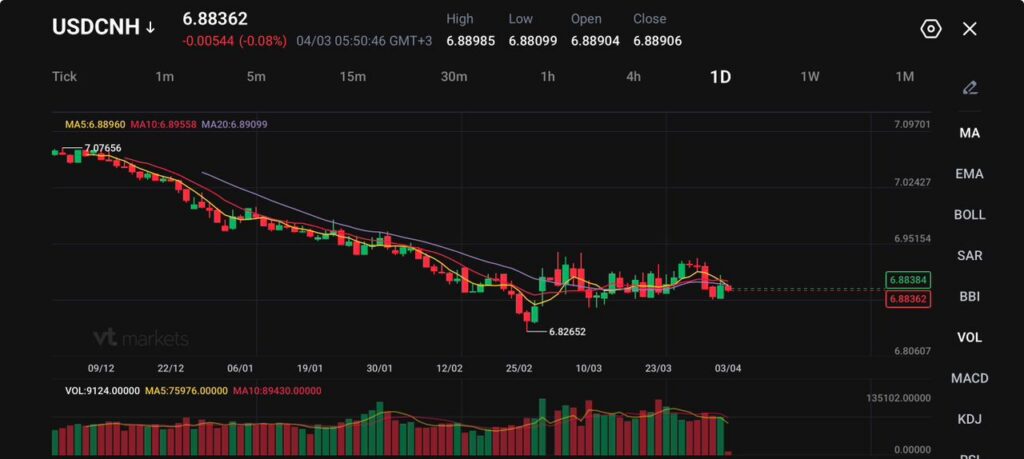
Key levels to watch:
- Support: 6.8800 → 6.8260 → 6.8000
- Resistance: 6.8950 → 6.9200 → 6.9500
In the near term, price is compressing around the 6.88–6.89 zone, with neither buyers nor sellers fully in control. A break below 6.8800 would likely reopen the move toward the 6.82 lows, while a sustained push above 6.8950 could trigger a short-term recovery toward 6.92.
Overall, USDCNH remains in a soft downtrend, but the current consolidation suggests momentum is fading. Traders should watch for a breakout from this narrow range, as it will likely dictate the next directional move.
What Traders Should Watch Next
The next move in USDCNH depends on whether Hormuz relief turns into actual flow stability and whether China’s softer March private PMI becomes a one-month pause or the start of a broader slowdown.
The latest China PMI reporting already showed weaker domestic demand and slower export orders in services, while manufacturing faced sharper input costs and longer delivery times.
A cautious forecast suggests that the exchange rate will remain within a narrow range around current levels. A significant decrease in USDCNH is likely to depend on a combination of calmer oil prices, stronger economic data from China, and a weaker dollar. However, any new disruptions in shipping could quickly push the pair back under upward pressure.
Learn more about trading Forex Pairs on VT Markets here.
Trader Questions
Why is USDCNH falling toward 6.88?
USDCNH eased because sentiment improved around the Strait of Hormuz and traders pulled back some defensive dollar positions. Reuters reported that hopes of monitored transit through the waterway helped support the yuan after four straight weekly losses.
What is supporting the offshore yuan right now?
The yuan is getting support from a softer dollar tone and from hopes that oil-shipping risks may ease. Reuters said the currency was heading for a weekly gain as markets reacted to signs that pressure around Hormuz could moderate.
Why has China’s PMI data limited yuan gains?
China’s March data showed slower momentum. The figures you provided showed the composite PMI at 51.5 versus 55.4 in February, with manufacturing at 50.8 versus 52.1 and services at 52.1 versus 56.7. Reuters also reported weaker private-sector demand and softer export momentum, which capped yuan upside.
Does a PMI above 50 still support the yuan?
Yes, but only partly. Readings above 50 still point to expansion, yet the slowdown from February means growth is losing speed. Currency markets usually reward improving momentum more than simple expansion.
Why does the Strait of Hormuz matter for USDCNH?
China imports a large amount of oil that moves through Hormuz. If the route stays disrupted, energy costs rise, freight costs stay high, and growth pressure builds. Reuters reported that China can absorb some of the shock through inventories and diversified supply, but it still faces a real economic cost.
What is the difference between the private PMI and China’s official PMI?
The private readings in your note softened sharply, while China’s official March data looked firmer. Reuters reported official manufacturing PMI at 50.4 and non-manufacturing PMI at 50.8, which suggests the economy is still expanding even though private surveys point to slower demand and rising cost pressure.
What does the USDCNH chart show right now?
The chart shows USDCNH at 6.88362, below the short-term moving averages at MA5 6.88960, MA10 6.89558, and MA20 6.89099. That keeps the short-term bias slightly softer for the dollar, though the move still looks like a cautious drift rather than a strong breakdown.
Start trading now – Click here to create your real VT Markets account







