







Key Points
- USDJPY trades at 159.623, up 0.048 (+0.03%), with price still pressing the upper end of the recent range.
- Traders price roughly a 70% chance of a BOJ rate increase, which means a hold could jar markets already on edge.
- Finance Minister Satsuki Katayama warned that speculative activity has increased in both currency and crude oil markets.
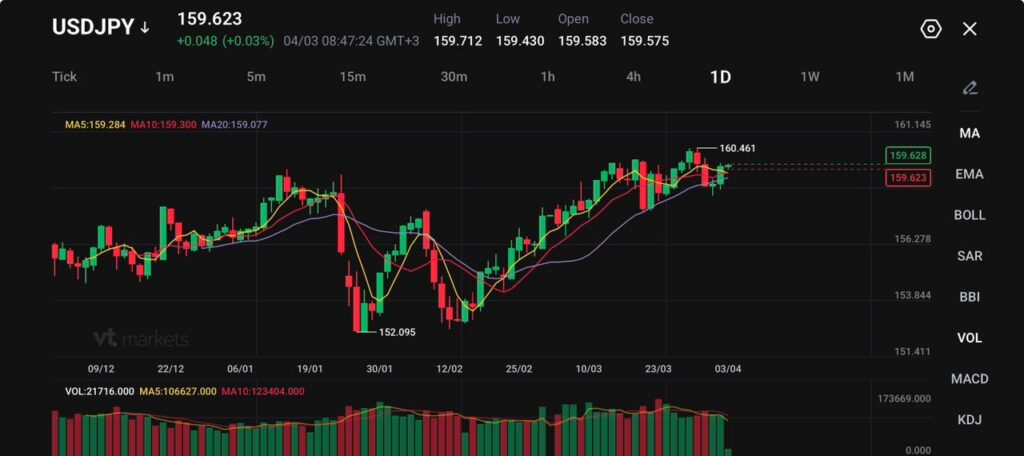
The yen is back near the level that keeps Tokyo on alert. USDJPY is trading at 159.623, close to the 160 area that previously triggered intervention fears, while the pair remains well above the January low at 152.095 shown on the chart.
The move reflects a market that still prefers the dollar when energy prices are high and geopolitical risk remains live. Japan imports most of its energy, so a weak yen and firmer oil work in the same direction. They lift import costs, worsen the terms of trade, and keep pressure on households and corporate margins.
The pair is not exploding higher today, but it is sitting close enough to 160 to keep officials, macro funds, and short-term traders focused on the next headline. A cautious near-term view still favours elevated levels unless oil cools or the BOJ gives markets a firmer signal.
BOJ Uncertainty is Driving the Trade
The Bank of Japan remains the main domestic variable. The market expects a meaningful chance of a rate increase at the next meeting, yet uncertainty over guidance is keeping the yen exposed. The BOJ left rates at 0.75% in March while maintaining a tightening bias, and pricing around the next step has stayed live into April.
That leaves USDJPY in an unstable balance. Expected tightening gives the yen some support underneath. A vague hold, or even a cautious hike without strong forward guidance, could still disappoint traders who want a clearer policy path.
Governor Kazuo Ueda has also signalled that exchange-rate moves now feed into inflation more directly than before, because companies are more willing to pass on higher costs.
Oil Keeps Tilting the Balance Against the Yen
Oil is still shaping the currency story. Higher crude prices have increased inflation pressure in Japan while also darkening the growth outlook. That weakens the yen’s usual defensive appeal. In a standard risk-off move, the yen often benefits from haven demand.
In this environment, high oil prices dilute that effect because the same shock is also increasing Japan’s import bill.
That explains why USDJPY can stay elevated even while broader markets worry about conflict. The dollar still has the cleaner relative-growth and energy-security story. A cautious forecast still favours upside pressure in USDJPY if oil stays high and the BOJ remains hesitant.
Tokyo is Raising the Volume on Intervention Warnings
Japanese officials have become more explicit. Finance Minister Satsuki Katayama said speculative activity in both oil futures and currency markets had increased significantly and warned that the government was prepared to respond if disruptions persisted.
Officials have also started describing parts of the yen move as speculative, which is firmer language than Tokyo used at the start of the conflict.
The warning may not reverse the trend by itself, but it can slow momentum and trigger sharp pullbacks if traders become too aggressive above 160. The bar for direct intervention still looks higher than in earlier episodes because this move is tied less to a one-way carry trade and more to oil, geopolitics, and broad dollar demand.
Technical Analysis
USDJPY is trading near 159.62, holding just below recent highs as the pair continues to press against the upper end of its range. Price action reflects steady bullish pressure, with higher lows forming since the February bottom around 152.09, and the market now testing resistance near the 160.00–160.50 zone, where upside has recently stalled.
From a technical standpoint, the trend remains constructive. Price is trading above the key short-term moving averages, with the 5-day (159.28) and 10-day (159.30) tightly clustered around current levels, acting as immediate support.
The 20-day (159.07) is also trending higher, reinforcing the ongoing upward structure, although momentum appears to be slowing slightly as price consolidates near resistance.
Key levels to watch:
- Support: 159.30 → 159.00 → 157.95
- Resistance: 160.50 → 161.10 → 162.00
The pair is currently consolidating just below 160.50, a level that has capped recent upside attempts. A clean break above this resistance could open the path toward 161.10, with further upside potential if momentum builds.
On the downside, 159.30 is acting as immediate support. A break below this level could trigger a pullback toward 159.00, though any decline is likely to remain corrective while the broader structure holds above the 157.95 region.
Overall, USDJPY remains in a steady uptrend with controlled pullbacks, reflecting persistent demand for the dollar against the yen.
However, with price hovering near the 160 handle, traders should remain alert to potential volatility or intervention risks, as this zone continues to attract heightened attention.
What Traders Should Watch Next
The next move in USDJPY depends on three things lining up. First, whether oil stays elevated. Second, whether the BOJ signals conviction ahead of the April 27–28 meeting window. Third, whether Tokyo’s warnings remain verbal or turn into action.
If oil remains firm and the BOJ stays vague, the market may test 160.461 again. If the BOJ sharpens its guidance or officials escalate intervention language further, USDJPY may keep moving sideways rather than breaking cleanly higher.
Learn more about trading Forex Pairs on VT Markets here.
Trader Questions
Why is USDJPY Staying So Close to 160?
USDJPY is staying elevated because the market still favours the dollar when oil prices are firm, geopolitical risk is live, and the Bank of Japan has not yet given traders a fully convincing policy signal. Your chart shows USDJPY at 159.623, still close to the recent high at 160.461.
Why Does Higher Oil Weaken the Yen?
Japan imports most of its energy, so higher crude prices raise import costs, worsen the trade balance, and increase inflation pressure without improving domestic growth. That combination usually works against the yen when energy shocks persist.
What Are Markets Expecting From the BOJ Right Now?
Markets are pricing a meaningful chance of another BOJ move, with recent reporting putting the probability in roughly the 60% to 70% range for the next step around the April meeting window. That supports the yen underneath, but it also raises the risk of disappointment if the BOJ holds or gives cautious guidance.
Why Would a BOJ Hold Be Negative for the Yen?
A hold would matter because traders already expect a decent chance of a hike. If the BOJ stays at 0.75% and sounds vague again, the market may treat that as a softer outcome than current pricing assumes, which could push USDJPY back toward the highs.
Why Has Tokyo Started Talking More About Speculation?
Officials are trying to slow one-way positioning before it becomes disorderly. Finance Minister Satsuki Katayama said speculative activity has increased in both FX and crude markets and warned the government is prepared to respond if disruption continues.
Start trading now – Click here to create your real VT Markets account







