


 Insights
  VT
VT 






Key Takeaways
- The US dollar index (USDX) stabilised near 98.5 after rising nearly 1% in the previous session.
- Escalating US-Israel military activity against Iran boosted safe-haven demand.
- Rising energy prices are reinforcing inflation concerns and pushing back Fed rate-cut expectations.
- Markets now expect the next Fed cut in September rather than July.
Dollar Supported by Global Risk Premium
The US dollar index hovered around 98.5 after surging nearly 1% in the prior session, as investors sought safety amid intensifying Middle East tensions.
Reports that Washington may significantly ramp up military action against Iran by targeting missile production, drone programmes and naval assets have reinforced risk aversion across markets.
In periods of geopolitical stress, the dollar typically benefits from its reserve currency status and the depth of US Treasury markets. That dynamic was evident as capital rotated defensively.
Energy Shock Complicates Rate-Cut Outlook
The dollar’s strength is not solely a safe-haven reaction.
Rising oil prices, driven by escalating conflict, have renewed inflation concerns. Higher energy costs feed into transportation, manufacturing and consumer pricing channels, potentially slowing progress toward the Federal Reserve’s inflation target.
Markets have consequently pushed back expectations for the next Fed rate cut to September, from earlier projections of July. However, approximately two 25-basis-point cuts remain priced in for the year.
The repricing reflects growing uncertainty around how persistent energy-driven inflation could influence policy timing.
Pressure on Energy-Importing Economies
Elevated oil prices are weighing more heavily on major energy-importing economies, particularly in Europe and Japan.
Higher energy costs can widen trade deficits, pressure corporate margins and dampen growth expectations. This dynamic has contributed to relative weakness in the euro and yen compared with the US dollar.
The divergence highlights how commodity shocks can alter currency performance through both inflation and trade channels.
Technical Outlook for USDX
The US Dollar Index (USDX) is trading near 98.52, marginally higher on the session, as the dollar continues to stabilise following its rebound from the 95.34 January low. The broader structure shows a recovery phase underway after the sharp mid-winter decline.
On the daily chart, price is now holding above the short-term moving averages. The 5-day (97.97) and 10-day (97.84) are turning higher, while the 20-day (97.45) and 30-day (97.30) sit just below current price and are beginning to flatten.
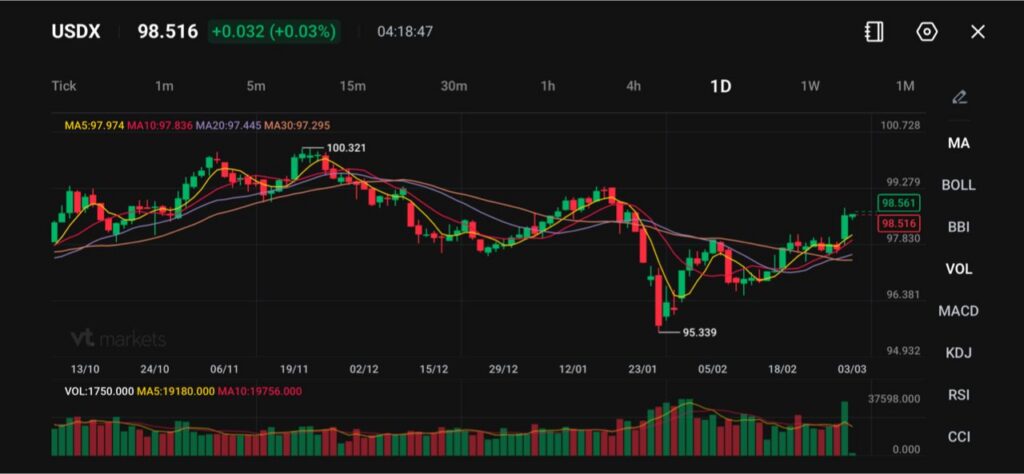
This alignment suggests improving short-term momentum, with the dollar attempting to build a higher base.
Immediate resistance lies near 98.80–99.30, where previous consolidation and rejection occurred. A sustained break above 99.30 would strengthen the recovery narrative and open the path toward the psychological 100.00–100.30 region.
On the downside, initial support is seen around 97.80, followed by stronger support near 97.30–97.50. A move back below 97.30 would weaken the rebound structure and could shift momentum back to the downside.
Learn more about trading Indices on VT Markets today.
Frequently Asked Questions
- Why is the US dollar rising?
The dollar is strengthening due to safe-haven demand amid escalating Middle East tensions and expectations that higher energy prices could delay Federal Reserve rate cuts. - How do rising oil prices support the dollar?
Higher oil prices can reinforce inflation pressures in the US, potentially reducing the urgency for the Fed to cut interest rates. Fewer expected rate cuts generally support the dollar through yield differentials. - Why are the euro and yen under pressure?
Europe and Japan are major energy importers. Rising oil prices increase their import costs and can weaken growth prospects, placing downward pressure on their currencies relative to the dollar. - Have Fed rate-cut expectations changed?
Yes. Markets have shifted expectations for the next Fed rate cut to September from July, although two rate reductions are still broadly priced in for the year. - What would weaken the dollar from here?
A rapid de-escalation in geopolitical tensions, a decline in energy prices or significantly weaker US economic data could reduce safe-haven flows and revive earlier rate-cut expectations.
Start trading now – Click here to create your real VT Markets account







