







Key Points
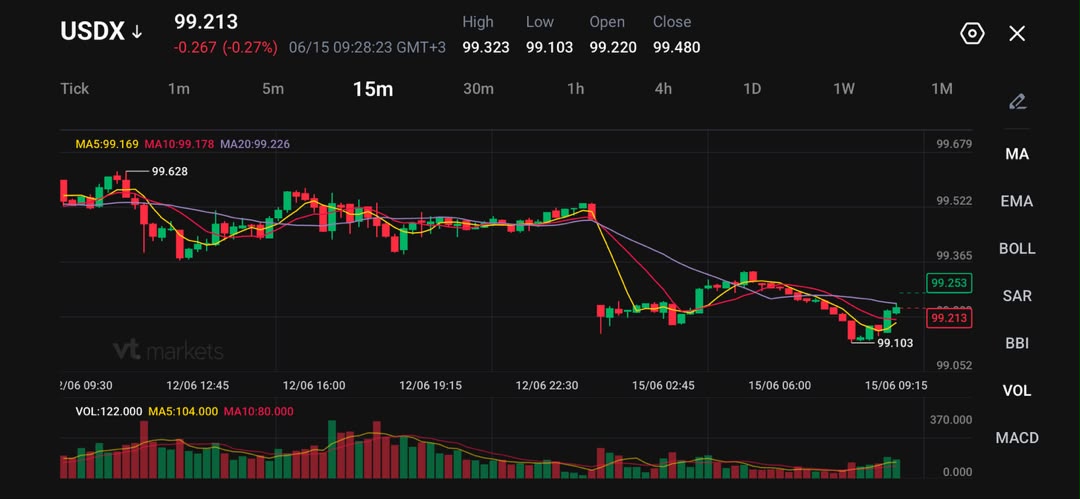
- USDX traded near 99.21, down 0.27%, after touching a low of 99.10.
- A preliminary US-Iran peace deal sent oil prices lower and reduced safe-haven demand for the dollar.
- Traders are watching 99.32 resistance and 99.10 support ahead of key central bank decisions.
USDX weakened on Monday as the dollar slipped to a 10-day low against major peers.
The move came after US and Iranian officials agreed on a framework to end the war, halt the US blockade of Iran, and reopen the Strait of Hormuz. The deal is expected to be signed on Friday in Switzerland, though traders remain cautious as details are still limited and Iran’s nuclear programme remains unresolved.
Oil prices dropped sharply on the news, with Brent crude falling more than 4% to $83.82. Lower oil prices reduced inflation fears and weakened demand for the safe-haven dollar.
Risk-sensitive currencies gained ground. AUDUSD rose nearly 0.7% to 0.7087, while NZDUSD climbed 0.6% to 0.5863. EURUSD also rose as much as 0.5% to 1.1622, while GBPUSD advanced 0.4% to 1.3459.
Why Traders Are Watching This
Traders are watching USDX because the dollar is losing support from two major themes: geopolitical risk and inflation pressure.
The possible reopening of the Strait of Hormuz has eased fears of prolonged energy supply disruption. If oil flows normalise, inflation risks may cool further. That could reduce pressure on central banks to keep tightening policy.
Markets have already trimmed Fed rate-hike expectations. Traders now price around a 50% chance of a December rate hike, down from more than 70% a week earlier.
This week’s central bank calendar also adds risk. The Federal Reserve is expected to hold rates at 3.5% to 3.75% on Wednesday, but traders will focus on the statement and press conference from new Fed Chair Kevin Warsh. The Reserve Bank of Australia is expected to hold at 4.35%, while the Bank of Japan is expected to raise rates to 1%.
That leaves USDX vulnerable to more movement if central banks sound less worried about inflation after the drop in oil.
Key Trading Levels
| Level | What Traders Are Watching |
| 99.63 | Previous upper swing and wider recovery level |
| 99.52 | Short-term recovery resistance |
| 99.32 | Intraday high and immediate resistance |
| 99.23 | 20-period moving average |
| 99.21 | Current trade zone |
| 99.18 | 10-period moving average |
| 99.17 | 5-period moving average |
| 99.1 | Intraday low and key support |
| 99.05 | Lower chart support |
USDX is trading near its short-term moving averages, with the 5-period MA at 99.169, the 10-period MA at 99.178, and the 20-period MA at 99.226.
The index has bounced slightly from 99.10, but it remains below the 20-period moving average. That keeps the short-term structure cautious.
A move above 99.23 would suggest the dollar is stabilising. A stronger recovery would need a break above 99.32. On the downside, a move below 99.10 would keep sellers in control and expose the lower 99.05 area.
Bullish and Bearish Setups
| Setup | Trigger | Potential Market Reaction |
| Bullish Recovery | Move above 99.23 | Buyers may target 99.32 |
| Breakout Setup | Move above 99.32 | Momentum may extend toward 99.52 |
| Pullback Setup | Hold above 99.10 | Traders may watch for short-term stabilisation |
| Bearish Break | Move below 99.10 | Sellers may target 99.05 |
The bullish setup depends on USDX reclaiming 99.23 and breaking above 99.32. That would show the dollar is recovering after the peace-deal-driven sell-off.
The pullback setup may become cleaner if price holds above 99.10 and starts to build a base. This would suggest sellers are pausing ahead of central bank decisions.
The bearish setup builds if USDX breaks below 99.10. A move under that level would show that risk-on flows and lower oil prices are still weighing on the dollar.
Disclaimer
The price levels and trade scenarios above reflect the author’s view at the time of writing and do not represent financial advice or an official recommendation from VT Markets. Traders should conduct their own analysis and manage risk carefully.
Trade USDX CFDs with VT Markets
USDX remains active when traders react to Fed expectations, geopolitical risk, oil prices, inflation data, and global currency flows.
With VT Markets, traders can access USDX CFDs alongside major forex pairs, gold, oil, indices, shares, ETFs, and other global CFD markets from one platform. This helps traders track the wider dollar story while comparing moves across EURUSD, USDJPY, AUDUSD, XAUUSD, and crude oil.
Use VT Markets’ charting tools to monitor support, resistance, moving averages, and breakout behaviour as the next USDX setup develops.
Start trading indices with VT Markets today.
Why Trade USDX as a CFD?
USDX CFDs allow traders to take a view on rising or falling US dollar index moves without owning the underlying currency basket.
That flexibility can be useful when the dollar reacts quickly to peace-deal headlines, oil price swings, Fed policy, and safe-haven flows. If USDX breaks above resistance, traders can watch bullish recovery setups. If risk appetite keeps improving, traders can monitor downside continuation.
With VT Markets, traders can follow USDX price action in real time and compare it with other major CFD markets from one account.
What To Watch Next
Traders should watch 99.32 resistance and 99.10 support.
A break above 99.32 could support a recovery toward 99.52. A move below 99.10 would weaken the setup and bring 99.05 into focus.
Beyond the chart, the next drivers are the official signing of the US-Iran agreement, oil price movement, the Fed decision, the Bank of Japan meeting, and the Reserve Bank of Australia rate decision.
FAQs
Why Is USDX Falling Today?
USDX is falling as US-Iran peace deal hopes reduce safe-haven demand for the dollar. Lower oil prices also eased inflation fears, which reduced expectations for aggressive Fed tightening.
What Is the Key Level to Watch for USDX?
The key upside level is 99.32. A break above this area could support a move toward 99.52. On the downside, 99.10 is the first major support level.
Can USDX Recover?
USDX could recover if buyers reclaim 99.23 and push price above 99.32. A stronger rebound may need cautious central bank signals or renewed doubt over the peace deal.
What Could Push USDX Lower?
USDX could move lower if the US-Iran deal progresses, oil prices keep falling, and markets reduce Fed rate-hike expectations further. A break below 99.10 would strengthen the bearish setup.
Can I Trade USDX With VT Markets?
Yes. VT Markets offers access to USDX CFDs, allowing traders to take a view on rising or falling US dollar index moves without owning the underlying currency basket. Traders can also access forex, gold, oil, indices, shares, ETFs, and other CFD markets from one platform.
Start trading now – Click here to create your real VT Markets account







