







Key Points
- USD/JPY traded at 156.748, down 0.304 points, or 0.19%, after falling as low as 155.703 on the chart.
- The yen climbed as much as 0.75% to 155.69, with much of the move coming in nine minutes around midday Singapore time.
- The US dollar index fell 0.1% to 98.041 as traders watched Japan, Hormuz, the RBA, and wider risk appetite.
The yen strengthened suddenly against the dollar on Monday as traders stayed alert for possible action from Japanese authorities. The move came after suspected intervention last week, when sources told Reuters that authorities bought yen for the first time in two years. The yen climbed as much as 0.75% to 155.69 during Monday’s move, with much of the appreciation coming in a sharp nine-minute stretch around midday Singapore time.
Markets did not receive official confirmation. Ministry of Finance officials did not immediately respond to requests for comment, while Tokyo officials declined to confirm whether they had intervened last week. Still, traders treated the price action as a warning shot.
Japan is closed for the Golden Week holiday, which can thin liquidity and magnify FX moves. Markets will focus on whether further intervention occurs, and more importantly, whether the US joins Japan’s efforts. She added that further yen weakness could raise the chance of bilateral intervention.
Intervention Can Slow The Move, But Rates Still Matter
Japan’s challenge is simple. Intervention can shock USD/JPY lower, but the wider trend still depends on rate spreads. The yen remains vulnerable when US yields stay high, and the Bank of Japan moves slowly. That is why analysts have questioned whether unilateral intervention, the third such effort in the past four years, can create lasting yen strength without support from rate policy or the US.
The dollar index eased 0.1% to 98.041, which helped the yen, but the move was not broad dollar capitulation. It looked more like targeted caution around USD/JPY after last week’s suspected yen-buying activity.
The cautious forecast is that USD/JPY may stay jumpy while it trades near the 155 to 160 zone. Japan can defend the currency through sudden action, but traders may test the upside again if US yields hold firm and if officials avoid direct confirmation.
Hormuz Headlines Keep Markets Defensive
Markets also opened the week with caution after President Donald Trump said the US would start an effort on Monday morning to free ships stranded in the Strait of Hormuz as a “humanitarian gesture” to help neutral countries in the US-Israeli war with Iran. Trump gave few details on the operation, including whether the US Navy would take part.
Hormuz risk continues to affect oil, inflation, trade flows, and safe-haven demand. If the operation helps shipping resume, oil-linked inflation pressure may cool and risk appetite may improve. If it triggers new friction with Iran, traders may move back into defensive positions.
For USD/JPY, the effect can cut both ways. Higher geopolitical stress can support the dollar, but it can also lift the yen when traders seek havens or expect Japanese authorities to lean harder against currency weakness.
Technical Analysis
USDJPY is trading near 156.75, pulling back sharply after a rejection from the 160.70 high, with price now slipping back into the prior range and testing lower support levels. The move lower appears aggressive, suggesting a shift in short-term sentiment after the pair failed to sustain gains above the key 160 zone.
From a technical standpoint, momentum has turned bearish in the near term. Price has broken below the 5-day (158.07) and 10-day (158.77) moving averages, both now rolling over and acting as immediate resistance. The 20-day (158.89) sits just above, reinforcing overhead pressure and indicating that the recent uptrend has lost traction.
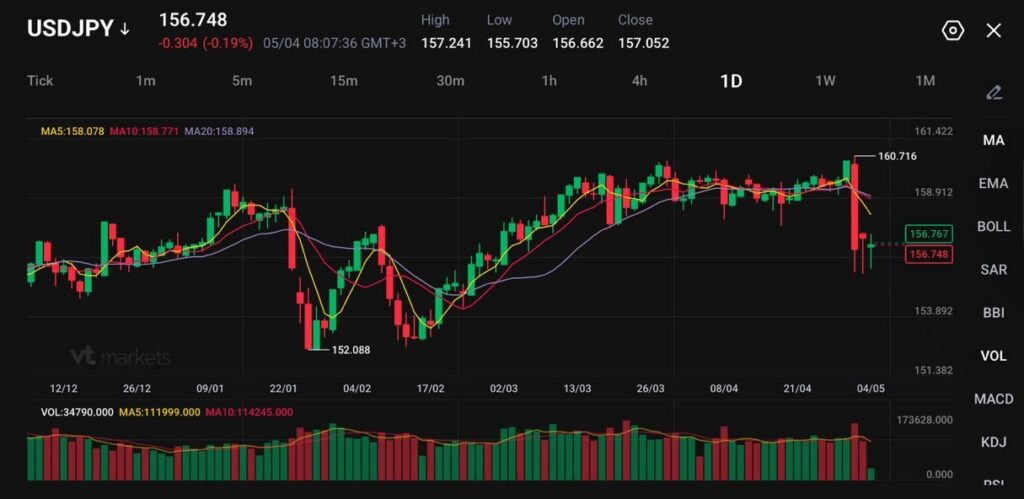
Key levels to watch:
- Support: 156.70 → 153.90 → 152.10
- Resistance: 158.10 → 158.80 → 160.70
Price is now hovering around 156.70 support, a level that is being tested following the sharp sell-off. A break below this zone could extend losses toward 153.90, with deeper downside risk toward 152.10 if selling momentum continues to build.
On the upside, 158.10 is now the first resistance level, aligning with short-term moving averages. A move back above this area would be needed to stabilise price action, though stronger confirmation would likely require a reclaim of 158.80–159.00.
Overall, USDJPY has shifted into a corrective phase after failing at highs, with downside pressure building in the short term. Price action around the 156.70 support zone will be key in determining whether this remains a pullback or develops into a deeper reversal.
Cautious Forecast
USD/JPY may stay under pressure while it holds below 158.078, 158.771, and 158.894. A break below 155.703 would strengthen the downside case and could pull the pair toward 153.892.
A recovery above 158.894 would show that intervention fears are fading and that rate differentials are taking control again. For now, traders may treat rallies toward 158 to 159 as vulnerable while Japan remains on intervention watch and liquidity stays thin during Golden Week.
Learn more about trading Forex Pairs on VT Markets here.
Trader Questions
Why Did The Yen Strengthen Against The Dollar?
The yen strengthened after traders grew alert to possible action from Japanese authorities.
USD/JPY fell as low as 155.703 on the chart, while the yen climbed as much as 0.75% to 155.69 in wider market trading. Much of the move came during a sharp nine-minute stretch around midday Singapore time.
Did Japan Intervene To Support The Yen?
Japan has not confirmed fresh intervention.
However, markets suspect authorities may have acted again after sources said Japan bought yen last week for the first time in two years. Traders are watching closely because Tokyo officials have warned against excessive yen weakness.
Why Is Intervention Risk High For USD/JPY?
Intervention risk is high because USD/JPY recently traded near the 160.716 area, where yen weakness can draw pressure from Japanese policymakers.
Officials may want to show that they will not tolerate a disorderly move lower in the yen, especially during thin Golden Week holiday trading.
Can Intervention Strengthen The Yen For Long?
Intervention can trigger sharp yen rebounds, but its longer-term impact depends on interest-rate spreads.
If US yields stay high and the Bank of Japan remains cautious, traders may still buy USD/JPY on dips. A stronger and longer-lasting yen rally may need support from US cooperation or a shift in rate expectations.
Why Does Golden Week Matter For Yen Trading?
Golden Week matters because Japanese markets are partly closed, which can reduce liquidity.
When liquidity is thin, smaller flows can create sharper moves. That makes USD/JPY more exposed to sudden price swings, especially when intervention risk is already high.
Start trading now – Click here to create your real VT Markets account







