Back

According to ING’s Chris Turner, the Japanese yen benefits from a shift towards defensive currency strategies.

The Japanese yen is benefitting from a shift towards conservative foreign exchange positioning. This trend is supported by the potential for global interest rates to align more closely with Japan’s low rates due to concerns about a global trade war.

A move below the 148.50/65 mark for USD/JPY may prompt a sell-off in equities or a significant miss in US job reports. Such conditions could lead to increased attention towards a lower Federal Reserve policy rate. The EUR/JPY, AUD/JPY, and CAD/JPY pairs are projected to decline as market activity is reassessed.

Reassessment Of Risk Management

The current strength of Japan’s currency reflects not only hesitancy in broader markets but also a reassessment of how risk should be managed. Investors are positioning themselves with more caution, given the uncertainty surrounding global trade relationships and potential shifts in monetary policy across key economies. If financial conditions tighten or expectations for interest rates in major economies decline, this cautious stance may continue to shape trading decisions.

A breach of the 148.50/65 level in USD/JPY could suggest either an external shock in equity markets or weaker-than-expected employment figures in the United States. Either scenario would support lower expectations for the Federal Reserve’s policy rate. These developments could push traders to unwind positions in carry trades, which may result in declines against Japan’s currency across several crosses. This is especially relevant for the euro, Australian dollar, and Canadian dollar, as these pairs exhibit sensitivity to risk sentiment adjustments.

Recent patterns in these crosses indicate that traders are already considering the possibility of less accommodating central bank policies outside Japan. With uncertainty remaining around economic performance in key regions, the reassessment of risk exposure is likely to drive further downward pressure. Should data releases over the coming weeks confirm weaker growth or softer inflation dynamics, repositioning may intensify.

Impact On Market Participants

We have seen that market participants are willing to react swiftly to changing policy expectations. The implications for derivatives traders lie in their ability to interpret rate differentials effectively and balance their exposure appropriately. If volatility persists, the pricing of options and futures may reflect higher demand for protection against adverse moves. Given this backdrop, staying alert to upcoming economic releases will be essential, particularly those that could alter expectations for policy direction in the United States and Europe.

Movements in other asset classes will also provide useful context. If equity markets begin to price in lower growth expectations, this could reinforce cautious positioning in foreign exchange. Additionally, energy prices and commodity demand trends play a role in how certain currencies react, particularly those tied to resource exports. Those monitoring short-term interest rate differentials should be mindful of how swiftly sentiment can shift in response to new data.


Create your live VT Markets account and start trading now.

Canada plans to implement 25% tariffs on $30 billion of US imports if US tariffs proceed.

Canada plans to impose 25% retaliatory tariffs on U.S. imports starting Tuesday if U.S. tariffs proceed. This will affect U.S. goods valued at approximately C$30 billion.

The new tariffs will be enacted if U.S. tariffs on Canada and Mexico take effect at 12.01 am on Tuesday, March 4, 2025, US Eastern time. Canada is also discussing various non-tariff measures with provinces and territories should the U.S. tariffs continue.

Canada’s Retaliatory Measures

This means that if the United States follows through with its planned tariffs on Canadian and Mexican goods, Canada will respond with its own measures within hours. Roughly C$30 billion worth of American products would be subject to new import duties, raising costs for businesses and consumers alike. The timing is firm. If U.S. officials do not reverse course before the deadline, Canadian levies will begin without delay.

The Canadian government is not limiting its response to higher import taxes. Officials are working with provincial and territorial leaders to assess further measures beyond standard trade restrictions. This suggests that policymakers are preparing broad strategies to shift trade patterns or apply pressure in other economic areas. There will be few surprises if additional steps follow after the initial tariff response.

For traders, the direct consequences are not vague. Clear deadlines mean that price adjustments may emerge swiftly, affecting contracts tied to Canadian and American markets. Exchange rate movements could also reflect shifting trade expectations. Volatility may rise in both commodity and equity derivatives, particularly in sectors that rely on cross-border trade flows.

Economic And Market Impact

Retaliation of this scale is not a routine event. When two of the world’s largest economies enter a tariff dispute, the effects spread across markets. If discussions between officials do not lead to adjustments before tariffs take effect, supply chains will begin absorbing new costs. Prices in certain industries may adjust sooner than others, depending on how companies react.

Those monitoring futures and options should account for these changes. Some industries will see immediate pricing shifts, while others might take longer to reflect new costs. Currency markets are also in play, especially if confidence in broader trade stability begins to shift.

Create your live VT Markets account and start trading now.

VT Markets supports traders with strategies for volatile markets at Money Expo Mexico 2025

Mexico City, Mexico, February 2025 – Markets today are volatile in a more complex and protectionist trading environment, which alters the mood of investors. In this context, effective strategies and advanced decision-making tools are essential to operate successfully and adapt to the new market dynamics.

In its participation in Money Expo Mexico 2025, VT Markets reaffirmed its commitment to traders, sharing practical approaches to optimise their performance in these markets. The multi-award winning broker consolidated its commitment to education and technology as fundamental pillars to help both experienced traders and those new to trading.

Following this vision, VT Markets was present at Money Expo Mexico 2025, the most important financial event in Latin America, which brought together more than 5,000 attendees, 150 financial brokers and 50 exhibitors on 26 and 27 February at the Centro Citibanamex. Strategies for more accurate trading As a multi-asset broker, VT Markets provided a space where attendees could interact with its team and learn about strategies designed to improve their trading in a competitive environment. One of the highlights of the event was the conference given by Eduardo Ramos, senior analyst at VT Markets, who shared strategies for trading the financial markets with a focus on gold trading (XAUUSD). During his presentation, Ramos addressed:

– Fundamental principles of risk management in gold trading.

– How to effectively capitalise on gold price movements.

– Tools and strategies to improve accuracy in decision making.

“The key to success in financial markets is not predicting the future, but knowing how to react with precision and control when volatility strikes. Smart investing is not a matter of luck, but of preparation, discipline and the ability to remain calm under pressure. That is the difference between those who survive and those who thrive”, Ramos stressed during his participation.

Enriching experiences for traders

Attendees had the opportunity to explore advanced trading tools, receive personalised advice and learn about financial solutions designed for both novice and experienced traders. In addition, VT Markets organised exclusive prize draws, adding to the attractiveness of the experience.

On Day 2 of the Money Expo Mexico, VT Markets was proudly recognized as the “Top Broker for Partnership Programme”. This accolade marks a successful conclusion to the company’s participation, reinforcing its leadership and strong foothold in the LATAM trading and brokerage sector.

Money Expo: A benchmark for the financial sector

Beyond being an exhibition space, Money Expo Mexico 2025 established itself as a key event for the exchange of knowledge and strategies in the financial industry. Companies such as VT Markets stood out for their focus on innovation and commitment to the region’s community of traders and investors. With its participation in the event, VT Markets reinforces its mission to support traders with cutting-edge resources, consolidating itself as a strategic ally for those seeking to remain competitive in the constantly evolving financial markets.

For event photos, please visit: https://bit.ly/VTMEM

About VT Markets

VT Markets is a regulated multi-asset broker with a presence in over 160 countries as of today. It has earned numerous international accolades including Best Online Trading and Fastest Growing Broker. In line with its mission to make trading accessible to all, VT Markets offers comprehensive access to over 1,000 financial instruments and clients benefit from a seamless trading experience via its award-winning mobile application. 

For more information, please visit the official VT Markets website or email us at [email protected]. Alternatively, follow VT Markets on Facebook, Instagram, or LinkedIn

For media enquiries and sponsorship opportunities, please email [email protected], or contact: 

Dandelyn Koh 

Global Brand & PR Lead 

[email protected]  


Brenda Wong 

Assistant Manager, Global PR & Communications 

[email protected] 

The UOB Group suggests that GBP may approach resistance at 1.2730 against the USD.

Pound Sterling (GBP) may test resistance at 1.2730 against the US Dollar (USD), with analysts suggesting a break above this level is possible, although 1.2770 is considered less likely to be reached soon. The long-term outlook shows potential for upward movement, contingent on GBP maintaining above 1.2730.

In the immediate term, GBP’s rise has outpaced expectations, with current support identified at 1.2645. If this level holds, GBP may approach the key resistance at 1.2730, which could encourage further upward momentum, provided the support at 1.2610 remains intact.

Sterling Price Movement

Sterling’s recent movement illustrates a pace that has caught many by surprise. If support at 1.2645 proves firm, we could see renewed attempts to breach 1.2730. Should this barrier give way, further gains could follow. However, expectations for an immediate push towards 1.2770 appear more restrained, with prevailing market conditions dampening the likelihood of such an advance.

The longer-term view suggests an inclination towards strength, albeit conditional upon maintaining a position above 1.2730 convincingly. Dips below 1.2610 would weaken this stance and might lead to reassessments of potential upward momentum.

For those managing derivatives, the relationship between short-term support and resistance levels remains pivotal in determining near-term strategies. A failure to hold 1.2645 may introduce added pressure, fostering caution among those with exposure to Sterling. Traders should be aware that movement through 1.2730 could prompt fresh positioning, reinforcing upward traction, but without a solid hold, confidence in sustained elevation may wane.

Market Reaction And Strategy

Given Sterling’s current pace, short-term fluctuations demand close monitoring. The market is reacting faster than many anticipated, which leaves room for reassessments at every step. As always, calculated entries and exits remain vital.

Create your live VT Markets account and start trading now.

Deutsche Bank predicts the ECB will reduce rates by 25 basis points amid economic adjustments.

Deutsche Bank projects that the European Central Bank (ECB) will reduce its policy rate by 25 basis points to 2.50% on March 6, marking a total reduction of 150 basis points. This decision comes as the ECB modifies its monetary policy in response to changing economic conditions, such as trade tensions and rising defence spending.

Markets are attentive to indications from the Governing Council regarding the status of monetary policy, particularly whether it remains “restrictive” or if further easing is possible. Moreover, there is speculation about a potential pause in rate cuts in April, with hints of a temporary “skip” before resuming adjustments later in the year.

Impact Of Interest Rate Shifts

A shift in interest rates influences borrowing costs, investment strategies, and overall liquidity. A reduction of 150 basis points—if projections hold—suggests a measured approach to sustaining economic momentum while addressing external pressures. Trade policy uncertainties and heightened military expenditure create an environment where policymakers must balance inflation control with economic support.

We observe that market participants are eager for clarity from Lagarde and her colleagues on their definition of “restrictive” policy. If rate levels are no longer seen as tight, expectations could shift towards a more accommodative stance sooner than previously thought. This creates opportunities for those anticipating changes in borrowing costs, particularly when considering how forward guidance shapes sentiment.

One aspect being debated is whether April will bring another rate cut or a brief pause. A temporary halt in adjustments could serve as a recalibration moment, giving policymakers additional time to assess inflation data and broader financial conditions. The possibility of skipping that month before easing measures resume later in the year keeps expectations fluid. If a pause indeed occurs, pricing models will adjust accordingly, affecting short-term positioning.

Market Reactions And Expectations

How Lagarde frames these decisions in the upcoming weeks matters. If policymakers signal confidence in inflation stabilisation, markets are likely to respond with greater certainty. However, any suggestion of hesitation may encourage speculation over future policy swings. Forward-looking statements from central bank officials will shape expectations not just for this quarter, but for the rest of the year.

Create your live VT Markets account and start trading now.

During Trump’s presidency, tariffs contributed to dollar strength while equity corrections had less impact.

During President Trump’s first term, the sequence of tax cuts followed by tariffs was linked to a strengthening dollar. Currently, protectionism appears to be occurring without the same level of fiscal support.

The dollar’s near-term performance may depend on US equity markets, as trade wars typically have negative impacts on equities. A decline in US stocks could lead to the outperformance of the Japanese yen and Swiss franc, potentially pulling USD/JPY and USD/CHF down.

Impact Of Tariffs On Fiscal Plans

Tariffs implement revenue for fiscal plans, suggesting they could become broader over time. President Trump’s agenda aims to revive high-paying manufacturing jobs in the US, complicating the outlook for currencies related to commodity exports.

Anticipations indicate that the dollar may strengthen in the first half of the year, although challenges will arise from European currency fluctuations affected by tariff developments and defence spending strategies. The DXY may find support at 106.15/35 unless US equities decline significantly.

The pattern witnessed during Trump’s first term, where tax reductions gave the dollar a foundation before trade tensions took hold, is not playing out in the same way now. This time, restrictive trade measures are unfolding without commensurate fiscal easing. That distinction matters. It means the dollar does not have the same fiscal tailwind, making its trajectory less straightforward.

For now, what happens in US stock markets could be closely tied to short-term shifts in foreign exchange. Past trade frictions have generally weighed on equities, and if that happens again, we could see a stronger yen and Swiss franc. That, in turn, might mean downward pressure on USD/JPY and USD/CHF. If equities remain resilient, though, those moves may not materialise in the same way.

Potential Strength Of The Dollar

Something else to consider is the role of tariffs in shaping future fiscal policies. Levying import taxes brings in revenue, and if this administration continues down this path, the coverage could expand rather than stay limited to isolated sectors. The stated goal of reshoring well-paid manufacturing positions complicates things for currencies linked to raw material exports. That could translate into periods of weakness for those assets.

Looking ahead, there is some expectation that the dollar may remain strong through the early part of the year. However, the strength of European currencies will depend on responses to trade policies and defence commitments. Technical levels suggest the DXY could hold around 106.15/35 unless a deeper equity downturn prompts a broader retreat. If stocks start to slide in a pronounced way, we might need to reassess those levels.

Create your live VT Markets account and start trading now.

CopyTrading (Vtrade) Adjustment – Mar 04 ,2025

Dear Client,

As part of our commitment to providing the most reliable service to our clients, VT Markets will have the following adjustment of CopyTrading (Vtrade) service on 8th March 2025:

1. “Management fee” will be removed from the Offer’s Performance setting.

The adjustments are intended to enhance our server quality and provide you with an improved trading environment. Thank you for your understanding about this important initiative.

If you’d like more information, please don’t hesitate to contact [email protected].

J.P. Morgan predicts gold could reach $3,000 by late 2025 amid ongoing economic uncertainties.

J.P. Morgan predicts that gold prices may reach nearly $3,000 per ounce by the end of 2025, reflecting a long-term positive perspective on the metal.

This forecast is based on ongoing demand for gold as a safeguard against inflation and geopolitical instability, alongside potential changes in global monetary policy.

Central Bank Influence On Gold

With central banks boosting their gold reserves and market conditions supporting high demand, J.P. Morgan foresees a continued upward trend in gold prices.

This projection highlights the expectation that gold will remain in demand as investors look for stability amidst economic uncertainties. Inflationary pressures, alongside shifts in global monetary strategies, serve as key reasons behind such an outlook. When central banks accumulate gold reserves at an increasing pace, it signals confidence in the metal’s long-term role as a store of value.

We have already seen a broader movement towards gold acquisition, particularly from institutions aiming to balance their reserves amid concerns over currency fluctuations. That pattern has not only persisted but appears reinforced by ongoing economic tensions in numerous regions. With policymakers adapting to structural changes in financial markets, the likelihood of further adjustments to interest rates directly impacts market sentiment surrounding metals.

This directly affects futures markets, where positions taken on gold anticipate both policy decisions and macroeconomic shifts. Higher expected prices offer traders opportunities, but they also suggest a need for careful positioning. Those tracking gold-related instruments should factor in the controlled expansion of central bank reserves and how currency stability may shift in response.

Geopolitical Factors And Market Sentiment

Meanwhile, geopolitical events continue to support wider interest in assets less vulnerable to external shocks. Periods of uncertainty tend to amplify investor preference for options that hold value independently of national policies. With this in mind, market participants must observe not only price movements but also institutional strategies shaping global reserve allocations.

We remain focused on how these trends interact with liquidity conditions, especially as financial institutions assess their exposure. The current outlook suggests growing market confidence in gold’s role, making it essential to monitor developments in fiscal planning that could either reinforce or challenge this trajectory.

Create your live VT Markets account and start trading now.

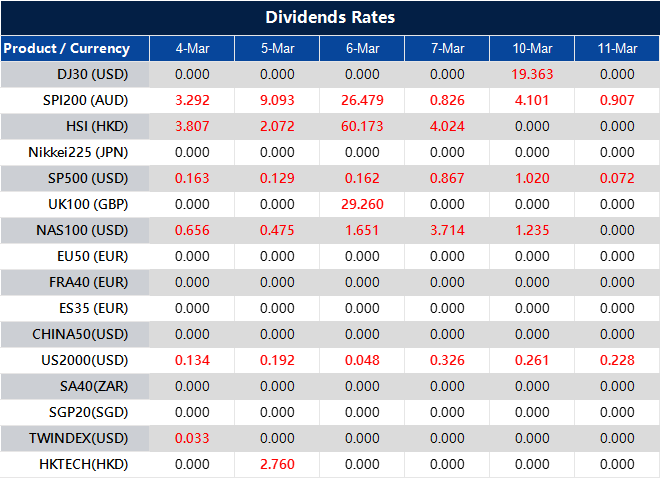
Dividend Adjustment Notice – Mar 04 ,2025

Dear Client,

Please note that the dividends of the following products will be adjusted accordingly. Index dividends will be executed separately through a balance statement directly to your trading account, and the comment will be in the following format “Div & Product Name & Net Volume ”.

Please refer to the table below for more details:

The above data is for reference only, please refer to the MT4/MT5 software for specific data.

If you’d like more information, please don’t hesitate to contact [email protected].

During the Asian session, the USD/CAD pair stabilises around 1.4500, nearing a one-month high.

The US Dollar has gained momentum due to fears that tariffs could increase inflation and push the Federal Reserve to maintain higher interest rates. Technical indicators suggest the pair is poised for further gains, with potential resistance around 1.4545 and 1.4600.

Key Support And Resistance Levels

Conversely, if it falls below the 1.4470 area, the pair may attract buyers near 1.4400, while further selling pressure could lead to a drop towards 1.4300. The Canadian Dollar is influenced by interest rates, oil prices, and economic data, which all impact its valuation.

The stability of USD/CAD near 1.4500 shows that broader market forces are at play, particularly the downward movement in oil prices. With oil being such an important export for Canada, declines in its value tend to weaken the country’s currency. The added concerns over trade relations with the United States only add to the pressure. Meanwhile, the US Dollar has gathered strength, largely because of worries that potential tariff adjustments could drive inflation higher. If that scenario develops, the Federal Reserve may have little choice but to hold rates steady at restrictive levels for longer than markets initially expected.

From a technical standpoint, the pair remains positioned for possible upside movement. Resistance levels at 1.4545 and 1.4600 appear to be the next points of focus if upward momentum continues. However, if buyers fail to push beyond current levels, setbacks could emerge. A dip below 1.4470 might bring in renewed interest around 1.4400, while a more sustained decline could bring 1.4300 into play. Given how dependent the Canadian currency is on multiple factors—particularly interest rate differentials, commodity prices, and macroeconomic releases—any shifts in these areas may provide new trading opportunities.

Market Factors To Watch

For those engaged in derivatives trading, the current climate calls for close attention to central bank communication, as small shifts in language from policymakers could provide clarity on monetary policy intentions. Additionally, developments in the oil market must be monitored carefully, as further declines could intensify pressure on the Canadian Dollar. Volatility could arise should new trade measures come into force, especially if they alter inflation expectations and influence interest rate bets. With multiple forces in motion, short-term positioning may benefit from flexibility, as sudden changes in sentiment may shape price movements in the coming weeks.

Create your live VT Markets account and start trading now.

Back To Top
server

Hai 👋

Bagaimana saya boleh membantu?

Segera berbual dengan pasukan kami

Chat Langsung

Mulakan perbualan secara langsung melalui...

  • Telegram
    hold Ditangguh
  • Akan datang...

Hai 👋

Bagaimana saya boleh membantu?

telegram

Imbas kod QR dengan telefon pintar anda untuk mula berbual dengan kami, atau klik di sini.

Tidak ada aplikasi Telegram atau versi Desktop terpasang? Gunakan Web Telegram sebaliknya.

QR code