The AUD/JPY pair has experienced a sharp decline, falling to around 94.80 and breaking below the 20-day Simple Moving Average (SMA). This represents its lowest point in over two weeks, indicating that sellers are currently in control.
The Relative Strength Index (RSI) is deeply in negative territory, showing that bearish momentum is increasing. Additionally, the Moving Average Convergence Divergence (MACD) histogram is rising with red bars, further signalling downside pressure.
For a shift in market sentiment, the pair needs to recover above the 20-day SMA. The next support level is anticipated around 94.50, while resistance may occur near the 20-day SMA at approximately 96.00.
What we are seeing here is a clear indication that sellers have taken control, pushing prices lower and breaking through a technical level that had previously acted as a foundation. The move below the 20-day Simple Moving Average suggests that downside momentum is picking up pace, and unless buyers step in with conviction, further losses cannot be ruled out. With the current price near 94.80, traders should prepare for possible movement toward the next reference point around 94.50.
Momentum indicators reflect what is happening beneath the surface. The Relative Strength Index has dropped firmly into bearish territory, meaning that downward forces remain strong. The Moving Average Convergence Divergence histogram is also displaying red bars that continue to grow, reinforcing the idea that selling pressure has not eased. These technical signals suggest that those expecting a recovery may need to be patient, as the current conditions are not in their favour.
For sentiment to shift, there must be a recovery above the 20-day SMA. That line, now acting as a barrier near 96.00, is likely to be a point where sellers re-emerge if the price attempts to climb. Until that threshold is cleared, rallies could be short-lived, and traders may need to adjust their expectations accordingly.
If movement toward 94.50 continues, attention should turn to whether buyers emerge at that level or whether weakness persists. If the decline extends below that point, it could open the door to further losses. On the other hand, if support holds firm, a period of price consolidation may follow.
Although short-term traders will need to navigate the ongoing decline, any attempt at recovery must be viewed alongside overall momentum. As long as downward forces dominate, sellers will stay in control, and breakouts toward higher levels could struggle to gain lasting traction.
Written on February 22, 2025 at 7:36 am, by anakin
Germany will hold elections on Sunday, February 23, with the first exit polls released at 6 pm CET. Initial results will be available 30 minutes later, followed by ongoing updates.
The conservative CDU/CSU leads in the polls with 31%, while the far-right AfD has 21%, the Social Democrats hold 15%, and the Greens have 13%. A coalition is necessary, which may take weeks to finalise due to the stable polling landscape.
A potential two-party coalition could involve the CDU/CSU with either the SPD or Greens. If confirmed, Friedrich Merz of CDU/CSU will take over as Chancellor from Olaf Scholz.
Attention will be focused on the AfD’s performance against their 21% poll prediction. Although they lack a coalition option, a strong result could encourage other parties to collaborate on economic stimulus measures and reform.
Increased defence spending is anticipated as a major priority for the new government. While fiscal changes could positively impact the economy, growth expectations remain low for the year.
Euro trading on Monday is expected to be stable, with potential relief trades following the election.
Volatility may initially be subdued in currency markets as the vote unfolds, but that does not mean traders should overlook potential shifts in sentiment once coalition discussions begin. If the CDU/CSU secures a strong mandate, we could see initial optimism in bond and equity markets, particularly if coalition negotiations with the SPD or Greens appear orderly. However, uncertainty will remain a feature over the coming weeks as policymakers work to finalise a governing agreement.
Friedrich’s prospects of replacing Olaf hinge on expected deal-making, which could take considerable time given the polling margins. Markets will be watching for any indications of policy direction, particularly regarding fiscal discipline or tax policies that could impact investor sentiment. While any strategy changes will take months to implement, early signals from party leaders could shape near-term positioning.
Traders will also be monitoring how the AfD’s final result compares to polling projections. If support exceeds expectations, it may increase speculation about broader shifts in voter sentiment, which could push policymakers to adjust their stance on economic relief measures. The extent to which other parties react could influence corporate confidence and broader fiscal planning.
Defence investment, already a topic of heightened discussion, is set to be a key theme in post-election negotiations. Any clarity on spending plans may have implications for industries tied to security and infrastructure, potentially affecting equity sectors linked to government procurement. The challenge for policymakers will be balancing these priorities with efforts to maintain budgetary discipline.
Although euro movements are likely to be measured at first, a smooth political transition could offer reassurance to investors. Early signs of stability in coalition negotiations may increase appetite for riskier assets, though any setbacks in forming a government could dampen sentiment. The extent of relief trades, if any, will depend on whether major policy concerns are addressed swiftly.
Economic expectations remain cautious for the year, meaning any overly positive market reaction could be short-lived unless reforms gain traction. In the days following the election, clarity from party leaders on fiscal plans and investment priorities will shape how traders navigate the shifting conditions.
Written on February 22, 2025 at 7:32 am, by anakin
Consumer sentiment in the US for February stands at 64.7, lower than the expected 67.8, with long-term inflation expectations reaching a 30-year high. Canada’s retail sales rose by 2.5% in December, surpassing the 1.6% forecast, while US existing home sales for January were reported at 4.08 million, slightly below the 4.12 million estimate.
The S&P 500 dropped 1.7% and the Russell 2000 fell by 2.9%. WTI crude oil decreased by $2.26 to $70.22, and the US 10-year yields fell 7 bps to 4.35%.
Market concerns centre on inflation, US tax cuts, and tariffs, alongside reports of a covid-like illness in China. The FX market showed a flight to safety, benefitting the yen and challenging commodity currencies, with EUR/JPY and CAD/JPY at recent lows.
February’s consumer sentiment figure for the US came in well below what many had anticipated. A reading of 64.7 versus an expected 67.8 suggests that confidence in the economy is slipping, which can have a direct effect on spending patterns. A weaker consumer outlook often translates to caution in household budgets, potentially slowing overall economic activity. At the same time, long-term inflation expectations have climbed to levels last seen three decades ago. If households and businesses believe inflation will persist at these levels, it could influence wage negotiations, borrowing behaviour, and ultimately, price-setting by companies.
Meanwhile, Canada’s retail sector provided a contrast, delivering a 2.5% rise in December, well above the forecast of 1.6%. This points towards much stronger spending than expected, which could imply resilience in household demand. However, whether this robustness carries forward into subsequent months remains a question, particularly with interest rates still at levels that restrain borrowing. Meanwhile, existing home sales in the US landed slightly shy of estimates, coming in at 4.08 million instead of the projected 4.12 million. This slight miss suggests the housing market remains under pressure, likely due to affordability constraints tied to mortgage rates.
Equities reacted broadly negatively. The S&P 500 lost 1.7%, while smaller-cap stocks, represented by the Russell 2000, fell by 2.9%. When smaller companies underperform larger names, it often signals decreased risk appetite among investors. The drop in WTI crude oil prices by $2.26 to $70.22 per barrel suggests a rethink regarding demand expectations. Further declines in energy prices could reflect concerns over economic momentum globally. Meanwhile, the 10-year US Treasury yield dipped by 7 basis points to 4.35%, pointing to increased demand for safer assets.
Among reasons for the current mood in markets are continued worries about inflation, discussions surrounding US tax policies and trade tariffs, and reports of a respiratory illness in China resembling previous outbreaks. Each of these elements carries the potential to sway risk sentiment, whether through shifts in monetary policy expectations, adjustments in global trade flows, or broader concerns over disruptions to business activity.
Currency markets reacted in a way often seen during periods of uncertainty. The yen benefitted from a shift in positioning towards safer assets, while currencies linked to commodities struggled. Both EUR/JPY and CAD/JPY retreated to levels last seen weeks ago. If cautious sentiment persists, traders may continue favouring currencies considered safer, at least in the near term.
Written on February 22, 2025 at 7:32 am, by anakin
Bybit crypto exchange reported a breach where a wallet was drained of $1.5 billion in Ethereum, potentially marking one of the largest thefts to date. Despite the loss, the exchange confirmed it remains solvent and clients’ assets are fully backed.
CEO Ben Zhou stated that the company would secure a bridge loan to mitigate the situation and dismissed concerns over a possible bank run. Reports suggest the attack may be linked to a North Korean group associated with the 2022 Axie Infinity Ronin Bridge hack, which involved $620 million.
The incident affected market sentiment, with Bitcoin and Ethereum dropping 3% and 4%, respectively. Comparatively, the loss rivals the 2002 Iraqi central bank robbery valued at $920 million, which would equal around $1.5 trillion today when adjusted for inflation.
A security breach of this scale naturally raises fears about the safety of funds held on exchanges. While Ben reassures everyone that all customer assets remain unaffected, traders will likely keep a close eye on any unusual withdrawal patterns in the coming weeks. The quick response with a bridge loan is intended to prevent liquidity concerns, but scepticism lingers whenever such large sums disappear.
With such an attack allegedly linked to an organisation previously tied to the Ronin Bridge hack, there is reason to believe methods used here may have evolved from past intrusions. If that suspicion is correct, firms relying on similar security models should be assessing their weaknesses immediately. We have seen time and time again that lapses in cybersecurity lead to vast sums of money being siphoned away before defences are adjusted. It is a pattern that cannot be ignored.
Market movements immediately reflected anxiety. A 3% loss in Bitcoin and a 4% dip in Ethereum is not catastrophic, but it does show that sentiment can shift quickly when a high-profile player takes a hit. Traders reacting to uncertainty often exaggerate short-term price swings, particularly when fear of further disruptions spreads. Some may take the view that such a drop presents a buying opportunity, whereas others may adopt a defensive stance, reducing leverage or limiting exposure until volatility diminishes.
Comparisons to the 2002 Iraqi central bank robbery put this event into a historical context that illustrates the scale of what has occurred. A financial loss that, if adjusted for inflation, would convert into around $1.5 trillion today serves as a stark reminder of how rare incidents of this magnitude truly are. Nonetheless, differences exist. This attack does not involve physical cash disappearing from a vault but rather a digital operation targeting vulnerabilities that may not have been fully appreciated until it was too late.
In the near term, market participants will also be watching how regulators react. Large-scale breaches tend to revive discussions about oversight, security requirements, and the potential risks of leaving vast sums on centralised platforms. Moves towards decentralised alternatives may accelerate as a result, but they bring their own risks, particularly for those unfamiliar with non-custodial solutions. Shift too quickly, and mistakes can be made. Stay too still, and the next attack could find weaknesses left unaddressed.
We do know that shocks like these test confidence in exchanges. Each similar breach in the past has led to increased scrutiny and calls for accountability. Whether that scrutiny results in meaningful changes or fades into the background over time depends on how well responses are executed. For now, the immediate focus rests on stabilising operations and reassuring traders that the worst has passed.
Written on February 22, 2025 at 7:32 am, by anakin
The major US indices have closed lower, with the NASDAQ down by 2.20% and the Russell 2000 index decreasing nearly 3%. The Dow industrial average fell by 748.63 points or 1.69% at 43,428.02, marking a weekly decline of 2.51%.
The S&P index dropped 104.39 points or 1.71%, ending its week at 6,013.13, its poorest week since January 6. The NASDAQ fell by 438.36 points or 2.20% to 19,524.01, also experiencing its worst performance since November 11.
The Russell 2000 decreased by 66.39 points or 2.94% to 2,195.34, with a weekly decline of 3.71%. Following a 20-day closing high, Meta shares fell for four consecutive days, down 7.21% for the week.
Large-cap stocks showed varied performance this week, with Nvidia down 3.21%, Microsoft down 0.34%, and Amazon declining by 5.29%. Alphabet fell 3.01%, while Apple rose by 0.38%. Other notable declines include Tesla at 5.07%, Palantir down 14.91%, and Broadcom down 6.17%.
The sharp declines across major US indices highlight a clear shift in sentiment. A 2.20% drop in the NASDAQ and a nearly 3% decline in small-cap stocks demonstrate that investors reassessed their positions, particularly in high-growth and risk-sensitive assets. The Dow’s 748-point slide underscores similar concerns, dragging it down by 2.51% over the week. The S&P 500 wasn’t spared either, suffering its worst weekly performance since early January.
Tech stocks, which had previously driven monumental gains, saw mounting pressure. Meta’s abrupt reversal after reaching a 20-day closing high suggests that enthusiasm around its recent momentum was replaced with a more cautious stance. A four-day losing streak wiped out its short-term strength, settling at a 7.21% weekly decline. Large-cap names followed suit. Nvidia’s 3.21% retreat comes after a strong rally, while Microsoft’s smaller dip of 0.34% suggests some resilience compared to the broader sell-off. Amazon dropping 5.29% alongside Alphabet’s 3.01% decline reinforces the idea that even well-established names weren’t spared from broader retracements.
Apple, on the other hand, managed to edge modestly higher, a rare sight amid a widespread pullback. Tesla’s ongoing struggles were evident in its 5.07% decline, adding to a series of concerns around demand and execution. Meanwhile, Palantir’s steep 14.91% loss paints a picture of extreme volatility, with broad scepticism around its ability to sustain previous gains. Broadcom also found itself under pressure, shedding 6.17%.
Looking ahead, short-term swings will likely remain pronounced, particularly as traders balance positioning against upcoming catalysts. The steep nature of the selloff suggests risk-taking has cooled, but that does not mean further downside is off the table. The way institutional investors adjust portfolios in response to this shift will provide clues. Some may see discounted valuations as opportunity, while others could opt for more caution, waiting for confirmation of stabilisation before re-entering.
For those assessing derivatives tied to these names, close attention to volume trends and open interest may help in gauging sentiment shifts. If downside positioning accelerates, expectations of further weakness could become self-reinforcing. Conversely, if hesitation to extend declines emerges, it may indicate markets are reaching a more stable footing.
Highly volatile names continue to be the most affected. With the Russell 2000 lagging, the appetite for higher-risk equities appears to be fading. A bounce-back is not guaranteed, especially if overall liquidity tightens or macroeconomic conditions shift in an unfavourable direction. If hedging activity increases, that could reinforce defensive behaviour, particularly within sectors that have seen recent selling pressure.
While broader sentiment may feel fragile, it is the reaction in the options market that could provide some of the clearest signals on what comes next. Relative strength in defensive positioning and shifts in implied volatility levels will assist in determining the degree of caution that institutions are exercising. Watching for sharp swings in weekly expiry contracts could provide early indications of any potential shift.
Written on February 22, 2025 at 7:30 am, by anakin
Trump has expressed a desire for the European Union to reduce tariffs, and there have been indications of improved relations. His comments suggest that the threats of tariffs may be part of a broader strategy for negotiations.
Additionally, Trump mentioned that Russia is keen to reach an agreement and urged cooperation between Putin and Zelensky. He is contemplating merging the US postal service with the Commerce Department and has indicated plans for reciprocal tariffs by the US. Furthermore, Trump stated that a minerals deal with Ukraine is nearing completion.
These remarks highlight a strategic approach rather than isolated policy decisions. By indicating that the European Union should reduce tariffs, Donald is not merely suggesting a preference but rather reinforcing a method he has applied in past negotiations. Threats of tariffs, in this context, seem to function as a bargaining chip, which means that actual policy adjustments may depend on how talks develop in the coming weeks. If discussions advance favourably, tension between both sides could ease.
On Russia, his statements imply that there is movement towards a potential agreement. The mention of Russian willingness signals that diplomatic efforts are underway, while the encouragement for cooperation between Vladimir and Volodymyr suggests active interest in resolving long-standing disputes. Whether this translates into immediate policy shifts remains to be seen, but it does indicate that discussions are not stagnant. Any developments in this area could affect views on stability in the region.
His consideration of merging the US postal service with the Commerce Department is a structural shift that could redefine how these institutions operate. Such a move would bring potential efficiency changes, but it also implies adjustments in regulatory oversight. The timing of this proposal raises questions about its broader implications, especially since it coincides with other economic discussions.
A plan for reciprocal tariffs also introduces another layer to upcoming trade policy. If this approach is implemented, it may lead to responses from other nations seeking to balance the effects. The extent to which these measures are enacted will depend on negotiations, but the direction is clearly being set.
His comment on a minerals deal with Ukraine nearing completion is particularly relevant. A completed deal would not only affect economic ties but could also shift geopolitical alignments. Resources remain a key factor in international agreements, so progress in this area may create reactions from those with vested interests.
Each of these elements presents a clear trajectory rather than isolated remarks. The manner in which they unfold will shape the decisions that follow. Remaining attentive to shifting tones in negotiations will be necessary, as these statements indicate that further developments are highly likely.
Written on February 22, 2025 at 7:29 am, by anakin
Perdagangan adalah lebih dari memahami carta, indikator teknikal, atau pun memiliki pengalaman. Jika ia semudah itu, setiap pedagang yang mempunyai pengetahuan pasaran pasti sudah berjaya. Tetapi hakikatnya? Kejayaan dalam perdagangan bukan hanya tentang apa yang anda tahu. Ia juga merangkumi cara anda berfikir, cara anda bertindak balas, dan cara anda menguruskan diri sendiri.
Pedagang terbaik bukan sahaja memahami pasaran. Mereka memahami diri mereka. Mereka telah menguasai seni kawalan emosi, disiplin, dan keupayaan menyesuaikan diri. Mereka tidak mudah goyah apabila mengalami kerugian, dan mereka tidak terlalu yakin selepas meraih kemenangan berturut-turut. Mereka telah belajar bahawa dalam perdagangan, seperti dalam kehidupan, konsistensi lebih penting daripada intensiti.
Jadi, apakah amalan-amalan pedagang yang berjaya? Dan lebih penting lagi – bagaimana anda boleh sampai ke tahap itu?
Fikir Dalam Kebarangkalian, Bukan Jaminan
Kesilapan terbesar ramai pedagang? Berfikir bahawa mereka perlu sentiasa betul.
Realitinya, pedagang terbaik pun sering mengalami kerugian. Tetapi, mereka menang dalam jangka masa panjang kerana mereka berfikir secara kebarangkalian, bukan secara mutlak. Mereka tidak terlalu taksub dengan satu peluang sempurna, sebaliknya fokus kepada melaksanakan strategi yang jelas secara konsisten. Mereka menerima hakikat bahawa tidak semua perdagangan akan berjaya, dan mereka tidak membiarkan satu kerugian mengganggu rentak mereka.
Perubahan minda ini mengubah segalanya. Ia bukan tentang menjadi betul setiap masa. Ia tentang berdisiplin.
Kuasai Kawalan Emosi
Pasaran mempunyai cara untuk ‘mendedahkan’ siapa kita. Jika anda impulsif, ia akan terlihat. Jika anda tidak sabar, ia akan terlihat. Jika anda membiarkan ketakutan atau ketamakan mengawal tindakan anda, ia pasti akan kelihatan.
Pedagang terbaik tidak bertindak secara emosi. Sebalinkya, mereka bertindak secara strategik.
Mereka telah melatih diri untuk tidak terlalu terikat pada hasil perdagangan. Mereka tidak terlalu gembira apabila menang, dan mereka tidak jatuh apabila kalah. Mereka faham bahawa emosi mengaburi pertimbangan, dan dalam permainan yang menuntut kejelasan sepenuhnya, disiplin emosi adalah senjata terkuat pedagang.
Bagaimana caranya membangunkan kemahiran ini?
– Jangan kejar kerugian. Jika perdagangan tidak menjadi, terima, belajar daripadanya, dan teruskan.
– Reka pelan perdagangan yang kukuh dan patuhinya. Jika anda mengikuti peraturan yang jelas, anda tidak perlu membuat keputusan secara tergesa-gesa.
– Ambil masa untuk berehat. Jauhkan diri dari skrin untuk kekal tenang.
Hormati Risiko Seperti Seorang Profesional
Apakah perbezaan antara pedagang baru dan profesional? Pedagang baru akan bertanya, “Berapa banyak keuntungan yang saya boleh dapat?” Pedagang profesional pula lebih mementingkan soalan “Berapa banyak saya sanggup rugi?”
Pedagang berjaya tahu bahawa pemeliharaan modal adalah keutamaan nombor satu. Mereka tidak menggunakan leverage secara berlebihan. Mereka tidak mengambil risiko melulu. Mereka fokus untuk kekal dalam permainan cukup lama supaya strategi mereka dapat membuahkan hasil.
Pengurusan risiko bukan sahaja mengenai melindungi wang anda. Ia juga penting untuk memelihara ketenangan fikiran. Tiada apa yang melemahkan keyakinan lebih cepat dari satu kerugian besar yang memadamkan keuntungan yang dikumpul selama berminggu-minggu.
Jika anda mahu berdagang seperti seorang profesional, mulakan dengan berfikir seperti seorang profesional: hormati risiko terlebih dahulu, dan keuntungan akan menyusul.
Belajar, Sesuaikan Diri Dan Kekalkan Sifat Ingin Mengambil Tahu
Pasaran adalah sesuatu yang hidup dan sentiasa berubah. Apa yang berkesan tahun lalu mungkin tidak relevan hari ini. Pedagang terbaik faham bahawa proses pembelajaran tidak pernah berhenti. Mereka sentiasa terbuka kepada idea baru, sentiasa memperbaiki pendekatan mereka, dan tidak pernah rasa mereka sudah menguasai segala-galanya.
Tetapi ini yang membezakan pedagang berjaya dengan pedagang biasa adalah mereka tidak melompat dari satu strategi ke strategi lain, mengejar perkara baru. Mereka ambil masa untuk menguji, menyesuaikan dan menguasai pendekatan mereka sebelum membuat perubahan.
Mahukan sifat-sifat ini?
– Kekal maklum, tetapi jangan terbeban dengan limpahan maklumat. Ikut sumber yang boleh dipercayai, dan jangan biarkan setiap tajuk berita pasaran menggugat keyakinan anda.
– Simpan jurnal perdagangan. Menyemak perdaganagn lampau membantu anda belajar apa yang berkesan dan apa yang tidak.
– Sertai komuniti yang memberikan anda motivasi. Perdagangan boleh jadi sunyi, tetapi komuniti yang kukuh boleh bantu anda kekal fokus.
Kekal Dalam Permainan Untuk Jangka Panjang
Ada sebab mengapa kebanyakan orang tidak bertahan dalam dunia perdagangan kerana mereka mahukan hasil segera. Mereka fikir kejayaan datang daripada satu perdagangan besar, satu strategi sempurna, atau satu pergerakan pasaran utama.
Tetapi pedagang terbaik berfikir dalam tempoh bertahun-tahun, bukan beberapa hari.
Mereka tahu bahawa kemenangan kecil yang konsisten lebih baik daripada pertaruhan besar yang berisiko tinggi. Mereka kekal sabar, mengawal emosi, dan fokus untuk menjadi lebih baik setiap hari, bukannya mengejar keuntungan pantas.
Kejayaan dalam perdagangan bukan tentang nasib. Ia tentang daya tahan. Jika anda boleh membina sifat yang mengekalkan anda dalam permainan, keuntungan akan menyertai anda.
Jadilah Pedagang Yang Anda Impikan
Persagangan bukan sekadar kemahiran teknikal. Ia tentang minda, kesabaran, dan disiplin. Ia tentang menguruskan emosi, menghormati risiko, dan kekal fleksibel dalam pasaran yang sentiasa berubah.
Jadi, tanya diri anda:
📉 Adakah anda mempunyai pelan, atau hanya berdagang secara impulsif?
📈 Adakah anda fokus untuk belajar, atau sekadar mengejar keuntungan?
💡 Adakah anda berfikir seperti seorang profesional, atau masih berdagang seperti seorang penjudi?
Kerana akhirnya, pasaran tidak memberi ganjaran kepada mereka yang mengambil risiko paling besar. Ia memberi ganjaran kepada mereka yang mampu kekal tenang dan terkawal.
Dan jika anda boleh kuasai perkara itu? Anda sudah jauh mendahului kebanyakan pedagang di luar sana.
Written on February 21, 2025 at 8:23 am, by anakin
There’s a moment in every trader’s journey when they realize that trying to master everything is the fastest way to master nothing. The world of trading is vast—forex, stocks, indices, commodities, scalping, swing trading, trend-following, news-based strategies. It’s easy to get lost in the noise, jumping from one approach to the next, hoping to strike gold.
But the most successful traders know that the real secret isn’t doing more—it’s doing the right things better.
Instead of chasing every opportunity, they narrow their focus, refine their strengths, and build a trading approach that suits them—not the other way around. They find their niche, develop a tailored strategy, and turn consistency into profitability.
So, how do you find your trading edge? How do you stop spinning your wheels and start gaining momentum? Let’s break it down.
Why Specializing is the Key to Trading Success
Ask any seasoned trader, and they’ll tell you the same thing: jack-of-all-trades, master of none.
Spreading yourself too thin—jumping between different asset classes, trading styles, or strategies—leads to inconsistency. Instead of learning how a market moves, you’re constantly trying to keep up. Instead of refining a skill, you’re starting over every time.
But when you specialize? That’s where the magic happens.
✅ You refine your skills – Focused practice turns you into an expert. ✅ You gain deeper market insight – Tracking one area closely gives you an edge in spotting trends. ✅ You maximize your time and effort – No more chasing trades or feeling overwhelmed—just precision and confidence.
The best traders don’t just trade—they own their space.
Finding Your Trading Niche: Where Do You Thrive?
Not sure where to start? The key to finding your niche is aligning your trading with your strengths, interests, and lifestyle. Here’s how to zero in on what works best for you.
Explore Different Markets
Not all markets move the same way. Forex is volatile and fast-paced, while commodities like gold or oil follow broader economic trends. Index trading lets you track entire markets instead of individual stocks. Test different asset classes and see which one clicks with you.
Play to Your Strengths
Are you a big-picture thinker? You might thrive with fundamental analysis, looking at macroeconomic trends and market sentiment. Prefer fast, technical moves? Scalping or short-term price action trading might be your edge.
Match Your Trading to Your Schedule
Your time matters. ⏳ Short on time? Stick to day trading, scalping, or automated strategies. 🕰️ More flexibility? Swing trading or position trading could be your sweet spot.
Test, Tweak, and Track
You wouldn’t build a house without a blueprint—why build a trading strategy without one? Use a demo account to test different approaches and keep a trading journal to track what works (and what doesn’t).
Building a Strategy That’s Built for You
Once you’ve found your niche, it’s time to refine it into a repeatable system. A good trading strategy is more than just setups and indicators—it’s a framework that keeps you disciplined, consistent, and adaptable.
Set Clear Goals
Ask yourself: What’s your priority? 💰 Steady income – Look for high-probability setups with lower risk. 📈 Growth and high returns – Take on more calculated risks with trend-based strategies. 🛡 Capital preservation – Focus on strong risk management and defensive trades.
Use the Right Tools
A trader is only as good as their tools. Platforms like MT4, MT5, and TradingView give you access to real-time data, advanced charting, and automation features that turn strategy into execution.
Keep a Trading Journal
What gets measured gets improved. Log every trade, including your reasoning, results, and emotions at the time. Over time, you’ll start to see patterns in your strengths and mistakes—allowing you to fine-tune your approach.
Stay Adaptable
Even the best strategies need adjustments. The market evolves, and so should your plan. Regularly review your performance, tweak your approach, and refine your execution. The best traders aren’t just consistent—they’re consistently improving.
The Power of Focus
Success in trading isn’t about knowing everything—it’s about knowing your space better than anyone else.
Find what you love to trade. Master it. Build a strategy around it. And then refine it until it becomes second nature.
The markets reward those who play to their strengths.
So instead of asking, What should I trade? ask yourself: Where do I perform best?
That’s where your edge is. That’s where your success begins.
Written on February 21, 2025 at 8:17 am, by anakin
There’s a moment every trader knows well—that split second before clicking buy or sell, where instincts and strategy collide. The charts are telling one story, the headlines another, and deep down, there’s a gut feeling whispering a third. Do you trust the data? The market? Yourself?
Trading isn’t just about numbers. It’s about psychology, resilience, and staying sharp when everything else is in motion.
In a world that moves at lightning speed, traders aren’t just analysts; they’re decision-makers. They navigate shifting trends, manage risks, and anticipate the unexpected. But success isn’t about being right all the time—it’s about knowing how to adapt, how to stay focused, and how to play the long game without burning out.
The Market Never Sleeps—But You Should
It’s easy to fall into the trap of constant vigilance. Refreshing the charts one more time before bed. Checking price alerts over breakfast. Watching global markets unfold in real-time, always trying to stay one step ahead.
But here’s the truth: the best traders aren’t the ones who spend the most time staring at screens—they’re the ones who know when to step away.
Burnout is real, and in trading, it’s costly. A fatigued mind makes impulsive decisions, hesitates at the wrong moments, and struggles to see the bigger picture. The market rewards those who can analyze without emotion, act without desperation, and trust in a well-built strategy.
Setting boundaries isn’t a weakness—it’s a power move. The sharper your mind, the stronger your trades.
The Fine Line Between Confidence and Overconfidence
There’s a reason trading is often compared to poker. It’s not about winning every hand—it’s about knowing which hands to play. The best traders aren’t reckless, but they also don’t hesitate when they see an opportunity.
Confidence is built through experience and preparation. It’s not about taking wild risks but about trusting a system that’s been tested and refined. Overconfidence, on the other hand, is when past wins lead to shortcuts, when risk management slips, and when the belief in “being right” overshadows the reality of a changing market.
A great trader knows this: Every win is just as important as every loss. Both teach lessons. Both shape the next decision.
Adaptability is the Name of the Game
Markets evolve. What worked six months ago might not work today. The difference between an average trader and a great one is the ability to adapt without abandoning strategy.
Some traders lock themselves into rigid rules, refusing to shift when conditions change. Others chase every new strategy, never mastering one before moving on to the next. The balance? A solid foundation with the flexibility to pivot.
Great traders stay informed, but they don’t let the noise dictate their moves. They follow trends but don’t blindly chase them. They know their edge and refine it constantly.
Mastering the Mental Game
No amount of market knowledge can compensate for a weak mindset. Trading is a game of patience, discipline, and emotional control. Fear and greed are the two biggest enemies, and the ones who last in the industry are the ones who learn to keep both in check.
The reality? Losses happen. Even the best traders take them. The key is how you respond.
Do you revenge trade, trying to win back what was lost? Do you freeze, afraid to pull the trigger again? Or do you step back, reassess, and adjust?
The market doesn’t owe anyone a win. But it rewards those who stay level-headed, who manage risk like a pro, and who keep their focus on the bigger picture.
The Future Belongs to the Prepared
If there’s one thing successful traders understand, it’s this: consistency beats intensity. The ones who survive in this game aren’t the ones making the biggest bets, but the ones who show up, learn, refine, and execute with discipline.
It’s not about finding the perfect strategy. It’s about finding what works for you, testing it, improving it, and sticking with it.
The market will always move. There will always be another opportunity, another breakout, another shift. The question is: will you be ready for it?
Because in the end, trading isn’t about predicting the future—it’s about preparing for it.
Written on February 20, 2025 at 3:13 am, by anakin
If you’ve got a bit of a green thumb, you’ll likely recognise the importance of hedges in your garden. These natural barriers don’t just act as windbreaks for nearby crops—they also filter pollution and offer many other benefits.
The same could be said about the importance of hedges in the world of trading–referring to assets that preserve their value even during economic uncertainty.
Gold has been the undisputed king of safe havens for centuries, preserving its value—if not appreciating significantly—even today. Over the past decade, though, Bitcoin has emerged as an alternative, with some calling it “digital gold”.
As we enter the new year, traders find themselves asking the big question: Which asset is the better hedge—gold or Bitcoin?
We’ll break down each asset and what they bring to the table–their strengths, pitfalls and how they can help diversify your portfolio in today’s unpredictable markets.
The Timeless Yellow Metal
Empires rise and fall as the sands of time slowly chip away at their legacy. Gold, however, has been a store of value for thousands of years–outlasting great rulers of history, economic crashes, currency devaluations, and financial crises.
Gold remains a strong hedge because central banks continue to stockpile it, reinforcing its status as a safe-haven asset. Unlike paper money, which governments can print freely, gold’s scarcity helps preserve its value over time. Today, most paper currencies are fiat money—government-issued and not backed by physical commodities, making them susceptible to inflation and policy shifts.
GIF: Even Seinfeld knows what’s the good good with gold.
As a finite resource resistant to inflation, gold historically rises during times of uncertainty—whether due to stock market crashes or geopolitical tensions—strengthening its role as a crisis hedge.
That said, even the shiniest of gold can tarnish over time. Unlike stocks or bonds, gold doesn’t generate dividends or interest–depending solely on price appreciation for its valuation. Physical gold requires secure storage as well, which adds to cost and complexity. Finally, while gold price movements are generally stable, they don’t offer the explosive growth potential seen in other assets.
A New Digital Challenger Arrives
Bitcoin is often called “digital gold”, and for good reason. It shares many similarities with gold–scarcity, decentralisation, and a growing reputation as a hedge against traditional financial risks.
With a fixed supply of only 21 million Bitcoin to ever exist–it becomes immune to inflationary policies that devalue fiat currencies. Unlike physical gold, Bitcoin can also be transferred instantly across the globe at any time and day of the week.
This allows traders to act on global news quicklywithout being limited by the traditional market hours that gold follows. Finally, Bitcoin has outperformed nearly every traditional asset over the past decade, with massive price increases despite its volatility.
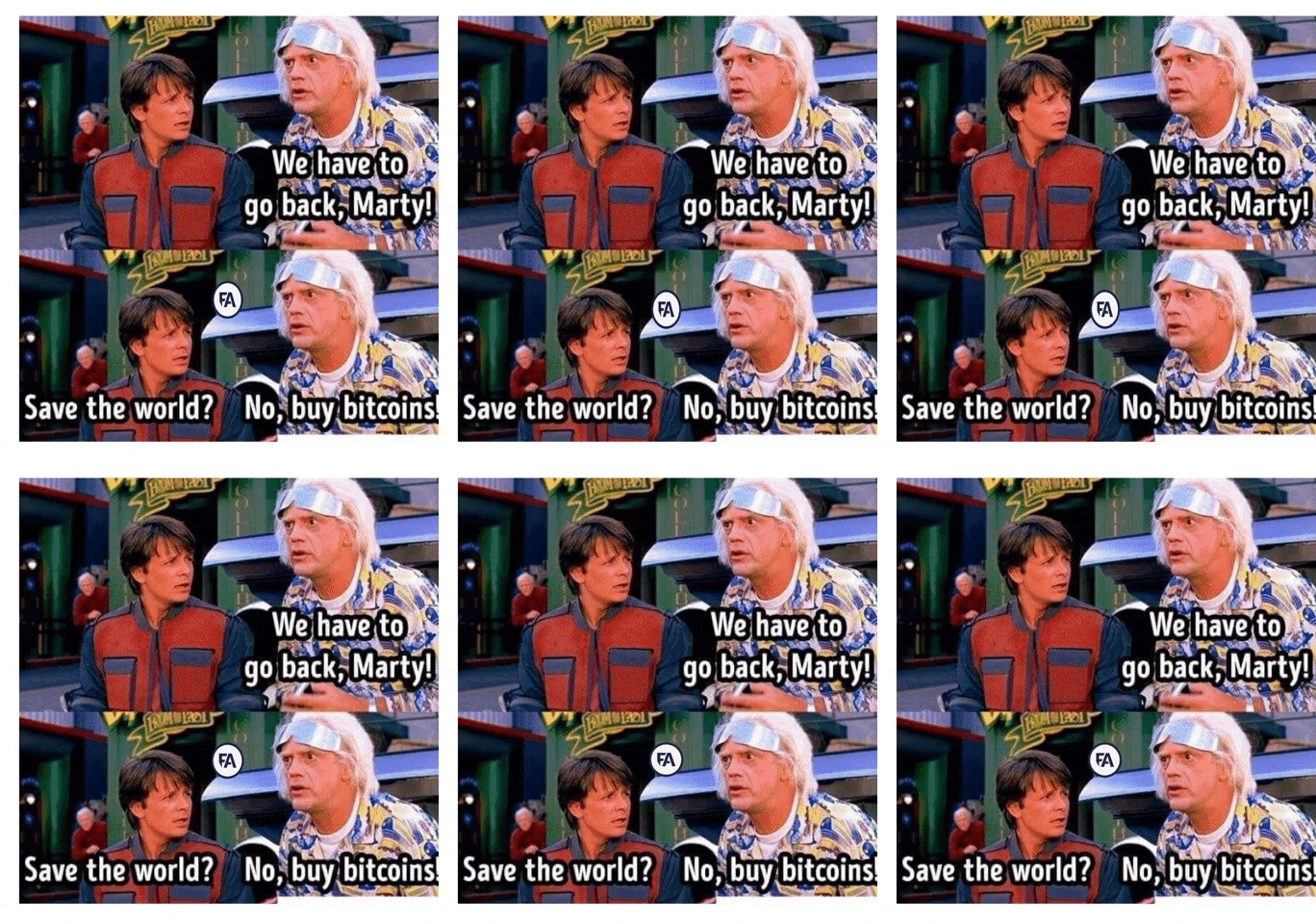
GIF: If only we knew how much Bitcoin’s price would skyrocket over the years, we wouldn’t wish to go Back to the Future.
However, Bitcoin’s inherent volatility can bring about dramatic price swings, making it a riskier short-term store of value compared to gold. The uncertainty around its regulation, future adoption, technological advancements, and speculative interest could also heavily impact its relevance–making it heavily driven by market sentiment.
Gold vs Bitcoin: A Head-to-Head Comparision
By now, it is apparent that both assets have their unique strengths and weaknesses–choosing between the two is a matter of individual risk tolerance and market outlook.
To make things easier for you, here’s a direct comparison of the two:
Feature
Gold
Bitcoin
Historical Reliability
Proven for centuries
Less than two decades of history
Inflation Hedge
Strong
Strong but untested in periods of prolonged inflation
Volatility
Low
High
Liquidity
High
24/7 global trading, highly liquid
Institutional Backing
Central banks hold reserves
Increasingly adopted but still debated
Growth Potential
Limited
High, albeit speculative
Regulatory Risks
None
Uncertain future policies
What’s Right for Me in 2025?
You’re a sparkling fit for gold if;
You prefer a stable, time-tested store of value.
You want an inflation hedge with low volatility.
You seek a tangible asset that holds global recognition.
Bitcoin’s your guy if;
You’re comfortable with volatility in exchange for high-growth potential.
You believe in Bitcoin’s long-term role as a digital store of value.
You want a decentralised, easily transferable hedge against economic uncertainty.
Or, why not both? Today, many traders are diversifying, holding gold and Bitcoin to balance security with potential upside. Gold provides the foundation of stability, while Bitcoin offers a speculative hedge with strong long-term possibilities.
Final Thoughts: Balancing the Old and the New
The debate between gold and Bitcoin isn’t about choosing one over the other—it’s about understanding what each asset offers in different economic scenarios.
GIF: If Homer Simpson can do it, so can you!
Gold remains the classic hedge, trusted for centuries, while Bitcoin is the modern alternative, offering digital advantages and potentially exponential returns.
At VT Markets, you don’t have to choose just one. With access to both gold and Bitcoin, you can trade with confidence and hedge against uncertainty in a way that suits your strategy. Which hedge fits your portfolio?