






Power used to be measured in missiles and troop counts.
Today, it’s increasingly measured in pipelines, trade tariffs, and payment systems.
While this shift has been gradual, it is now the foundation of global competition. Over the last two decades, major economies have learned to turn their commercial strengths into political leverage. By controlling trade access, energy supplies, or financial infrastructure, states can now extract concessions and reshape relationships without firing a single shot.
From Military Force to Economic Pressure
The best way to see this shift is to look at the tools leaders look to first.
- The United States operates at the structural level. By controlling access to the US dollar and the SWIFT payment system, it can effectively decide who gets to participate in global trade.
- Russia spent decades building energy dependency in Europe, using natural gas exports as a tether.
- China has secured a near-monopoly on processing rare earth minerals — the essential ingredients for electric vehicles, smartphones, and defense systems.
- Saudi Arabia and OPEC use oil production levels to do more than just stabilise prices; they use them to signal friendship or displeasure to the West.
The logic across the board is identical: convert a dominant economic position into raw political power.
Key Leverages
1. Energy as a Tether: The “Interdependence” Theory
For decades, the West followed a theory called Change through Trade. The idea was that deep commercial links would make war too expensive for anyone to start. If Germany bought Russian gas and Russia needed German Euros, both were “locked in” to peace. In reality, this created a lopsided vulnerability. While Russia wanted cash, Europe needed the heat. When conflict broke out, Russia used this dependency as a leash, threatening to cut off fuel supplies to paralyze Europe’s political response.
This same logic applies to global “chokepoints” like the Strait of Hormuz. Roughly 20% of the world’s total oil consumption passes through this narrow stretch of water controlled by Iran. Much like Russia’s pipelines, the Strait is a physical valve. Iran has frequently used the threat of closing the Strait to deter sanctions or military pressure from the West. Today, global strategy has flipped: concentrated infrastructure and narrow shipping lanes are no longer seen as bridges to peace, but as “choke points” that a rival can squeeze to force submission.
2. The Resource Monopoly: Understanding “Rare Earths”
“Rare earths” are a group of 17 minerals used in almost everything high-tech, from smartphone screens to electric vehicle motors and missile guidance systems. While these minerals aren’t actually rare in nature, they are incredibly difficult and “dirty” to refine. Over the last few decades, China has positioned itself to handle about 60% of the world’s mining and nearly 90% of the refining for these materials. Read about China’s Export Surplus here.
Because China handles processing plants, they can slow down global tech production simply by tightening export licenses or changing regulations. They don’t need to declare a formal trade war to make an impact; the mere threat of a supply hiccup is enough to make other countries think twice during a diplomatic dispute. It turns a mining industry into a powerful tool for global negotiation.
3. The Financial Thermostat: What is OPEC?
OPEC acts as a global economic “thermostat.” By coordinating how much oil they pump, these nations can swing global prices, which directly impacts inflation and interest rates worldwide. However, this collective power is currently facing its biggest test following the UAE’s historic decision to go it alone.
| Feature | The Old Model (OPEC Unity) | The New Reality (UAE Exit) |
| Membership | A 13-nation cartel led by Saudi Arabia. | The UAE officially exited on May 1, 2026. |
| Strategy | Members follow strict production quotas to keep oil prices high. | The UAE is prioritizing its own national revenue over group discipline. |
| Leverage | A unified “shock” to the market can force global political concessions. | Influence is now fragmented, making oil markets more volatile and harder to predict. |
| Goal | Collective price stability for the group. | Maximising individual production (targeting 5M barrels/day). |
The UAE’s departure, the most significant in OPEC’s 65-year history, signals a shift away from central control. As major players prioritize their own investments over old alliances, the “thermostat” becomes much harder for any one group to control.
4. The ‘Chokepoint’: Payment Channels
SWIFT is often described as the “financial nervous system” of the world. It isn’t a bank, and it doesn’t hold money; it is a messaging network that allows 11,000 banks in 200 countries to securely send instructions for cross-border payments. Because it is so dominant and connects nearly every major financial institution, it has become the go-to for global trade.
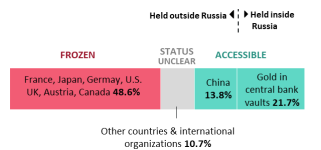
When a country is disconnected from SWIFT — as happened to several major Russian banks in 2022 — it effectively becomes an island in the global economy. Companies find it nearly impossible to pay for imports or receive money for exports.
The risk of being cut off has triggered a “fragmentation” of the global payments market, where “new forms of money are being developed” to ensure countries have a backup plan.
While these alternatives are growing, the dollar-based SWIFT system remains the central hub, meaning the ability to grant or deny access to this network remains one of the most significant tools of political pressure today.
The Axis is Changing
The global map is reshaping.
The common thread here is dependency. The more you need something, and the fewer alternatives you have, the more leverage the supplier holds.
As a result, we aren’t seeing “deglobalisation,” but rather a “strategic restructuring.”
Countries are no longer building supply chains based purely on the lowest cost. Instead, they are prioritising security:
- Europe is diversifying its energy sources.
- The US and Australia are racing to build domestic mineral processing.
- China is attempting to internationalise the Yuan to bypass the dollar.
These aren’t just business moves; they are insurance premiums against economic coercion. Something that every country is increasingly impacted by in current trade dynamics of the Trump era.
What This Means for the Future
Markets are great at pricing known risks, but they are historically bad at pricing “strategic dependency.” A commercial relationship looks normal until the moment it is weaponized.
For investors and policy leaders, the gap between business and geopolitics has vanished. Exposure to oil prices or semiconductor minerals is no longer just a line item on a balance sheet—it’s a vulnerability.
In this new multipolar world, the most powerful players aren’t necessarily those with the biggest militaries. They are the ones who identified early which economic gears move the world—and put their hands on the lever. Find the most relevant, tradable assets and the latest news on world trade here at VT Markets.
Tap here for Article summary
What is “weaponised interdependence”?
It is a strategy where a state uses its control over a global network (like a payment system or a pipeline) to pressure others. Since modern nations are “locked in” to these networks to function, the party that controls the “tap” can exert political power without military force.
Why are “rare earths” a geopolitical risk?
While the minerals themselves are common, China controls nearly 90% of the refining process. Because they are essential for high-tech goods (EVs, smartphones, missiles), this monopoly allows one country to disrupt global tech supply chains through simple regulatory changes or export limits.
What does the UAE’s exit from OPEC mean for oil prices?
The UAE’s departure on May 1, 2026, signals the decline of centralised oil pricing. By leaving the cartel to maximize its own production (targeting 5M barrels/day), the UAE has prioritized national revenue over group unity, likely leading to a more volatile and competitive global energy market.
Is the world actually deglobalizing?
No, it is “restructuring.” Trade is moving away from the lowest-cost models toward “security-first” models. Countries are now willing to pay more to build redundant supply chains and domestic industries as an insurance premium against being coerced by rivals.
How does being cut off from SWIFT affect a country?
It acts as a financial “kill-switch.” Disconnected banks lose the ability to send secure payment instructions across borders, making it almost impossible to pay for imports or receive money for exports. This effectively exiles a nation from the global financial system.
Create a live VT Markets account today to access our platform features, including market insights and educational content!
Start trading now – Click here to create your real VT Markets account







