







At a glance
– Robinhood is trying to expand from a retail trading app into a broader consumer-finance platform.
– Its product range now includes cards, cash tools, retirement products, managed investing, and private-market access.
– Users, assets, and deposits are growing, but revenue still depends heavily on trading activity, crypto cycles, and market sentiment.
– The investment case now rests on whether product expansion can lead to more stable and diversified earnings.
Robinhood is a US fintech platform best known for retail stock, options, and crypto trading.
Just recently, the company announced a $1.5 billion share repurchase programme on 24 March, a move that typically signals confidence in capital strength and long-term value.
Buybacks can support earnings per share over time and often suggest that management believes the stock is worth backing at current levels.
But the announcement signals a larger purpose. Robinhood is no longer trying to be seen only as a trading app built for bursts of market activity. It is trying to establish itself as a broader financial platform that can hold more of a user’s money, attention, and financial behaviour over time.
Previously, Robinhood was seen as a symbol of meme-era retail trading. Now, the focus is shifting to whether it can retain users as they become more experienced, better funded, and less reliant on short-term speculation.
Find HOOD stock as a CFD Share on our platform today.
How Robinhood is changing beyond trading
Robinhood’s original appeal was straightforward. It lowered the barrier to market access and matched well with users who were comfortable taking risks, acting quickly, and participating in fast-moving themes.
That trading-led base still matters. Robinhood remains centred on self-directed retail activity across equities, options, and crypto. These are products that naturally attract active users and benefit from volatility, engagement, and risk appetite.
What has changed is the company’s effort to build around that base rather than rely on it alone.
In its March 2026 investor presentation, Robinhood outlined a long-term path:
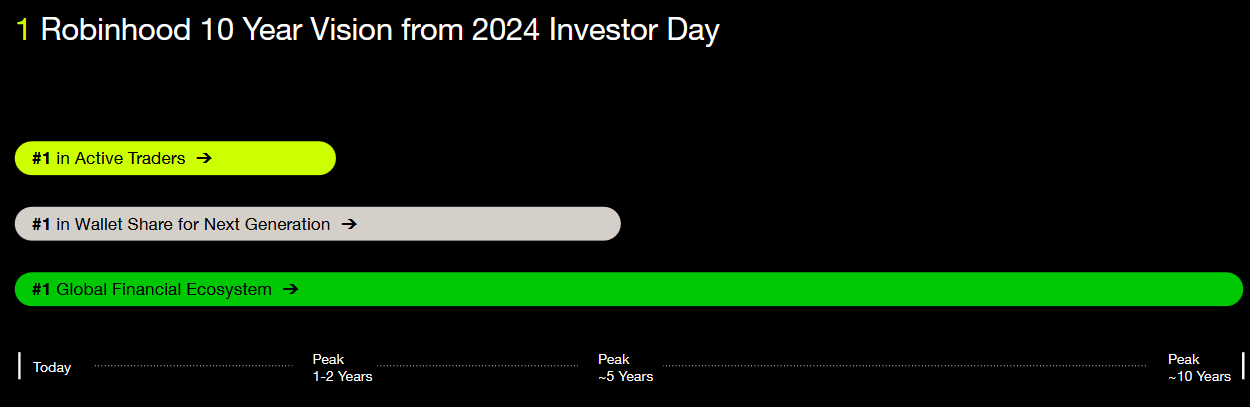
That progression is important because it shows how management sees the business evolving.
Instead of focusing only on trading frequency, Robinhood is trying to capture a larger share of each user’s overall financial life.
Its expanding product set now includes:
- cash management and spending tools
- credit products, including premium cards
- retirement accounts and longer-term investing features
- managed portfolios
- private-market exposure through retail-facing fund structures
This is not a move away from trading. It is a move to keep users inside the platform as their financial behaviour becomes more deliberate and more diversified.
How Robinhood fits Trader Behaviour
For a risk-aware audience, this shift is easier to understand when viewed through trader behaviour rather than product labels.
Many active traders do not stay in one financial mode forever. They often begin with shorter-term opportunities, build confidence through market participation, then gradually develop broader goals around cash management, capital preservation, diversification, and long-term allocation.
Robinhood’s strategy increasingly reflects that progression.
| Trader phase | Typical behaviour | Robinhood alignment |
| Early stage | Short-term activity, high engagement, risk-taking | Stocks, options, crypto |
| Developing stage | More structured capital use, growing balances | Cash tools, credit, retirement |
| Mature stage | Diversification, longer holding periods, broader allocation | Managed portfolios, private markets |
This is where Robinhood looks more credible than it did a few years ago. The company is no longer built only for the first phase of the customer journey. It is trying to remain useful as that same customer becomes more financially capable and more selective.
That also helps explain the move upmarket.
Reuters reported that Robinhood’s premium card strategy is aimed at higher-income users, reflecting an effort to move beyond its earlier speculative image as its customer base ages. The February filing for a planned $1 billion private investment fund IPO fits the same pattern. It is not really an institutional pivot. It is a retail-facing wrapper that allows ordinary investors to buy exposure to private-company stakes through a listed fund structure.
In other words, Robinhood is broadening its menu for the same broad retail audience, from newer traders to wealthier and more experienced users.
Why eyes are on HOOD stock
There are solid reasons why investors are taking this transition more seriously.
As of March 2026, Robinhood reported:
- 27M funded customers
- $322B in platform assets
- $68B in net deposits
These figures suggest more than app engagement. They show that Robinhood continues to gather assets and retain financial relevance even as the business broadens beyond trading alone.
The product mix is also becoming more coherent.
Trading may be the entry point, but newer services are designed to increase retention and make the platform useful across different financial needs. A customer who once used Robinhood for options or crypto can now also hold cash, use credit, contribute to retirement products, and explore managed or alternative exposure without leaving the ecosystem.
One of the more interesting additions is Robinhood Ventures Fund I (RVI). Unlike a debit card or cash feature, RVI, which debuted at $658.4 million, is a publicly traded closed-end fund designed to give retail investors access to a concentrated basket of private companies. Structurally, that makes it less of a payment feature than an access product. But it still says something important about where Robinhood is positioning itself in the financial sector.
By offering indirect exposure to private companies such as Stripe, Revolut, Ramp, and Databricks, Robinhood is expanding what retail users can do on the platform. Instead of waiting for high-profile fintech and infrastructure businesses to reach the public market, users can gain earlier exposure through a listed fund wrapper, placing the platform closer to where financial innovation is being built.
The larger significance is that Robinhood is not just serving users who want to trade what is already public. It is gradually widening access across different layers of the financial ecosystem, from liquid markets to private-company exposure. That makes the platform more relevant to users whose strategies, capital base, and time horizon are becoming more developed.
Robinhood’s past identity is still intact
Even with a broader product set, Robinhood’s earnings profile remains closely linked to market conditions.
A significant portion of revenue still depends on:
- retail trading volumes
- crypto sentiment and activity
- interest-rate dynamics
- payment for order flow and regulatory direction
- general retail risk appetite
That dependence showed up in recent results.
Q4 2025 revenue reached a record $1.28 billion, but still missed consensus expectations. Crypto slumped with revenue of $221 million also came in below forecasts. February operating data showed continued strength in customers, assets, and deposits, but equity notional trading volumes and options contracts declined month on month.
This matters because it shows that platform expansion has not yet fully changed the business model’s sensitivity to market activity.
Robinhood may be adding more stable-looking products around the edges, but the core earnings engine still responds strongly to cycles in participation, volatility, and speculative interest.
That is the restraint investors keep returning to. The company is broadening structurally, but the income statement still appears cyclical.
Why Traders are alert
For traders, Robinhood is not interesting only because of its products. It is interesting because the company itself reflects a style of market participation.
Robinhood grew by appealing to users who value access, speed, flexibility, and the ability to act on conviction quickly, aligning up with active CFD trading behaviour.
What is different now is that the business is trying to hold that user for longer. Instead of benefiting only from short-term activity, Robinhood wants to benefit as that same user matures, builds capital, and starts allocating across more financial needs.
That makes Robinhood more inviting for serious assessment than it was when it was mainly discussed through the lens of meme stocks and speculative bursts.
For a market-aware reader, the company now raises a broader question about platform quality:can a business that was built around active risk-taking grow into one that also supports longer-term financial habits without losing the energy that made it relevant in the first place?
Bull vs Bear: reading Robinhood today
| Bull case | Bear case |
| Robinhood is expanding into a broader financial ecosystem beyond trading. | Revenue is still meaningfully tied to trading activity and crypto cycles. |
| Funded customers, platform assets, and net deposits continue to grow. | Recent results still showed sensitivity to expectations and activity fluctuations. |
| New products may increase wallet share, improve retention, and support a more mature customer base over time. | Newer products still need to prove they can scale and monetise consistently. |
| RVI shows Robinhood broadening retail access beyond public markets into private-company exposure. | Access products can widen the menu, but they do not automatically change earnings quality in the near term. |
| The $1.5 billion buyback signals confidence and capital maturity. | Valuation may remain volatile if growth slows or activity weakens. |
| A successful transition could support a re-rating toward a diversified fintech profile. | The market may continue to treat Robinhood as a cyclical trading platform until revenue becomes less market-dependent. |
In simple terms, the bull case rests on platform maturity, accessibility, and retention.
If Robinhood can deepen wallet share and retain users across more stages of their financial lives, these layers begin to reinforce one another. Robinhood may look less like a trading app reacting to market bursts and more like a consumer-finance platform with a wider role in capital allocation.
The bear case is that this broader menu still sits on top of an earnings base that remains highly sensitive to trading volumes, crypto activity, and retail sentiment. Until the newer layers contribute more meaningfully and more consistently, the market may remain reluctant to reward the company with a steadier valuation framework.
From here, investors are likely to watch three things closely:
- whether asset growth leads to more stable revenue streams
- whether newer products gain enough scale to reduce earnings dependence on trading
- whether Robinhood can retain users as they become more sophisticated, rather than losing them to more traditional platforms
Robinhood’s Coming-of-Age
Robinhood looks more credible today than it did in its meme-stock era. Its product range is broader, its customer base is larger, and management is clearly trying to grow wallet share rather than rely only on trading activity.
But the transition is not complete. The business is still exposed to trading volumes, crypto cycles, market sentiment, and retail participation, which means the re-rating case still needs firmer proof. The challenge is no longer product expansion by itself. It is whether those newer products can gradually reduce Robinhood’s dependence on trading-driven revenue.
Robinhood’s next phase will be judged less by headlines and more by whether it can turn platform expansion into steadier earnings, deeper customer relationships, and a more durable role in how users manage money.
We equip traders with the tools, insights, and execution capabilities to navigate these transformative shifts, helping you position ahead of major market developments. Join today.
Click here for Refresher!
What is Robinhood trying to become?
Robinhood is trying to evolve from a retail trading app into a broader consumer-finance platform with products across trading, cash management, credit, retirement, managed investing, and private-market access.
Why is Robinhood still considered cyclical?
Robinhood is still considered cyclical because a significant part of its revenue depends on trading activity, crypto sentiment, retail risk appetite, and overall market conditions.
Why does Robinhood’s buyback matter?
The $1.5 billion buyback signals management confidence in the company’s capital position and long-term value, although it does not remove concerns about earnings volatility.
What is the bull case for Robinhood stock?
The bull case is that Robinhood can grow wallet share, deepen product usage, and eventually be valued more like a diversified fintech platform rather than a trading-led business.
What is the bear case for Robinhood stock?
The bear case is that Robinhood’s earnings remain heavily exposed to trading cycles, crypto activity, and market sentiment, which could keep the stock volatile if growth slows or activity declines.
Start trading now – Click here to create your real VT Markets account







