







Where We Were
The CLARITY Act passed the US House in July 2025 and then sat. For most of late 2025 and early 2026, the bill stalled in the Senate over a single sticking point: whether crypto firms could pay yield on stablecoin balances. Banks objected. Crypto firms pushed back. Negotiations dragged. Markets reacted to the idea of regulatory clarity rather than the substance of it.
That stalemate just ended.
What Changed in the First Week of May
On May 2, 2026, Senators Thom Tillis (R-NC) and Angela Alsobrooks (D-MD) released a bipartisan compromise on the stablecoin yield question. The agreement bans yield structures that function like traditional bank deposits, but allows rewards tied to active use of stablecoins, effectively a “buy and use” model, rather than a passive “buy and hold” approach.
The reaction was immediate. Coinbase CEO Brian Armstrong’s two-word response on social media: “Mark it up.” Circle endorsed the deal without qualification. By May 4, Senator Cynthia Lummis confirmed the text was final. By May 6, White House digital-assets adviser Patrick Witt told Consensus Miami the yield compromise “is closed.”
In other words: the bill is moving again.
Recap on What CLARITY Does
The bill’s significance is structural. It splits regulatory authority between the SEC and CFTC, introduces a “mature blockchain” test that determines which tokens qualify as digital commodities, and creates new registration paths for crypto exchanges, brokers, and dealers. (Full breakdown in the FAQ below.)
The yield compromise unblocked the bill. The substance is what comes next.
Simplified timeline on record:
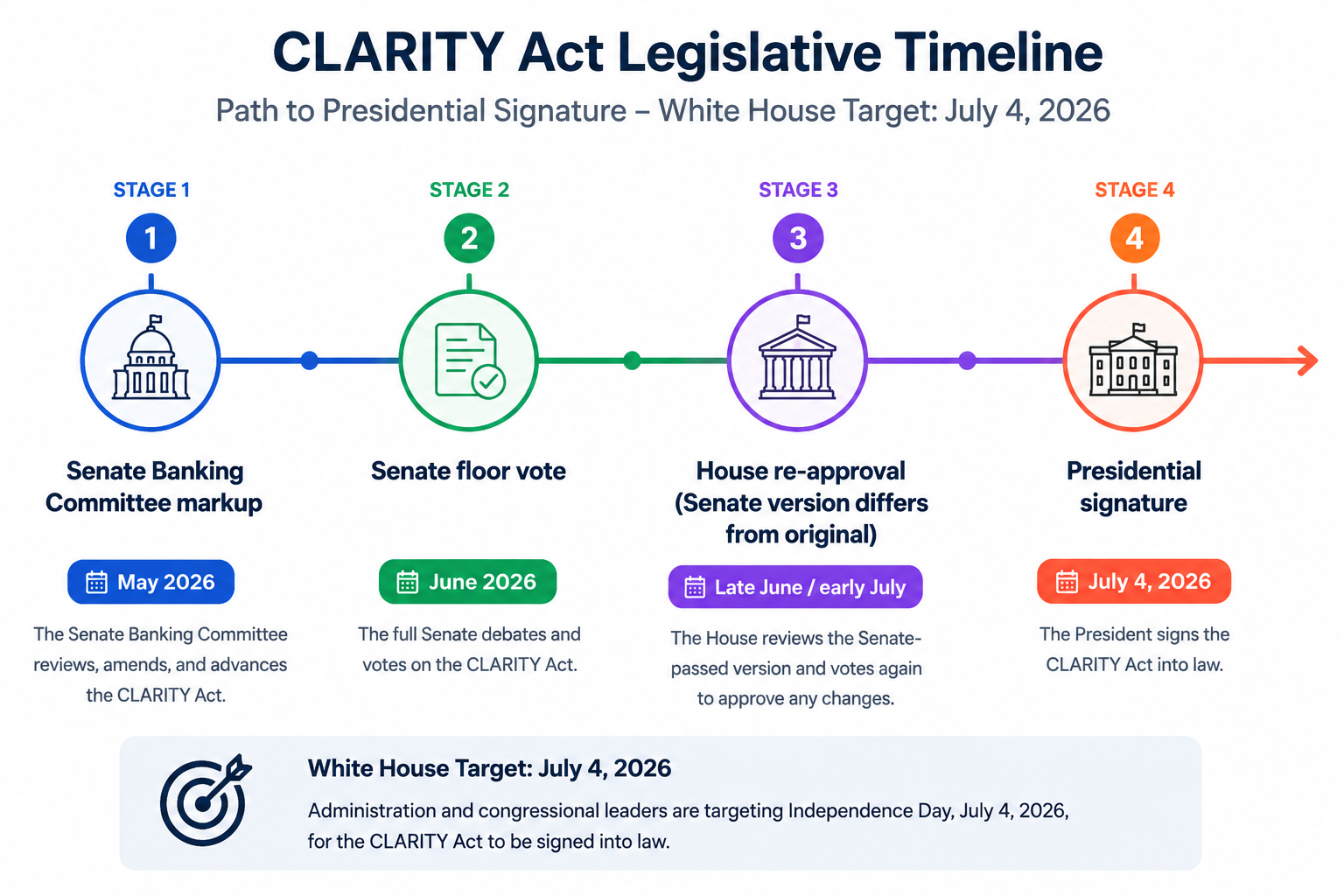
Witt called July 4 “a tremendous birthday present for America, celebrating our 250th“. That’s the optimistic case. Galaxy’s research desk still puts overall 2026 passage odds at roughly 50-50, citing the tight Senate calendar. Prediction markets sit higher, around 67%.
The timeline is genuine but fragile. Each stage is a potential volatility catalyst, and a potential delay point.
How Markets Reflected Sentiments
In our previous assessment of CLARITY, altcoins showed stronger sensitivity to legislative progress than Bitcoin. The first week of May tested that view but it’s worth tracking what came before, because the same bill produced opposite reactions within six weeks.
In late March, an earlier draft of the CLARITY Act proposed strict limits on stablecoin rewards — banning anything “economically equivalent to interest.” The market reaction was brutal: Circle shares fell about 20% on March 24, its worst single day on record. Coinbase shares fell about 10%.
The May 2 compromise softened that language and preserved activity-based rewards, which is why the May 4 reaction was the mirror image:
- Bitcoin briefly crossed $80,000 on the news
- Coinbase shares (COIN) climbed 6.1% to $202.99
- Circle shares (CRCL) jumped 19.9% to $119.53
- Prediction-market odds moved from below 50% to 70%.
The whipsaw is the lesson. The same bill, on different draft language, moved these stocks 20% in opposite directions within six weeks.
For CFD traders, that range is the thesis: legislative volatility, not legislative outcome, is where the trading edge sits. Learn more about trading Crypto CFDs on VT Markets.
What This Means for Crypto Traders
The bill addresses different things for different tokens. A broad “crypto sentiment” narrative can miss where the strongest exposure actually sits. Here’s how seven products on our platform might witness changes related to CLARITY:
Tier 1 — Direct Legislative Exposure
- SOLUSD (Solana): Direct beneficiary of CFTC reclassification as a digital commodity, lifting legal concerns over security status.
- UNIUSD (Uniswap): Benefits from the secondary trading clarification for DeFi tokens, addressing SEC scrutiny.
- BNBUSD (Binance Coin): Likely to remain sensitive to exchange registration provisions due to Binance’s regulatory challenges.
Tier 2 — Strong but Partially Sentiment-Driven
- ADAUSD (Cardano): Potential relief from CFTC reclassification, but mixed sentiment due to founder’s opposition to the bill’s “mature blockchain” standards.
- LNKUSD (Chainlink): Indirect benefits from tokenisation of real-world assets, boosting infrastructure demand.
Tier 3 — Stablecoin-Adjacent and Benchmark Exposure
- USDTJPY (Tether vs Japanese Yen): Might be affected by new stablecoin yield provisions under the CLARITY Act.
- BTCUSD (Bitcoin): No direct impact but serves as a sentiment barometer for broader market reaction to legislative progress.
Download the VT Markets app to monitor real-time price action.
What is Ahead
The yield compromise unblocked the bill. It didn’t pass it. Several things still need to land:
- Conflict-of-interest provisions is still being negotiated. The White House wants language that applies broadly rather than targeting specific officeholders, but this remains a sticking point with Democrats.
- Senate calendar existing pressure. Galaxy’s note flagged “the sheer number of unresolved questions that must be settled in sequence under severe time pressure.” Even a single new dispute could delay the timeline beyond the summer window.
- Critic voices on bill design. Arthur Hayes has argued the bill may favour large centralised firms with established lobbying relationships. Charles Hoskinson has raised similar concerns about the “mature blockchain” standard. These critiques may not stop the bill from progressing, but they could influence how the framework is ultimately received by the industry.
- The election clock — if CLARITY slips past July, momentum could weaken as Congress shifts focus towards the US midterm election cycle.
To watch in the coming weeks
Three concrete catalysts on the calendar:
- Senate Banking Committee markup (May) — the first hard test. A clean markup confirms the timeline holds. Delays here could become the first indication of legislative friction.
- Senate floor vote window (June) — four working weeks. If a vote doesn’t happen in this window, the July 4 passage becomes significantly less likely.
- House re-approval — expected to move quickly if nothing else blows up, but worth tracking because the Senate version diverges meaningfully from the House bill that originally passed in 2025.
None of these is directional by default. CFDs work both ways. A clean markup rewards long altcoin exposure; a delay rewards short-side positioning. The skill is reading the reaction — not predicting the outcome.
As mentioned in initial points on CLARITY, it requires “disciplined attention to where the market is starting to draw its own lines.” Those lines are now visible as seen in recent market sentiments. The market is pricing in real probability of passage. Whether that probability holds depends on what survives the next eight weeks.
Start exploring crypto CFD trading with VT Markets.
Frequently Asked Questions: The Clarity Act
What is the CLARITY Act?
The CLARITY Act (formally, the Digital Asset Market Clarity Act of 2025) is a US federal bill that creates a regulatory framework for digital assets. It passed the House in July 2025 and is currently moving through the Senate, with a target signing date of July 4, 2026.
What is the jurisdiction split between SEC and CFTC?
US crypto has been governed by two regulators with overlapping claims. The Securities and Exchange Commission (SEC) handles investment contracts. The Commodity Futures Trading Commission (CFTC) handles commodities. For years, the same asset has been treated differently in different cases. CLARITY draws a firmer line: tokens that function like assets — digital commodities — fall under the CFTC. Investment contracts stay with the SEC. For most major altcoins, this means a clearer, less litigation-prone regulatory home.
What is the “mature blockchain” standard?
The bill introduces a test for whether a network has moved past its early, centrally controlled stage. Networks that pass — broadly distributed, not run by a small founding group — qualify for digital commodity treatment. Networks that don’t, stay closer to securities oversight. Critics, including Cardano founder Charles Hoskinson, argue the standard favours established networks over newer ones.
What are the new registration paths?
CLARITY creates registration categories built specifically for digital commodity exchanges, brokers, and dealers — separate from rules designed for stocks. Firms get a defined compliance route, with provisional status, while final rules are being written.
What is the stablecoin yield compromise?
The compromise released by Senators Tillis and Alsobrooks on May 2, 2026 bans stablecoin yield that functions like a bank deposit but allows rewards tied to active use of stablecoins — a “buy and use” model rather than “buy and hold.” This was the final major sticking point that had stalled the bill in the Senate since January.
When could CLARITY become law?
Senate Banking Committee markup is targeted for May 2026, Senate floor vote in June, House re-approval in late June or early July, and presidential signature targeted for July 4, 2026. Prediction markets put 2026 passage odds at roughly 67%; Galaxy’s research desk estimates closer to 50-50.
Stay tuned to news on Crypto with VT Markets.
Start trading now – Click here to create your real VT Markets account







