Gold pulls back from highs after weak US inflation report, currently trading at $4,335
Gold prices dropped after reaching nearly two-month highs as traders took advantage of weaker US inflation reports. The US Consumer Price Index (CPI) is at its lowest in years, but concerns about a possible government shutdown make the data less reliable. While short-term easing from the Federal Reserve is expected to be limited, a weaker US Dollar and geopolitical tensions continue to support gold prices.
Gold hit a high of $4,374 following the US’s disappointing inflation figures, closing at $4,335. The US core CPI for November is its lowest since 2021, raising concerns over potential data inaccuracies due to the government shutdown.
Argentina’s unemployment rate fell to 6.6% in the third quarter, down from 7.6%
Argentina’s unemployment rate has dropped to 6.6% in the third quarter, down from 7.6% previously. This is a good sign for the labor market, but challenges remain.
The economic landscape is constantly shifting, influenced by various factors affecting currencies and commodities. Market reactions may vary as analysts evaluate this data alongside global economic trends.
Unemployment Rate Drop
The decline in Argentina’s unemployment rate to 6.6% is encouraging. It suggests that the economic reforms started in late 2023 might be stabilizing the labor market. This marks the second consecutive quarterly drop, indicating a slow yet genuine recovery after the severe recession in 2024. Traders should see this not as a sign of rapid growth but as reduced risk for Argentine investments. For those trading the Argentine Peso, this news could support a strategy of selling USD/ARS volatility. Following the significant devaluation in 2024, when the unofficial exchange rate exceeded 2,000 pesos to the dollar, the currency has been somewhat stable around 1,500 pesos in the latter part of 2025. Given this positive news, it may be wise to consider selling out-of-the-money call options on the USD/ARS pair, as the likelihood of a major currency collapse seems lower in the short term. In equity derivatives, focus on the Merval index, which has increased by nearly 50% in 2025 as foreign investment cautiously returns. This employment report benefits consumer and banking stocks, which make up a large part of the index. Buying call options on Merval-linked ETFs for the first quarter of 2026 could be an easy way to position for continued positive sentiment.Risk Management Strategies
Nevertheless, we must be careful since central bank reserves are still very low, and inflation, while down from its peak, was reported at 8.5% month-over-month in November 2025. Therefore, any long positions should be protected. Pairing long equity calls with a small purchase of far out-of-the-money USD/ARS calls could help safeguard against any sudden political or economic changes. Create your live VT Markets account and start trading now.Holiday Trading Adjustment Notice – Dec 19 ,2025
Dear Client,
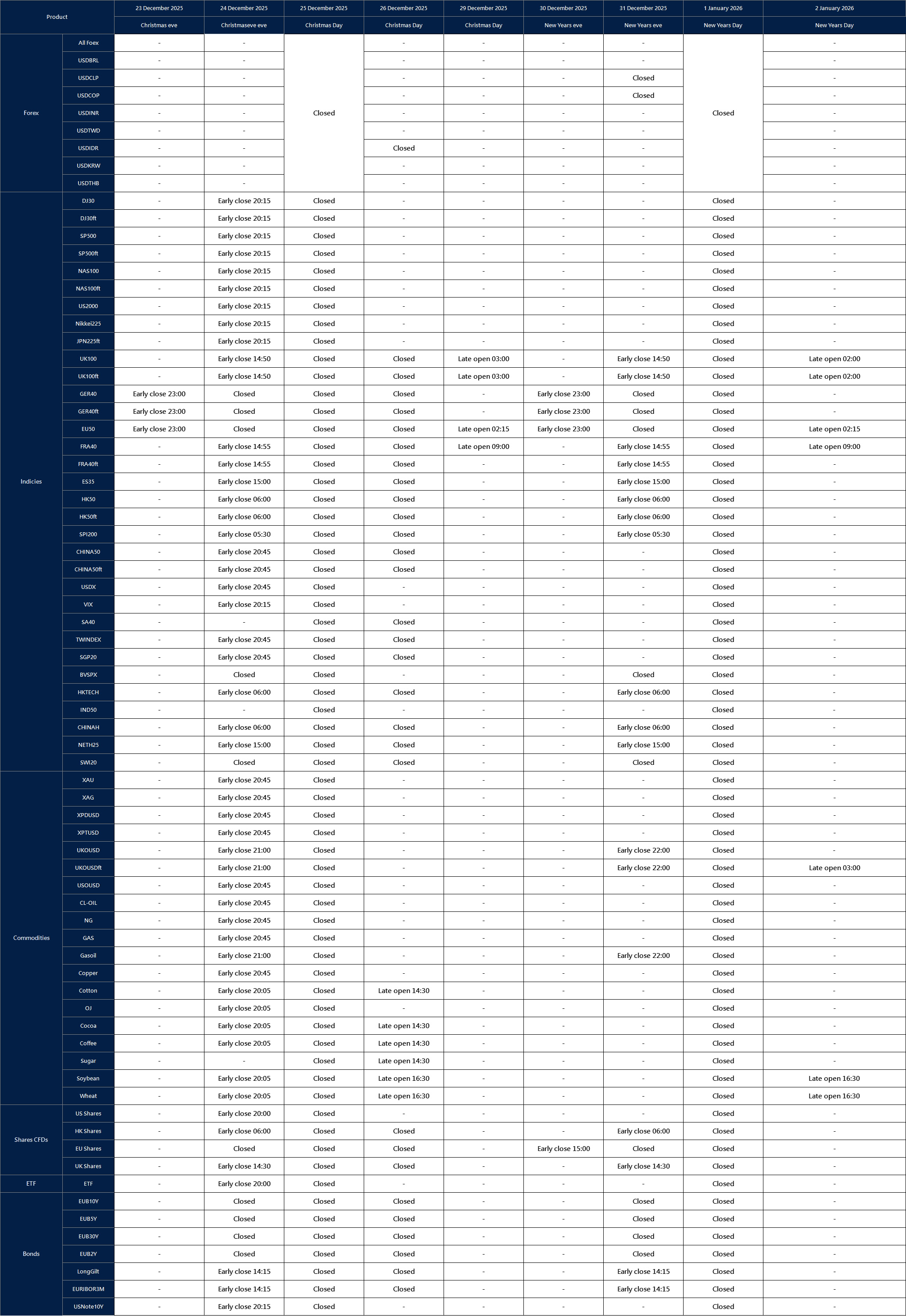
Affected by international holidays, the trading hours of some VT Markets products will be adjusted. Please check the following link for the affected products:
Holiday Trading Adjustment Notice
Note: The dash sign (-) indicates normal trading hours.
Friendly Reminder:
The above data is for reference only, please refer to the MT4/MT5 software for specific data.
If you’d like more information, please don’t hesitate to contact [email protected]
Argentina’s trade balance in November exceeded forecasts, reaching $2.498 billion instead of the expected $869 million.
Argentina’s trade balance for November showed a surplus of $2,498 million, far exceeding the expected $869 million. This indicates stronger exports, which may impact the country’s economic plans as it navigates fiscal and foreign exchange challenges.
Such results could lead to changes in future policies, especially regarding trade agreements and currency stability. Many will be watching how Argentina adjusts its fiscal strategies in response.
Financial Market Changes
In financial markets, there were moderate shifts. The Australian Dollar gained strength while the US dollar remained steady due to the Federal Reserve’s policies. The PBOC set its USD/CNY reference rate slightly lower than before. The NZD/USD pair saw minor gains thanks to softer US CPI inflation. Meanwhile, GBP/USD stayed stable just below 1.3400 as traders assessed the Bank of England’s policy update along with US inflation data. Gold prices fell despite hopes for Fed rate cuts, and cryptocurrencies like Bitcoin experienced volatility following low US inflation rates. Additionally, the Bank of England lowered rates after a controversial decision. Ripple’s value remained at $1.82, affected by low retail demand. The significant surplus in Argentina’s November trade balance is a strong indicator for the economy. The actual surplus of nearly $2.5 billion, much higher than the expected $869 million, suggests robust export revenues and could help increase foreign currency reserves. Traders should view this as a key reason for a stronger Argentine Peso (ARS) in the coming weeks.Effects of Trade Surplus
This trade surplus is the largest since the major currency devaluation in early 2024, suggesting that trade policies are starting to take effect. As a result, we are considering buying out-of-the-money call options on ARS futures that expire in January or February 2026. This approach offers a limited-risk way to benefit from a potential appreciation of the peso against the dollar. This positive news for Argentina fits well with the broader trend of a weakening US dollar. The latest US CPI reading of 1.8%, the lowest since 2022, has heightened expectations for a Federal Reserve rate cut in the first quarter of 2026. A dovish Fed often pressures the dollar while supporting emerging market assets. The strength of Argentina’s external sector might also boost its equity market. The Merval index, which has soared over 45% year-to-date in local currency, could see further gains from this development. We see opportunities to buy call options on key Argentine ADRs traded in the US, which may benefit from both a stronger local market and a better exchange rate. Additionally, we are noticing dovish trends globally, as seen with the Bank of England’s recent rate cut. This global easing environment favors riskier assets and currencies that offer higher yields or compelling growth stories. The data from Argentina highlights such a story, standing out in a landscape of slowing inflation and supportive central banks. Create your live VT Markets account and start trading now.Banxico’s interest rate decision for Mexico matches expectations at seven percent
Mexico’s central bank has kept the interest rate steady at 7%, meeting market expectations. This decision comes as global economic conditions and inflation pressures rise.
In November, the US Consumer Price Index rose by 2.7% from the previous year, below the expected increase of 3.1%. This is a decrease from September’s 3.0%, according to the Bureau of Labour Statistics.
Rates and Inflation in the UK
In the UK, the Bank of England has reduced rates to 3.75%. This hawkish approach has slightly boosted the value of the pound. The decision creates uncertainty about possible rate cuts in February or March. The cryptocurrency market saw significant fluctuations after the US inflation report. Bitcoin, Ethereum, and XRP experienced sharp price changes. The lower-than-expected inflation rate has affected traders’ feelings towards these cryptocurrencies. The GBP/USD has stabilized below 1.3400 as traders assess the Bank of England’s policy updates along with the US inflation data. In the forex market, the EUR/USD pair is approaching 1.1700, following the European Central Bank’s revisions to inflation and growth forecasts without changing rates. US inflation has cooled to 2.7%, supporting the argument for Federal Reserve rate cuts in the early part of the new year. This is particularly noteworthy as we remember the struggle to reduce inflation from 3.1% back in November 2023. The market is adjusting to anticipate a looser monetary policy, which will shape our strategy in the weeks ahead.Global Currency and Market Trends
With potential Fed rate cuts approaching, the US Dollar seems poised to weaken. This trend favors currencies like the Australian and New Zealand dollars, which are already performing well against the dollar. Options strategies betting on continued gains in pairs like AUD/USD may provide a smart way to take advantage of this trend. The situation outside the US is less certain, creating chances for volatility in cross-currency pairs. The Bank of England’s recent rate cut to 3.75% was a divided decision, while the European Central Bank expresses optimism about growth. This divergence suggests ongoing volatility, making straddle or strangle strategies on pairs like EUR/GBP a compelling option given the uncertainty. Gold is experiencing some profit-taking below $4,350, but this shouldn’t be viewed as a shift in the overall trend. The prospect of lower US interest rates continues to support non-yielding assets. Gold has been sensitive to rate expectations, particularly during its historic rise in 2024, and this recent dip may offer an attractive entry point for call options. The crypto market is reacting to US inflation news with sharp volatility, a common occurrence for this asset class. Ripple’s trading range between $1.82 and $2.00 illustrates the current indecision. Derivative strategies that benefit from price swings, rather than betting on a particular direction, fit well in this environment. Create your live VT Markets account and start trading now.Pressure on the US dollar continues due to the Bank of England, ECB, and US CPI release
The US Dollar Index is currently around 98.45. This comes after the US Consumer Price Index increased by 2.7% year-on-year in November, which is lower than the expected 3.1% and down from 3.0% in September.
EUR/USD is trading close to 1.1720 as the Euro faces selling pressure after the European Central Bank (ECB) decided to keep interest rates unchanged. On the other hand, GBP/USD is stable at about 1.3370 following a 25 basis point cut by the Bank of England (BoE), which had a split vote of 5-4 amid rising inflation concerns in the UK.
Exchange Rate Trends
The Australian Dollar is showing little movement around 0.6620, while USD/JPY is holding steady at about 155.60 as the market awaits the Bank of Japan’s (BoJ) upcoming interest rate decision. Gold prices are stable at $4,330 per troy ounce, decreasing from a peak of $4,374 due to lower-than-expected US inflation data. The BoJ has been a significant influencer of the Japanese Yen since adopting an ultra-loose monetary policy in 2013, which included negative rates. In 2024, this strategy was reversed due to yen depreciation and inflation surpassing the 2% target, along with expected salary increases. The disappointing US inflation rate of 2.7% is crucial. It is a decrease from the 3.4% annual rate at the end of 2023, indicating the Federal Reserve may soon ease its restrictive policy. Traders should consider positions that profit from a weakening US Dollar, such as buying puts on the DXY index.Trading Opportunities
The Japanese Yen presents a significant trading opportunity, as the Bank of Japan is expected to announce a rate hike. This reflects the ongoing normalization of policy that began in March 2024 when they first ended negative interest rates. With this clear difference from US policy, strategies that benefit from a stronger Yen, particularly shorting the USD/JPY pair, may be worthwhile. The Bank of England’s rate cut, despite rising inflation, suggests a dovish stance for the near future. This could weaken the Pound against currencies of tightening central banks. A strong trading idea for the coming weeks is to short the Pound against the Japanese Yen (GBP/JPY) to take advantage of this significant policy shift. As for the Euro, the ECB’s neutral position limits the chance for substantial gains. With EUR/USD near 1.1720, the Euro is weak against the dollar, which itself is facing challenges. It would be wise to avoid long Euro positions until we see a clearer signal from the ECB. Gold prices around $4,330 an ounce reflect a complicated market for traders. Although a weaker dollar typically supports gold, lower US inflation also diminishes gold’s role as an immediate hedge against inflation. With gold’s price significantly increasing from above $2,400 in 2024, we recommend options strategies that capitalize on market volatility rather than direct movements. Create your live VT Markets account and start trading now.The US dollar stabilizes, causing a slight rebound for the Canadian dollar.
The USD/CAD pair rebounded slightly as the US Dollar stabilized after losses tied to disappointing US inflation data. In November, the Consumer Price Index (CPI) in the US rose by 2.7% year-on-year, lower than the expected 3.1%, and down from 3.0% in September. The Core CPI also decreased to 2.6%.
This weaker inflation data strengthened the belief that the Federal Reserve might cut interest rates by 2026, with markets expecting two cuts next year. Currently, the outlook favors the Canadian Dollar since the Federal Reserve is easing rates while the Bank of Canada maintains its interest rate at 2.25%, reflecting steady inflation and strong economic activity.
Upcoming Economic Data Releases
Attention is now on upcoming economic reports from Canada and the US, especially Canadian Retail Sales and US Existing Home Sales. The University of Michigan will also release indices for Consumer Sentiment and Consumer Expectations, as well as surveys on one-year and five-year inflation expectations, which will provide more insights into the economic situation. Overall, the Canadian Dollar performed strongest against the Euro in today’s market movements. The US inflation rate of 2.7% confirms the ongoing disinflation trend we’ve seen over the last two years, significantly down from the highs above 8% in 2022. This trend signals further potential weakness for the US Dollar against the Canadian Dollar. We view the pair’s rise to 1.3770 as just a temporary stabilization before another drop. The key point is the growing difference between policies: the Federal Reserve is easing while the Bank of Canada holds its rate at 2.25%. The Fed has indicated more cuts are expected in 2026, especially since US GDP growth for the third quarter of 2025 was recently revised down to just 1.5%. This fundamental difference supports a stronger CAD as we head into the new year.Derivative Traders Strategy
For derivative traders, this situation suggests that implied volatility on USD/CAD may decrease as the Fed’s plans become clearer. Traders should consider purchasing Canadian Dollar call options or US Dollar put options with expirations in the first quarter of 2026. This allows traders to take advantage of the expected decline in USD/CAD while managing their risk. Canada’s economic strength adds credibility to this outlook, especially after the positive jobs report from two weeks ago, which showed a steady unemployment rate of 5.5%. This contrasts sharply with the recent soft labor market data from the US. Canada’s strong performance gives the Bank of Canada room to maintain its position, which supports the CAD further. For those with a moderately bearish view, setting up bear put spreads on USD/CAD could be a cost-effective strategy. This method limits the upfront cost while still allowing profits from a decline towards the 1.3500-1.3600 range. This zone was a crucial support level during the volatile markets of late 2024. We will be closely monitoring tomorrow’s Canadian Retail Sales data for more signs of economic strength. A strong report would bolster the Bank of Canada’s cautious stance and likely increase the decline in USD/CAD. Traders should anticipate a possible surge in short-term volatility around this data release. Create your live VT Markets account and start trading now.Tesla’s shares hit an all-time high after a regulatory delay on sales suspension
Tesla’s shares hit an all-time high after regulators postponed a planned sales suspension. This suspension was due to claims from the Department of Motor Vehicles about misleading advertising related to Tesla’s self-driving features.
If the suspension had gone forward, it could have caused a 30-day halt in sales and production in California, which is Tesla’s main market. The delay gives Tesla more time to resolve these issues.
Tesla’s Challenges
Earlier in 2025, Tesla faced difficulties, but its shift towards robotaxis and humanoid robots in the second quarter boosted market confidence. The company’s share price increased to $495.28, exceeding the previous peak of $488.54 from a year ago. Currently, Tesla’s stock stands at $487.63. The company’s recent developments and regulatory challenges continue to shape its stock performance. With Tesla shares reaching a new high, implied volatility has jumped. This increase is due to the temporary relief from the California sales suspension, causing options premiums to rise. Traders should be careful when buying calls or puts at these high prices, as a lot of the positive news may already be reflected in the stock. Strong momentum exists, fueled by Tesla’s successful shift to robotaxis earlier in 2025. Recent checks indicate that Q4 delivery expectations are high, with initial November 2025 data showing a 14% year-over-year increase in global production. This strong performance may support buying call spreads to take advantage of further gains while managing risk.Regulatory Concerns from the DMV
However, the regulatory threat from the DMV is still present, just delayed. This ongoing uncertainty makes buying protective puts for February and March 2026 expirations a wise strategy against a negative decision. We saw similar volatility during earlier regulatory challenges in the 2020s, where initial relief often led to ongoing fluctuations. Given the uncertain regulatory outcome, we can expect significant price movements in either direction soon. Options data for the January 2026 expiration indicates a possible move of over 15%, suggesting that a long straddle could be a successful strategy. This approach allows traders to gain from large price changes, regardless of whether the news is positive or negative. All of this is happening while the broader market assesses recent economic data. The November 2025 Consumer Price Index (CPI) report showed a lower-than-expected 2.9% increase. This reinforces the belief that the Federal Reserve will keep interest rates steady through the first quarter of 2026. While this overall economic situation is generally favorable for growth stocks, the specific risk surrounding Tesla remains a key concern for now. Create your live VT Markets account and start trading now.The mid-structure pivot is being closely monitored as Nasdaq futures align in daily and intraday trends.
Nasdaq March futures are currently trading within an established framework, with both daily and intraday charts focusing on a mid-structure zone. Right now, price action is more about acceptance and rejection at key levels rather than a clear trend.
On the daily chart, after moving below the Micro-5 level at 25,051, prices bounced back toward the 25,405 pivot, which failed to hold in earlier sessions. If prices stay above this pivot, we could see movement toward higher levels at Micro-1 (25,794) and Micro-2 (26,036). However, if they drop below, we may see another dip toward lower levels.
Intraday Support And Resistance
Looking at the intraday 15-minute chart, support sits at Micro-4 (24,924), and momentum reflects recent daily trends. The daily pivot at 25,514 is key resistance for the session; staying above it suggests a return to upper levels, while falling back may lead to a drop toward lower levels. Important levels to watch include 25,405 as the daily structural pivot, and 25,794 to 26,036 for the upper micro structure. On the intraday chart, 25,514 is the main pivot, and 24,924 served as support in the previous session. Both daily and intraday structures align, highlighting activity around these midpoints. The Nasdaq March futures market is at a crucial point, with the 25,405 daily pivot serving as a major decision marker. Prices are moving between established support and resistance, indicating that a significant shift will come after a confirmed break of this mid-zone. Currently, the market shows indecision instead of a clear direction. As we enter the last weeks of 2025, we expect lower trading volumes, which can cause erratic price swings within this structure. Thin liquidity increases the risk of false breakouts. Any key level break must be confirmed with sustained movement, not just a brief spike. **Market Fundamentals And Economic Indicators** The overall economic landscape supports this technical indecision. November’s CPI report came in slightly lower than expected at 2.8%, easing some inflation worries. However, the Federal Reserve’s cautious comments last week left their first rate move for 2026 uncertain. This conflict keeps both buyers and sellers active without either side gaining control. In light of this, keep an eye on the pivotal 25,405 on the daily chart and 25,514 on the intraday chart. Holding above these levels could lead to a potential “Santa Claus Rally” toward 26,000. In contrast, a rejection would suggest a move to test support near 25,051 and possibly the intraday level at 24,924. This environment is ideal for options strategies that can take advantage of either a defined range or a breakout. Traders are likely creating positions like iron condors to profit from consolidation between the upper and lower structures. Others may be purchasing straddles in anticipation of a sharp move in either direction. Historically, this consolidation resembles the pattern observed during the summer of 2024, when the market oscillated for weeks before determining its next direction. This suggests that patience is crucial now—wait for the market to signal its intent by decisively breaking and maintaining above or below the current mid-structure pivot. With the VIX around a low 15.5, the market is not indicating extreme short-term volatility. Therefore, our approach should be disciplined, focusing on confirmation at key levels instead of chasing momentum. The signal for the next move will come from clear acceptance or rejection at the 25,405 pivot. Create your live VT Markets account and start trading now.Gold recovers after unexpected US inflation data, trading near $4,368 and approaching $4,381 peak
Gold (XAU/USD) rallied on Thursday after US inflation data came in lower than expected. At that time, XAU/USD was trading around $4,368, breaking out of the week’s previous range.
The US Consumer Price Index (CPI) rose 2.7% year-on-year in November, below market expectations of 3.1% and down from 3.0% in September. Core CPI also slowed to 2.6%, below the expected 3.0%, which could affect the Federal Reserve’s potential decisions on monetary policy.