



The euro strengthens against the Japanese yen, nearing 180.90 amid disappointing GDP figures
Recent Politburo meeting indicates China’s economic situation remains stable
China’s Politburo has recently said that the country’s economy is stable and shared plans for future policies. They aim to implement active macroeconomic strategies, tackle risks in important areas, and ensure stable employment and market confidence.
They plan to use proactive fiscal policies and maintain a moderately loose monetary policy. In the coming year, efforts will also focus on strengthening the domestic market and improving the coordination of domestic and international economic activities.
The Australian Dollar rose slightly, trading at 0.6645, with a 0.08% increase for the day. The value of the Australian Dollar is influenced by interest rates set by the Reserve Bank of Australia (RBA) and the condition of the Chinese economy, which is Australia’s largest trading partner.
The RBA impacts the AUD by adjusting interest rates to keep inflation steady. The health of the Chinese economy plays a crucial role; if China does well economically, it tends to boost demand for Australian exports.
Prices for Iron Ore, a key Australian export, have a major effect on the AUD’s value. A positive trade balance, which indicates strong export demand, can strengthen the Australian Dollar, while a negative balance can weaken it.
China’s leaders are signaling plans for more economic support through active and looser policies, indicating a desire for growth in the new year. Their commitment to enhancing the domestic market suggests a renewed focus on construction and manufacturing. This implies that demand for important industrial commodities, like iron ore, is likely to rise in the coming weeks.
Recent data shows iron ore prices stabilized around $115 per tonne in Q4 2025 after a dip earlier in the year. This news from Beijing could help push prices back toward the highs of early 2024, when prices frequently exceeded $135. Traders should consider this a signal to explore long positions in commodity futures or options linked to mining companies sensitive to these price changes.
The Australian dollar is currently trading near 0.6720 and is very responsive to the health of the Chinese economy and commodity prices. Since the Reserve Bank of Australia has kept its cash rate steady at 4.35% for much of 2025, this external boost from China’s economy supports a strong case for potential gains in the AUD. We believe that buying call options on the AUD/USD is a smart way to prepare for possible upward movement, aiming for a rise above the 0.69 level.
We can look back to 2023 to see how similar Chinese stimulus measures helped revive global commodity markets. During that time, even small policy support from Beijing resulted in a significant increase in industrial metals and the Australian dollar. While the situation may differ, the policy direction set by the Politburo mirrors that past strategy.
We should also be cautious about how China handles its “international economic and trade battle” mentioned in their statement. If trade tensions increase, it could lower risk appetite and counteract the positive impact of domestic stimulus. Therefore, using defined-risk strategies, like buying call spreads on the AUD, could be a smart way to capture upside while limiting potential losses.
Gold prices rise in Saudi Arabia, according to various sources.
Gold prices in Saudi Arabia have gone up, according to FXStreet. On Monday, the price for one gram was 507.83 Saudi Riyals, an increase from 507.10 SAR on Friday. The cost for one tola also rose to 5,923.48 SAR, compared to 5,914.72 SAR the previous Friday.
FXStreet reports a range of Gold prices: 1 gram is 507.83 SAR, 10 grams cost 5,078.51 SAR, and a troy ounce is valued at 15,795.31 SAR. These prices reflect international rates converted to the local currency and are updated daily. They mainly serve as a reference, as local markets may show slight variations.
Safe Haven Amid Market Volatility
Gold is valued as a safe place to store wealth and is a popular choice for trading, especially during market fluctuations. In 2022, central banks bought 1,136 tonnes of gold worth about $70 billion, according to the World Gold Council. This was the largest purchase in history, with emerging economies boosting their holdings. Gold prices usually move opposite to the US Dollar and US Treasuries. Geopolitical issues and interest rates also play a role, with lower rates typically leading to higher gold prices. Gold’s value is primarily influenced by its price in USD. Gold prices have shown a slight increase today, December 8th, signaling potential market tension. This small rise reflects broader sentiment, rather than just local Saudi trading. Traders should consider this a sign of positioning ahead of anticipated volatility in the US dollar. We see the market factoring in a softer approach from the Federal Reserve, which is good for gold. The shift away from aggressive rate hikes started in late 2023, setting a long-term trend. With recent US inflation rates just above 2.5%, the pressure to keep rates high is lessening, making gold, a non-yielding asset, more appealing.Impact of the US Dollar on Gold
The relationship between gold and the US Dollar is important, and we see the dollar as weak. The US Dollar Index (DXY) has struggled to stay above 103, a significant decrease from previous highs. A weaker dollar means gold becomes cheaper for buyers using other currencies, which could increase demand in the coming weeks. We should also consider the steady demand from central banks, which helps support gold prices. After record purchases in 2022 and ongoing strong buying in 2023 and 2024, institutional demand has absorbed much of the available supply. This ongoing buying by significant global players strengthens the price against sharp declines. With the recent strength in stock markets, gold acts as an important hedge. As stock indices reach new highs, some investors may shift a portion of their gains into safe-haven assets. This strategy could further boost gold prices if market sentiment towards riskier investments changes. Create your live VT Markets account and start trading now.Gold prices rise in the United Arab Emirates, according to compiled data sources.
Gold prices in the United Arab Emirates went up on Monday. The price per gram is now 497.09 AED, up from 496.28 AED on Friday. The price for Gold per tola also increased to AED 5,798.02 from AED 5,788.48.
Here are the latest Gold prices in different measurements in AED:
– 10 grams: 4,970.95 AED
– 1 troy ounce: 15,461.16 AED
These prices are updated daily by FXStreet based on international market rates and may differ slightly locally.
Gold As A Safe Haven
Gold is seen as a secure investment, especially during times of global unrest and economic struggles. It’s a good way to protect against inflation and currency loss. Central banks are major buyers of Gold. They hold large reserves because Gold is reliable for backing currencies during tough times. In 2022, central banks added 1,136 tonnes of Gold, worth about $70 billion, to their reserves. Gold prices depend on various factors, including political instability, fears of recession, and interest rates. Typically, when the US Dollar weakens, Gold prices go up because Gold is priced in US dollars. Conversely, when the stock market does well, Gold prices often drop. However, if there’s a sell-off in risky investments, Gold’s value can rise.Current Market Trends
Today, we see a small rise in Gold prices, confirming its status as a safe-haven asset. This trend encourages us to pay attention to broader economic signals. Investors are considering Gold as a protective measure during these uncertain times. People are watching the US Federal Reserve closely. It has kept interest rates steady much of 2025 after rising them sharply in previous years. Recent comments from the Fed suggest possible rate cuts in the first half of 2026. This has led to a drop in the US Dollar Index from recent highs above 106, which is favorable for Gold since a weaker dollar makes it cheaper for foreign buyers. We should also consider the ongoing, though lower, inflation seen in the US and Europe this year. Currently, inflation is around 3.1% in the G7, which enhances Gold’s appeal as a store of value. For traders, this means that any unexpected negative economic news could trigger a quick rise in Gold prices. Gold continues to get support from central banks. After record purchases in 2022 and 2023, recent data for the third quarter of 2025 shows central banks, especially in Asia, are still adding to their reserves at an impressive rate. This ongoing buying creates a strong foundation for prices, boosting trader confidence against significant downturns. Given these factors, traders should consider strategies that could benefit from a price increase and heightened volatility. Buying call options or using bull call spreads may allow you to profit if geopolitical tensions rise or if economic data points to a slowdown. These strategies can help you take advantage of price gains while clearly defining your risks. Create your live VT Markets account and start trading now.During Asian trading hours, the US Dollar Index remains around 98.90 as Fed rate expectations decline.
The US Dollar Index dropped to about 98.90 during the early hours of Monday’s Asian session. Expectations are rising for a 25 basis point rate cut at the Federal Reserve’s December meeting.
The chance of this rate cut surged to nearly 90% from 71% in just one week. In addition, US Consumer Sentiment has improved for the first time in five months, rising to 53.3 in December from 51.0.
Traders Eager for Fed Guidance
Traders are looking forward to hearing from Fed Chair Jerome Powell for direction on future rate decisions. Positive sentiment could help limit the decline of the US Dollar. The US Dollar is the official currency of the United States and the most widely traded currency in the world, making up over 88% of global foreign exchange transactions. The Federal Reserve’s decisions greatly affect the dollar’s value, especially through changes in interest rates. The Fed uses these changes to manage inflation and employment levels. Quantitative easing involves the Fed purchasing government bonds, which typically leads to a weaker US Dollar. On the other hand, quantitative tightening means stopping these purchases, which often strengthens the Dollar.Market Expectations for Fed Rate Cut
With the US Dollar Index sitting below 99.0, it’s clear the market has priced in about a 90% chance of a Fed rate cut this Wednesday. This high probability suggests much of the dollar’s potential decline is already reflected in current prices. Now we need to focus not just on the cut itself, but on what might happen afterward. We should be careful about betting more against the dollar since this trade is becoming crowded. A surprise could come from Fed Chair Powell’s press conference; if he indicates this is a “one-and-done” cut due to recent positive signs like the rise in Consumer Sentiment, the dollar could rally sharply. When the Fed changed policies in late 2023, markets initially overshot rate cut expectations, leading to a bounce-back rally when the Fed pushed back. Given the uncertainty surrounding the Fed’s guidance, we might explore strategies that profit from a spike in volatility. Options strategies like a long straddle or strangle on DXY futures or popular currency pairs like EUR/USD could work well. These positions would benefit from significant price movements in either direction after Wednesday’s announcement, allowing us to avoid guessing the Fed’s tone. We should also keep an eye on key currency pairs, particularly USD/JPY, where interest rate differences play a crucial role. While the Fed is expected to cut rates, the Bank of Japan has kept its very loose policy throughout 2025, which has pressured the yen. A clear dovish shift from the Fed could finally strengthen the yen by closing the gap between US and Japanese government bond yields. Create your live VT Markets account and start trading now.Gold prices have risen in Pakistan according to the latest market data.
Gold prices in Pakistan went up on Monday, according to FXStreet data. The price per gram rose from PKR 37,862.34 on Friday to PKR 37,928.75.
The price per tola also increased, moving to PKR 442,400.90 from PKR 441,618.90. FXStreet updates international gold prices to PKR and local units every day.
Central banks hold the most gold, adding 1,136 tonnes in 2022, worth around $70 billion. Gold is seen as a safe investment during uncertain times.
Gold’s value usually goes up when the US Dollar weakens and goes down when interest rates rise.
Geopolitical issues and fears of recession can push gold prices higher. A strong dollar generally keeps gold prices stable, while a weak dollar tends to raise them.
Gold serves as a shield against inflation and currency devaluation. It doesn’t depend on any government or issuer, which makes it an appealing investment during uncertain periods.
With expectations for a Federal Reserve rate cut later this month, the US Dollar is weakening a lot. This is beneficial for gold, since it is priced in dollars and usually rises when the dollar falls. Traders dealing in derivatives should think about positioning for continued dollar weakness in the weeks ahead.
The latest inflation figures from November 2025 show a drop in the Consumer Price Index to 2.8%. This supports the idea that the Fed may ease its monetary policy. This marks a big shift from the aggressive rate hikes we saw in 2023. Lower interest rates make it easier to hold non-yielding assets like gold, making it more appealing.
We’re also seeing strong and ongoing purchases from central banks, a trend that has been growing for years. The World Gold Council noted that another 250 tonnes were added to global reserves in the third quarter of 2025, with emerging economies leading in purchases. This strong demand from institutions helps stabilize gold prices.
Continuing geopolitical tensions and concerns over global supply chains are pushing investors toward safe-haven assets. This steady demand supports gold during uncertain market times, likely limiting any major price drops.
Given this situation, buying call options on gold futures expiring in January or February 2026 might be a good strategy to benefit from the expected price rise. However, silver has recently performed well, reaching new highs while gold has not. This could mean gold has potential to rise or signal caution for the entire precious metals market.
The focus will be on the Federal Reserve’s statement later this month. If the tone is more dovish than expected, it could lead to a price rally. Traders should use options to manage their risk, as a surprise hawkish position from the Fed might cause a quick reversal, pushing the dollar up and gold prices down.
GBP/USD pair is trading in a tight range around 1.3320-1.3325 during the Asian session.
The GBP/USD pair starts the week trading within a narrow range of 1.3320-1.3325 in the Asian session. While this calm beginning suggests stability, the prices are close to the highest level since October 22. A confirmation above the 100-day Simple Moving Average is needed for further movement.
The US Dollar is under pressure, mainly due to rumors that the Federal Reserve may soon cut interest rates again. This situation boosts the GBP/USD, but traders remain cautious, awaiting clearer signals from the Fed about potential rate cuts. Focus is on economic forecasts and what Fed Chair Jerome Powell has to say.
Pound Sterling Movement
The Pound Sterling has gained strength against the US Dollar, reaching five-week highs above 1.3350. This increase is supported by the recent UK Budget and ongoing weakness in the US Dollar. Additionally, the UK’s GDP forecast has been upgraded to 1.5% for 2025, which adds to the positive momentum. The British Chancellor of the Exchequer’s plan for a £26 billion annual tax increase helps close fiscal gaps without heavily taxing households. This strategy aligns with the Labour Party’s approach of avoiding new debt for everyday expenses, further boosting the Pound’s strength. As we enter the week of December 8, 2025, the Pound Sterling remains strong against the Dollar, staying above the 1.3300 level. This resilience is largely due to the weaker US Dollar, with markets expecting the Federal Reserve to maintain a dovish stance. All attention is now on the upcoming Fed meeting, which may guide expectations for 2026. In 2025, the Federal Reserve has already cut rates three times, lowering the target range to 3.00%-3.25% to support a slowing economy. Current market pricing suggests traders believe there is over a 70% chance of another 25-basis-point cut in the first quarter of 2026. This outlook limits the chances of a rally in the US Dollar.UK Economic Outlook
In the UK, optimism from earlier this year, when the OBR projected 1.5% GDP growth for 2025, has diminished. Recent data from the ONS indicated that the economy only grew by 0.2% in the third quarter, which could constrain the Pound’s gains. This makes the upcoming inflation report from the Bank of England crucial for future direction. For derivative traders, this means implied volatility on GBP/USD options may increase as central bank announcements approach. Given the likelihood of surprises from either the Fed or UK inflation data, using options like buying a strangle could be a wise approach. This strategy allows for potential profits from large price movements in either direction, while also limiting possible losses. We also note that gold is trading strongly above $4,200 per ounce, benefiting from low interest rates. Meanwhile, EUR/GBP remains steady around the 0.8750 level, as recent German industrial production figures display unexpected strength. This cross-currency pair is a crucial indicator of economic comparisons between the UK and the Eurozone. Create your live VT Markets account and start trading now.Gold prices in India have risen today, according to compiled data.
Gold prices in India rose on Monday, based on data from FXStreet. The price per gram increased to 12,203.55 Indian Rupees (INR) from 12,173.11 INR on Friday.
Gold Prices Update
The price per tola went up to INR 142,341.80, rising from INR 141,984.80 from the previous trading day. FXStreet adjusts international gold prices to INR and updates them daily depending on market rates. Gold is valued as a reliable investment, especially during uncertain times. People often buy it to protect against inflation and currency loss. Central banks are significant holders of gold. In 2022, central banks acquired 1,136 tonnes of gold, worth about $70 billion, according to the World Gold Council. Nations like China, India, and Turkey have notably increased their gold reserves. Gold and the US Dollar often move in opposite directions. A weaker dollar usually leads to higher gold prices, while a strong stock market can push gold prices down. Other factors, like geopolitical tensions and interest rates, also affect gold’s value. Today’s slight rise in gold prices fits into a larger trend that we’ve noticed over recent weeks, driven by economic changes. The US Dollar Index recently dropped below 102, which is significant given its strength in 2025. This reflects the typical relationship where a weaker dollar boosts gold prices.Market Speculation and New Trends
The market is now focusing on what the US Federal Reserve will do next, with growing expectations of a rate cut in the first half of 2026. After a series of aggressive rate hikes in 2022-2023, and a pause in 2024 and 2025, the latest inflation data has cooled sufficiently to spark this speculation. Lower interest rates make holding non-yielding assets like gold less costly. We see this sentiment in the options market, where more call options are being bought for the first and second quarters of 2026. Implied volatility is increasing from earlier lows, suggesting traders anticipate a breakout rather than stable prices. This scenario benefits strategies that can capitalize on a sharp price increase in the coming months. The demand for gold remains strong, providing solid price support. Central banks are still purchasing gold at a high rate, continuing the record levels from 2022. Recent figures from the World Gold Council for the third quarter of 2025 show that emerging market banks are the primary buyers, moving away from dollar-based assets. Furthermore, ongoing geopolitical tensions are crucial in maintaining gold’s status as a safe-haven investment. Any sudden escalations in global trade issues or regional conflicts could lead to increased demand for gold. We’ve seen this repeatedly in the early 2020s, and it remains an important factor for hedging strategies. Create your live VT Markets account and start trading now.Recent data shows that gold prices in Malaysia have increased.
Gold prices in Malaysia increased on Monday, according to data from FXStreet. The price rose to 556.19 Malaysian Ringgits (MYR) per gram, up from MYR 555.05 on Friday. The cost of Gold per tola also went up to MYR 6,487.29, from MYR 6,474.02, showing how international prices affect local currency.
Central banks are the largest holders of Gold, with 1,136 tonnes valued at about $70 billion in 2022. Countries like China, India, and Turkey have significantly increased their reserves to strengthen their economies.
Inverse Relationship With The US Dollar
Gold has an inverse relationship with the US Dollar and US Treasuries. When the Dollar weakens, Gold usually climbs. Gold is often seen as a safe investment and a way to protect against inflation and declining currencies. The price of Gold can fluctuate due to various reasons, including geopolitical tensions, fears of recession, and changes in interest rates. A weaker US Dollar often results in higher Gold prices, while a stronger Dollar tends to stabilize them. Market rates are updated daily, and prices are available in different measurements for local context. The recent uptick in Gold prices is part of a larger trend driven by key economic factors. With the US Dollar Index (DXY) dropping from its 2023 highs to around 101, this has lessened a major obstacle for Gold and suggests prices might rise further in the upcoming weeks. An important factor is the change in interest rate policy over the last two years. The US Federal Reserve raised rates above 5.25% in 2023 but has since cut them, making it less costly to hold non-yielding assets like Gold. As markets expect a pause or small tweaks in early 2026, Gold remains an appealing choice for investors.Central Bank Demand And Global Economic Outlook
We must also consider the steady demand from central banks, which helps support Gold prices. Last year, central banks purchased a record 1,136 tonnes, and reports from the World Gold Council indicate this buying trend continues into 2023 and 2024. This ongoing demand, especially from emerging economies, creates a solid foundation for prices. Given current geopolitical uncertainties and predictions for slower global GDP growth in 2026, Gold’s role as a safe-haven asset is especially important. A weaker US Dollar alongside these risks strengthens the argument for holding Gold as a hedge. This makes Gold a useful tool for diversifying away from potential stock market volatility. For traders focused on derivatives, this outlook encourages a cautiously optimistic approach as we head into the new year. Buying call options that expire in the first quarter of 2026 may be a way to profit from potential price increases while managing risk. Alternatively, bull call spreads can help reduce entry costs if implied volatility is high. Create your live VT Markets account and start trading now.Dividend Adjustment Notice – Dec 08 ,2025
Dear Client,
Please note that the dividends of the following products will be adjusted accordingly. Index dividends will be executed separately through a balance statement directly to your trading account, and the comment will be in the following format “Div & Product Name & Net Volume”.
Please refer to the table below for more details:
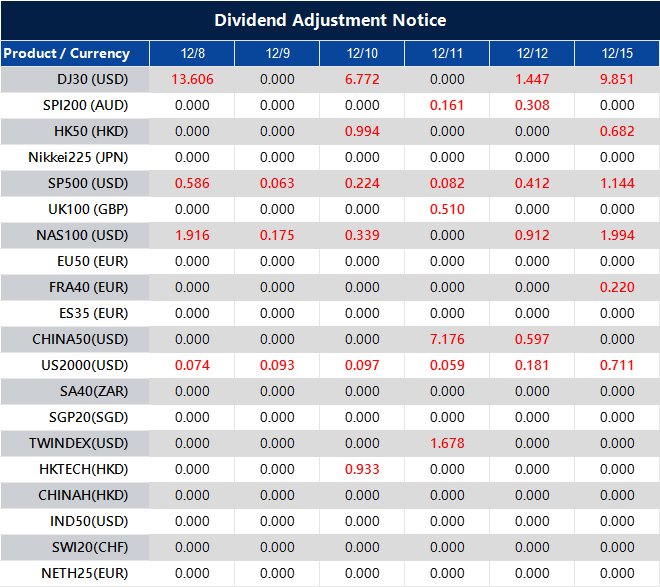
The above data is for reference only, please refer to the MT4/MT5 software for specific data.
If you’d like more information, please don’t hesitate to contact [email protected].







