Back

Modifications on Leverage for Shares (20 > 33)

Dear Client,

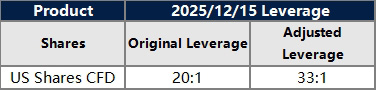
To provide a favorable trading environment to our clients, VT Markets will modify the trading setting of US Shares on December 15, 2025:

1. All US Shares products leverage will be adjusted to 33:1 .

Modifications on US Shares

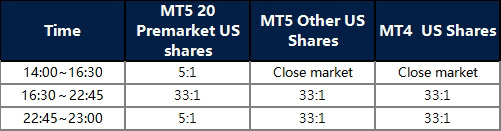
2. 20 Premarket US shares on MT5: Leverage will be 5:1 during 14:00-16:30 and 22:45-23:00 ; and remain 33:1 during the rest of the trading time.

Modifications on US Shares

3. MT5 20 pre-market US stocks: TSLA, NVIDIA, NFLX, META, GOOG, AMAZON, AAPL, ALIBABA, MSFT, SHOP, BOEING, IBM, BAIDU, JPM, EXXON, INTEL, TSM, MCD, ORCL, DISNEY.

The above data is for reference only, please refer to the MT4 and MT5 software for specific data.

Friendly reminders:

1. All specifications for Shares CFD stay the same except leverage during the mentioned period.

2. The margin requirement of the trade may be affected by this adjustment. Please make sure the funds in your account are sufficient to hold the position before this adjustment.

If you’d like more information, please don’t hesitate to contact [email protected]

MetaTrader 4 Or MetaTrader 5: Which One Is Right For You?

Ask any beginner or seasoned traders if they use MetaTrader 4 or MetaTrader 5 to trade their preferred instruments. It is fair to say that 9 out of 10 traders would answer ‘yes’ to this question.

But between MetaTrader 4 and MetaTrader 5, which one is more useful, and what exactly are the differences between these two platform versions?

MetaTrader 4 (MT4): Simple Forex Trading For Everyone

Launched in 2005, MetaTrader 4 is a platform that has become the preferred choice among forex traders. Known for its ease of use and practical features with a strong focus on currency trading, MT4 offers a user-friendly trading experience for both beginners and experienced traders.

Features Of MetaTrader 4

1. Forex-Focused

MetaTrader 4 is designed specifically for forex trading and provides essential tools for analysis and execution.

2. Customisable Charts And Indicators

MetaTrader 4 offers basic charting support with 30 technical indicators and 31 graphical objects.

3. Automated Trading With Expert Advisors (EAs)

MetaTrader 4 users can deploy automated strategies, backtest potential strategies, and enhance their trading experience through algorithmic trading using EAs.

4. Fast and Smooth Performance

Designed to run efficiently across devices, MT4 has proven to remain responsive even during volatile market conditions.

Advantages Of MetaTrader 4

1. User-Friendly Interface

The intuitive MT4 interface makes it easy to access the trading functions you need.

2. Wide Broker Support

MetaTrader 4 is offered by the majority of CFD brokers.

3. Algorithmic Trading

Traders can automate strategies using EAs to execute trades and perform analysis. They can also backtest strategies using historical data before entering the market.

4. Technical Analysis Tools

MT4 provides a wide range of technical indicators and charting tools for conducting technical analysis.

Limitations of MetaTrader 4

1. Outdated Technology

MT4 uses the older MQL4 programming language. This limitation can restrict the sophistication of custom-built indicators and EAs.

2. Limited Timeframes

MT4 offers a relatively small selection of timeframes. Traders who require more unique or specific timeframes may find these limitations restrictive.

3. Hedging Restrictions in Certain Regions

MT4 does not support hedging or netting in certain jurisdictions.

MetaTrader 5: Advanced Tools For Multi-Asset Trading

MetaTrader 5 is an upgraded version of MT4 and offers a broader range of tools for multi-asset trading.

While MT5 retains the core features of MT4, traders gain access to additional trading tools and asset classes, making it more suitable for professional traders looking to diversify their portfolios beyond forex.

Features Of MetaTrader 5

1. Multi-Asset Support

In addition to forex, MT5 is designed for trading stocks, commodities, indices, and cryptocurrencies. It is built for traders who prioritise portfolio diversification.

2. More Order Types And Timeframes

MT5 introduces two additional order types (Buy Stop Limit and Sell Stop Limit) and supports 21 timeframes. As a result, traders benefit from greater flexibility compared to MT4.

3. Economic Calendar

MT5 includes an integrated economic calendar and news feed, allowing traders to track events that may impact their trading strategies.

4. Updated MQL5 Programming Language

The more modern MQL5 language enables the development of more complex automated trading scripts.

5. Depth Of Market (DOM)

MT5 features Depth of Market (DOM), which displays bid and ask prices across multiple levels. This feature is useful for traders assessing market sentiment and liquidity.

6. More Indicators And Analytical Tools

With 38 technical indicators, 44 graphical objects, and a wide range of analytical tools, MT5 provides a data-rich environment for in-depth analysis.

Advantages of MetaTrader 5

1. High Performance

MT5 can handle more indicators, timeframes, and chart windows without sacrificing speed or stability.

2. Hedging

Traders can open both buy and sell positions on the same asset, allowing for more flexible risk management.

3. Comprehensive and Versatile

Traders with diverse trading styles may find MT5 more suitable, as it offers more comprehensive features compared to MT4.

Limitations Of MetaTrader 5

1. Less Popular

MT5 is not as widely adopted as MT4. As a result, more brokers continue to offer MT4 than MT5. In addition, many traders prefer to stick with MT4 due to familiarity.

2. Smaller Community

MT4 has a large user base and developer community that actively contributes support, insights, and resources. In contrast, the MT5 community is smaller, which limits available support and resources.

3. More Complex Platform

The advanced features of MT5 may present a steeper learning curve for new traders.

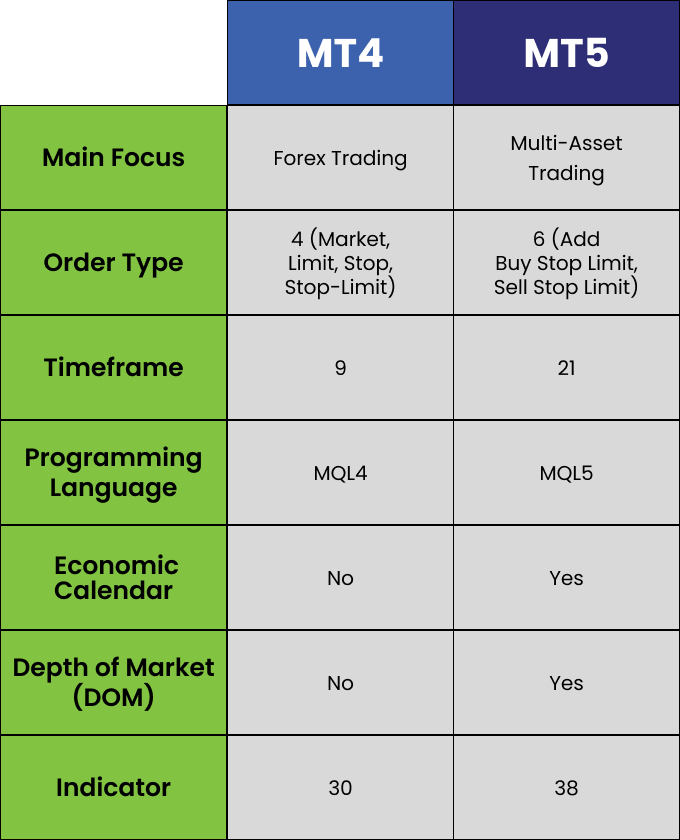
Summary Of Key Differences Between MetaTrader 4 And MetaTrader 5

Conclusion

Are you still unsure which platform is best suited to your trading needs?

You may wish to consider the following questions and answers:

1. Do you focus on only 2–3 assets?

If so, MT4 is more than sufficient. However, if you plan to trade forex, cryptocurrencies, equities, commodities, and indices, MT5 would better meet your requirements.

2. Do you rely heavily on indicators and economic events when making trading decisions?

If yes, you will find that MT5 offers a broader range of technical and fundamental indicators to support your decision-making process.

3. Do you require faster backtesting and algorithmic trading capabilities?

If so, MT5 is more suitable, as it operates using the MQL5 programming language. This language is capable of executing more complex programmes at greater speed.

4. And most importantly… are you new to trading?

For those who are just starting out in the trading world, particularly in forex or gold, MT4 is sufficient for your needs.

You may still choose to use MT5, but be aware that it takes time to understand its additional features. As a beginner, you are unlikely to fully utilise MT5 to its maximum potential.

It is recommended that you start with MT4, as it can still support you with basic analysis, asset selection, market entry, and the opportunity to generate profits if the market moves in your favour.

Further reading: Visit our MetaTrader 4 and MetaTrader 5 pages.

Open a VT Markets live account to begin your trading journey.

The recent decrease in South Korea’s money supply growth from 7.2% to 7.1%

The growth of money supply in South Korea dropped from 7.2% to 7.1% in October. This change might hint at adjustments in the country’s monetary policy and economic conditions. As the economy changes, it’s important to look at how this slower growth rate affects consumer spending and lending. It also plays a role in the overall economic growth in South Korea.

Small Change in Money Supply

The small decrease in South Korea’s M2 money supply growth to 7.1% in October was a subtle sign. Looking ahead from mid-December 2025, this suggests that the Bank of Korea (BOK) might be shifting towards a less supportive economic approach. This is the first significant drop we’ve noticed in several quarters, which deserves our attention. This idea is supported by recent data; for instance, November’s consumer price index showed inflation unexpectedly rose to 3.1%. The BOK kept its policy rate steady at 3.75% during its last meeting but provided cautious guidance, emphasizing its commitment to price stability. Thus, we should view the October M2 figure not as an isolated event but as the start of a bigger trend.

Considerations for Traders

For currency traders, this suggests a strengthening of the South Korean won. They might want to adopt strategies that benefit from a lower USD/KRW exchange rate, such as buying puts on this currency pair. The uncertainty about the BOK’s next steps could increase volatility, making options a useful way to manage risk. However, this tightening of policy may pose challenges for the KOSPI index, as higher borrowing costs may pressure stocks. Strategies like buying protective puts on KOSPI 200 futures or selling call spreads could help protect against potential declines, especially since November’s export data showed a 2.5% drop, indicating that economic growth is already weak. We should recall the BOK’s firm actions during the inflationary period of 2022-2023 when it raised rates aggressively ahead of many other central banks. This history suggests that the BOK will prioritize controlling inflation, even if it means sacrificing short-term economic growth. Therefore, the current small changes in money supply are more important than they might seem at first glance. Create your live VT Markets account and start trading now.

here to set up a live account on VT Markets now

WTI faces selling pressure during Asian trading hours, trading near $56.35 amid optimism over a peace deal.

The price of West Texas Intermediate (WTI) dropped to about $56.35 during Asian trading on Tuesday. This drop is linked to possible progress in peace talks between Russia and Ukraine. A peace deal could help reduce the chances of supply disruptions from Russia. US officials have suggested that a peace agreement with Ukraine’s President Volodymyr Zelenskyy is close to being finalized, though there are still some unresolved issues related to territory and security. If a peace deal is reached, it could increase Russian oil supply, which might drive WTI prices even lower. Alternatively, the threat of US military action in Venezuela could limit how much WTI prices fall.

Impact of Sanctions and Supply Dynamics

Venezuela’s oil exports have significantly reduced due to US sanctions and the seizure of a supertanker. WTI Oil, a key benchmark for crude oil, is affected by supply and demand, political issues, and decisions made by OPEC about production. The value of the US Dollar also plays a role, as oil is traded in this currency. Data from the American Petroleum Institute (API) and the Energy Information Administration (EIA) can influence WTI prices too. Lower inventory levels indicate higher demand, which can push prices up, while higher inventories often result in price decreases. OPEC’s production choices frequently impact WTI prices since they dictate global oil supply. With WTI crude oil falling below $56.50 on news of a possible peace deal between Russia and Ukraine, we are seeing a clear bearish shift. Traders might consider purchasing out-of-the-money put options on February or March 2026 futures contracts, anticipating a drop toward the low $50s. This strategy allows traders to manage risk while taking advantage of the likelihood of Russian oil returning fully to the market. We should recall what happened during the 2015 Iran nuclear deal, which pressured oil prices down for months as new supplies were expected. This bearish outlook is strengthened by last week’s Energy Information Administration (EIA) report, which revealed a surprise increase in inventory of 2.1 million barrels, contrary to expectations of a decrease. However, ongoing tensions with Venezuela may provide some support for prices.

Uncertainty and Volatility in Oil Markets

Implied volatility on WTI options is currently high, reflecting significant uncertainty about the peace deal’s success. Traders can adopt strategies like bear put spreads to manage costs and control risk during this volatile period. This involves buying a put option at a higher strike price and selling one at a lower strike price, allowing for profit from a moderate price decline while protecting against sudden increases. In the upcoming weeks, it’s important to watch signals from the next OPEC+ meeting. With prices falling to levels that may strain the budgets of many member nations, the cartel is likely to indicate or implement production cuts to create a new price floor. If production cuts are coordinated, especially if they involve a post-war Russia, it could quickly reverse the current downward trend. Create your live VT Markets account and start trading now.

here to set up a live account on VT Markets now

Gold prices near seven-week highs in Asia as expectations for US rate cuts rise

Gold prices fell during Tuesday’s Asian session as traders took profits and showed optimism about peace talks in Ukraine. Prices dropped below $4,300, affected by weak selling from short-term futures traders. The hope for peace talks may lower demand for gold as a safe-haven investment. Recently, the Fed cut interest rates and hinted at future cuts, which could help gold by reducing its opportunity cost. The upcoming US government shutdown has delayed important economic data, including the Nonfarm Payrolls (NFP) report, which is crucial for understanding future US interest rates. A slowdown in the US labor market might lead the Fed to further cut rates, potentially boosting gold prices. Additionally, we are awaiting US Retail Sales and the Purchasing Managers Index (PMI) reports.

Gold Price Trends and Resistance Levels

Gold is currently in a long-term uptrend, supported by the 100-day Exponential Moving Average. The next resistance levels are $4,350 and possibly $4,365, while support is at $4,285 and $4,257. The Fed suggests one rate cut by 2026, but the market expects more cuts. The CME Group’s FedWatch tool shows a 75.6% chance that rates will stay the same in January. Gold is pulling back from recent highs as traders take profits and news about potential peace in Ukraine reduces the need for safe havens. However, since the Federal Reserve is lowering rates, this offers strong support for gold. A significant factor awaits us later today in the form of US jobs data. The market is preparing for the delayed Nonfarm Payrolls (NFP) report. Consensus forecasts predict only 95,000 job gains for November 2025, a drop from the previous month’s 150,000. If the actual number is this low or lower, gold prices may rise, making call options or call spreads attractive for those expecting quicker Fed rate cuts. For traders holding long gold futures, this pullback is a chance to think about hedging. Buying put options with a strike price around the important support level of $4,257 could protect against a surprisingly strong jobs report that might temporarily drop prices. This strategy acts as affordable insurance while keeping exposure to potential long-term gains.

Market Projections and Trading Strategies

There is a noticeable gap between the Fed’s forecast of one rate cut in 2026 and the market’s expectation of at least two cuts. A similar situation occurred in late 2023, where market sentiments on rate cuts outpaced the Fed’s guidance, eventually pushing gold to new highs in 2024. This indicates that selling cash-secured puts or establishing bull put spreads below the $4,210 level might be a smart strategy to take advantage of dips. With the NFP report coming up, we can expect increased volatility in gold options. The technical resistance at $4,350 offers an opportunity to sell covered calls from existing positions, generating income from the higher premium. Alternatively, traders expecting significant price movements in either direction might opt for a long straddle strategy to profit from the volatility after the announcement. Create your live VT Markets account and start trading now.

here to set up a live account on VT Markets now

GBP/USD pair remains steady around 1.3370-1.3365 ahead of UK jobs report

The GBP/USD pair is trading around 1.3370-1.3365, staying steady as we approach important economic reports and events. Traders are looking forward to UK employment data, the US Nonfarm Payrolls report, UK inflation numbers, and the Bank of England’s policy decision later this week. Market analysts expect that the Bank of England may lower borrowing costs, and a dovish Federal Reserve chair could help the pair maintain support at the crucial 200-day Simple Moving Average. Currently, the global mood favors the safety of the US Dollar, but its rise is limited by anticipated rate cuts from the Federal Reserve.

UK Claimant Count Change

The UK Claimant Count Change data provides valuable insights into the labor market. If the claimant count rises, it indicates economic troubles and may weaken the GBP. On the flip side, if the count decreases, it can signal improvement and strengthen the Pound. This measure is timely for gauging economic health and can greatly influence GBP volatility. It’s important to remember that the views shared here are by the contributors and may not reflect the official stance of FXStreet. The platform and the author are not liable for any inaccuracies or omissions and do not offer investment advice. Currently, the GBP/USD pair is trading in a tight range around 1.2250, showing little activity ahead of major economic news. This familiar price action reminds us of previous periods of consolidation before important central bank decisions. Traders seem to be hesitant, waiting for a clear direction before making commitments.

Bank of England’s Upcoming Meeting

All eyes are on the Bank of England’s policy meeting scheduled for Thursday. Recent data revealed that the UK Claimant Count for November increased by 15,200, more than expected, while inflation cooled to 2.3%. This reinforces the belief that the BoE may hint at future rate cuts to give support to a slow economy, limiting any significant strength in the Pound for the time being. We recall a similar situation when the 1.3350 level, supported by the 200-day moving average, was a key focus before central bank announcements. Like those times, the pair now seems poised for a sharp move once the economic picture becomes clearer, with the key support level being the psychological mark of 1.2200. Meanwhile, the US Dollar is also facing pressure. The new Federal Reserve leadership, which took over in mid-2025, is expected to pursue more aggressive rate cuts in 2026 to boost growth, even though core inflation is still around 2.8%. This expectation is limiting the Dollar’s strength and providing a safety net for the GBP/USD pair. With the market in this tight range and important news on the horizon, traders might consider using options to prepare for a potential volatility breakout. A strategy like buying a straddle—purchasing both a call and put option with the same strike price near 1.2250—could be effective. This approach would profit from significant price movements in either direction following the Bank of England’s announcement. For those believing the central bank news may not trigger a large movement, monitoring volatility indexes is essential. The Cboe Sterling VIX (GVZ) is currently at moderate low levels, indicating the market isn’t expecting dramatic changes. Selling options to capture premium might be an appealing yet higher-risk strategy for those anticipating a range-bound situation. Create your live VT Markets account and start trading now.

here to set up a live account on VT Markets now

New Zealand dollar falls below 0.5800 due to weak Chinese and US economic data

NZD/USD has fallen below 0.5800, marking its fourth straight day in the red, currently trading around 0.5775 in early Asian markets. Weak economic data from China has placed selling pressure on the New Zealand Dollar against the US Dollar, as traders look forward to upcoming US economic indicators, including the postponed November jobs report. China’s Retail Sales grew at their slowest rate since the COVID-19 pandemic. Additionally, November’s Industrial Production did not meet expectations. Retail Sales increased by 1.3% year-on-year, down from 2.9%, and missing market forecasts. Industrial Production rose by 4.8% year-on-year, falling short of the expected 5.0% and the previous 4.9%.

US Economic Data Release

The US Bureau of Labor Statistics will publish the delayed Nonfarm Payrolls data for October and November, which was postponed due to a government shutdown. These numbers may offer insights into US employment trends and possible interest rate adjustments. A slowdown in the US labor market could lead to expectations of interest rate cuts from the Federal Reserve, which might weaken the US Dollar. The Reserve Bank of New Zealand aims to maintain inflation between 1% and 3%, impacting interest rates and overall economic conditions. Broader market sentiment also affects the NZD, making it stronger during positive market periods and weaker in times of economic uncertainty. Currently, the New Zealand Dollar is showing weakness, similar to trends we saw in late 2023. This decline is driven by disappointing economic news from China, a key export partner for New Zealand. The latest data for November 2025 revealed that Chinese retail sales grew by only 2.1% and industrial production by 4.5%, both failing to meet forecasts and indicating a slowdown. Conversely, the US economy is also showing signs of slowing down, complicating the outlook. The November Nonfarm Payrolls report released earlier this month revealed only 150,000 new jobs, below expectations, leading to an increase in the unemployment rate to 4.0%. This suggests that the Federal Reserve might consider interest rate cuts in 2026, which could limit the strength of the US Dollar.

Trading Strategy Options

For traders, this environment of uncertainty suggests that buying put options on the NZD/USD could be a smart move to guard against further declines. This strategy would act as a hedge if the negative sentiment from China’s economy worsens and pushes the exchange rate below critical support levels. The premium paid for options helps define the risk involved with this position. We should also look at New Zealand’s economic situation, which offers little support for the Kiwi. The latest Global Dairy Trade auction showed prices declining for the third consecutive time, negatively impacting the country’s export revenue. While the Reserve Bank of New Zealand (RBNZ) maintains a strong stance on inflation, this weak export data may limit its ability to bolster the currency. Given the conflicting pressures on the exchange rate, a strategy focused on higher volatility could be effective in the coming weeks. Using options to create a long straddle could allow us to profit from significant price movements in either direction. This strategy is useful when we anticipate volatility but are uncertain whether it will stem from an unexpectedly weak US jobs report or continued declines in Chinese economic performance. Create your live VT Markets account and start trading now.

here to set up a live account on VT Markets now

The PBOC’s USD/CNY central rate is now 7.0602, down from 7.0656

The People’s Bank of China (PBOC) has set the USD/CNY reference rate for the next trading session at 7.0602, down from the previous rate of 7.0656. The PBOC aims to maintain price stability, including stable exchange rates, and to support economic growth through financial reforms and market development. The PBOC is owned by the People’s Republic of China. The Committee Secretary, appointed by the State Council, greatly influences its management. Mr. Pan Gongsheng currently holds both the Committee Secretary position and the Governor role at the PBOC.

PBOC’s Policy Tools

The PBOC uses many policy tools, such as the seven-day Reverse Repo Rate, Medium-term Lending Facility, foreign exchange interventions, and Reserve Requirement Ratio. The Loan Prime Rate serves as the main interest rate for market loans, mortgages, and savings interest. China has 19 private banks, which make up a small part of the financial system. Among these are digital banks WeBank and MYbank, linked to tech companies Tencent and Ant Group. Since 2014, the Chinese government has allowed fully private-funded banks to enter the financial market. With the PBOC setting a stronger reference rate at 7.0602, it clearly intends to strengthen the yuan against the US dollar. This marks a level not seen since early 2024, indicating a policy change. Therefore, we should prepare for a potential decline in the USD/CNY pair in the next few weeks. This official move aligns with recent signs of stabilization in the Chinese economy. For instance, the November 2025 manufacturing PMI data showed an unexpected rise to 51.2, indicating growth. A robust yuan helps manage commodity import costs and signals economic confidence, providing strong support for the currency’s rise.

Opportunities for Traders

For derivative traders, this situation creates opportunities in FX options, especially buying puts on the USD/CNY. This strategy allows you to benefit from a possible decline to the 7.00 psychological level while minimizing risk. If the PBOC’s guidance creates a clear trend, implied volatility may decrease, making long-option strategies more appealing. A stronger yuan also impacts commodities, as it enhances China’s purchasing power for dollar-priced goods like crude oil and iron ore. Currently, oil prices are stabilizing around $85 per barrel due to strong global demand. This currency development could provide extra support, making call options on energy and industrial metal ETFs a smart secondary trade. On a global level, the yuan’s strength coincides with the market expecting a US Federal Reserve policy change in the first quarter of 2026, which is putting pressure on the US dollar. This difference in central bank policies offers a favorable environment for the yuan. We should keep a close watch on upcoming US inflation data, as a lower reading could speed up this trend. Create your live VT Markets account and start trading now.

here to set up a live account on VT Markets now

AUD/USD pair, trading near 0.6630, faces sellers for four straight days in Asia

The AUD/USD has faced pressure for four days due to mixed Australian employment data and economic concerns in China. This situation has impacted the Australian Dollar, although expectations about the Reserve Bank of Australia’s policies offer some support. The pair is trading around 0.6630, down 0.10%, amidst weak global equity markets. Additionally, the US Dollar is near its lowest point since October 7, as expectations for US Federal Reserve interest rate cuts rise.

October NFP Report Awaited

Traders are closely watching the US NFP report for October and are hesitant to make significant moves until its release. Expectations of a more dovish successor to Fed Chair Jerome Powell also support the AUD/USD. In Australia, interest rates from the RBA and prices of key exports, like Iron Ore, play important roles. The health of the Chinese economy is crucial since it directly affects demand for the Australian Dollar. A positive trade balance, driven by high export demand compared to imports, further strengthens the currency. Overall, a stable interest environment and shifting commodity prices are key factors for the AUD. As of today, December 16, 2025, the main themes from over two years ago still influence the AUD/USD, though the situation has changed. The gap between a hawkish Reserve Bank of Australia (RBA) and a dovish US Federal Reserve has widened, pushing the pair to above the 0.66 level seen previously. Currently, the pair is consolidating around the 0.6850 mark.

High Yield Support for AUD

The RBA has maintained a hawkish approach, keeping the cash rate at a restrictive 4.35% throughout 2024 and 2025 to combat ongoing inflation. Australia’s Q3 2025 inflation rate stood at 3.4%, still above the RBA’s target band, which suggests that rate cuts are not coming soon. This high yield is a key support for the Australian dollar. On the other hand, the Federal Reserve began cutting rates mid-2024 as US inflation eased more significantly. The latest US jobs report for November 2025 showed a modest payroll increase of 160,000, confirming a slower labor market and keeping Fed rate cuts on the table for early 2026. This ongoing US dollar weakness benefits the AUD/USD. Concerns about China’s economy remain persistent, limiting the Aussie’s potential. China’s official manufacturing PMI for November 2025 came in at 49.9, indicating a slight contraction, mainly due to issues in its property sector. However, iron ore prices have stayed unexpectedly stable around $120 per tonne, which has helped prevent a larger drop in the AUD. For derivative traders, selling AUD/USD put options with a strike price around 0.6700 could be a useful strategy for earning premium. The high yield of the AUD and the weakening USD provide solid support for the currency pair. This method profits from time decay, betting that significant downturns are unlikely soon. Alternatively, those who believe the pair will move higher could consider buying call spreads as a defined-risk approach to a potential breakout above 0.6900. A softer-than-expected US inflation report could hasten the timeline for Fed cuts, pushing the pair higher. The main risk to this strategy would be an unexpected dovish stance from the RBA, which seems unlikely before their next meeting in February 2026. Create your live VT Markets account and start trading now.

here to set up a live account on VT Markets now

Jibun Bank Manufacturing PMI for Japan reaches 49.7, surpassing expectations of 48.8

The Japan Jibun Bank Manufacturing PMI for December reached 49.7, surpassing the expected 48.8. This shows a positive trend in the manufacturing sector. Additionally, USD/CAD remained steady at around 1.3770, while the Japanese Yen gained value due to expectations of BOJ rate hikes. Meanwhile, WTI crude oil prices fell below $56.50, partly due to speculation about a possible peace deal between Russia and Ukraine.

Gold And Currency Performance

Moreover, Gold prices increased amid hopes for US Fed rate cuts. The GBP/USD pair stayed above the mid-1.3300s, while NZD/USD dropped below 0.5800 due to negative data from China. In top picks, EUR/USD held its gains near 1.1750, and GBP/USD remained stable ahead of key economic data. Gold continued to trade above $4,300, supported by rate cut expectations, while cryptocurrencies like Aster and Ethena experienced declines. An NFP preview suggested a complex data release that could impact monetary policy decisions. For brokers in 2025, leading currency dealing firms were recommended, especially those with low spreads and trading opportunities involving EUR/USD. Benefits for traders included educational resources and cashback offers. A legal disclaimer emphasized the importance of thorough research before any financial commitments, as potential risks and losses are the investor’s responsibility. Japan’s manufacturing sector shows surprising strength as we near the end of 2025, with the latest PMI data exceeding expectations. A reading of 49.7 is the best we’ve had in nearly two years, a significant improvement from the sub-48 levels seen throughout much of 2024. This resilience suggests the Japanese economy may be on the rise, supporting a stronger yen. The key focus for derivative traders is the growing differences between the Bank of Japan (BOJ) and the US Federal Reserve. The BOJ’s historic move to end negative interest rates in March 2024 has set the stage for today’s situation, where markets expect more rate hikes. This contrasts sharply with the Fed’s ongoing rate cuts, a major shift from last year’s peak rates of over 5%.

Market And Economic Trends

This policy split puts downward pressure on the USD/JPY currency pair. We have already seen the pair retreat significantly from the highs above 150 in 2024. Options markets now predict a shift toward the 130 level in the first quarter of 2026, making it wise for traders to position for further yen strength against the dollar. However, the global economic picture is complex, indicating rising volatility in the coming weeks. Gold holding near $4,300 an ounce suggests significant flight to safety or ongoing inflation fears, greatly surpassing the previous records set in 2024. In contrast, WTI crude oil trading below $56.50 a barrel points to a global slowdown and weak industrial demand. These mixed signals make broad market bets risky, but they also create opportunities for relative value trades. Weakness in Chinese data is dragging down currencies like the New Zealand dollar, opening up possibilities for pair trades against stronger economies. Strategies that capitalize on volatility, such as straddles on major equity indices, should be considered as the market processes these conflicting economic signals. Create your live VT Markets account and start trading now.

here to set up a live account on VT Markets now

Back To Top
server

Hello there 👋

How can I help you?

Chat with our team instantly

Live Chat

Start a live conversation through...

  • Telegram
    hold On hold
  • Coming Soon...

Hello there 👋

How can I help you?

telegram

Scan the QR code with your smartphone to start a chat with us, or click here.

Don’t have the Telegram App or Desktop installed? Use Web Telegram instead.

QR code