



UK’s actual goods trade balance of £-22.542 billion falls short of £-19.3 billion forecast
In October, the United Kingdom’s goods trade balance showed a deficit of £22.542 billion, worse than the expected £19.3 billion. This suggests a bigger trade imbalance than previously thought.
The British Pound remained stable despite mixed economic news. The UK GDP unexpectedly fell by 0.1%, while a 0.5% rise in Manufacturing Production fell short of the anticipated 1% growth.
The Harmonised Index of Consumer Prices in Germany fell by 0.5%, matching the forecast.
The German Harmonized Index of Consumer Prices (HICP) for November showed a rate of -0.5%, which matches expectations. This suggests that prices in the German economy are stable.
In other currency news, the Pound Sterling has dropped following another decline in the UK’s monthly GDP. The USD/INR exchange rate remains stable despite uncertainties in US-India trade relations, while USD/CAD continues to decrease for the fourth consecutive day.
Market Trends and Movements
Current market trends highlight important movements, including gold prices rising above $4,300. The EUR/USD is approaching two-month highs amid speculation about potential US Federal Reserve rate cuts. The Japanese yen is gaining ground due to a positive outlook from the Bank of Japan. A discussion about broker options for 2025 includes information on offerings with low spreads and high leverage. The list features top brokers from various regions, each with unique advantages and drawbacks. It is important to conduct personal research before trading. Investors are reminded of the risks involved, as losses are possible. All data should be independently verified, as neither FXStreet nor the author guarantees accuracy or timely updates. Germany’s 0.5% month-on-month price drop confirms the overall disinflation trend in Europe. This has contributed to the annual inflation rate in Germany falling to 2.3% last month, the lowest since mid-2023. We expect this will make the European Central Bank wary of raising interest rates, even as the Euro gains strength against a weakening US dollar.Market Expectations
The main factor driving the markets is the expectation of interest rate cuts from the US Federal Reserve. The latest US inflation data from November 2025 shows a slowdown to an annual rate of 2.5%. Futures markets now indicate over a 90% chance of a rate cut by March 2026, which is likely to lead to a weaker US dollar and support dollar-denominated assets. In this context, using options to gain exposure to rising gold prices might be wise. Gold’s rise past $4,300 is linked to the declining dollar and the possibility of lower interest rates, similar to what we observed during the monetary easing period of 2020-2021. Long-dated call options on gold futures or major gold mining ETFs could be smart ways to benefit from this trend. Meanwhile, there is a clear divergence among major economies. The UK economy’s 0.2% contraction in the third quarter of 2025 indicates further weakness for the Pound Sterling, making put options on GBP/USD appealing. In contrast, the Bank of Japan’s firm stance supports the yen, suggesting opportunities in selling EUR/JPY or GBP/JPY futures contracts. Create your live VT Markets account and start trading now.German Harmonised Index of Consumer Prices matches predictions at 2.6% year-on-year
Germany’s Harmonized Index of Consumer Prices (HICP) for November showed an annual rate of 2.6%, which aligns with expectations. This number indicates stability in the German economy and confirms earlier analyses of inflation rates.
The stability shows that while there are inflationary pressures, they are not increasing. This could influence future economic policies as analysts and policymakers evaluate the situation.
Importance of Inflation Data
Inflation data is crucial since it affects interest rate decisions and economic outlooks in Germany and the Eurozone. The consistent consumer prices may provide some comfort amid global economic changes. It’s important to watch how the market reacts to this information, as it might influence actions by the European Central Bank (ECB) regarding ongoing inflation trends. With German inflation closely matching expectations at 2.6% for November, we can anticipate a time of lower market volatility. This predictability reduces surprises that often lead to sharp price movements. For derivative traders, this suggests that strategies focused on selling options for premium collection could be beneficial in the near term. This steady inflation figure will likely keep European market volatility low, as measured by the VSTOXX index. The index has been around multi-year lows near 15, and this data gives little reason for volatility spikes. Thus, selling volatility through tools like short straddles on the Euro Stoxx 50 index may be a wise strategy.ECB’s Approach to Interest Rates
The data supports the idea that the European Central Bank will not rush to make large interest rate cuts. With inflation still above the 2% target, monetary policy is expected to move slowly, contrasting with the rapid rate increases seen in 2023. This suggests that expectations for major rate cuts in the first quarter of 2026 may need to be adjusted. For currency traders, this stable outlook for Europe could bolster the Euro, particularly against currencies with central banks indicating quicker rate cuts. We have seen the EUR/USD pair getting solid demand around the 1.08 level throughout the last quarter. This data strengthens the case for a stable or slightly stronger Euro, making long positions via call options or futures a viable strategy. Create your live VT Markets account and start trading now.Dividend Adjustment Notice – Dec 12 ,2025
Dear Client,
Please note that the dividends of the following products will be adjusted accordingly. Index dividends will be executed separately through a balance statement directly to your trading account, and the comment will be in the following format “Div & Product Name & Net Volume”.
Please refer to the table below for more details:
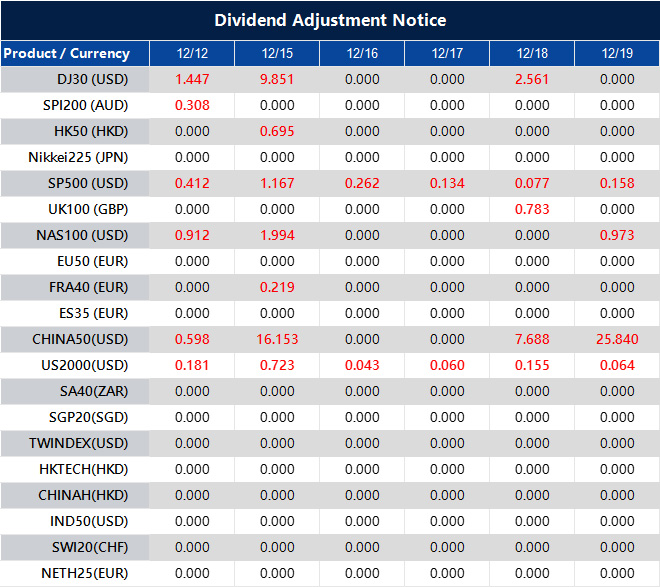
The above data is for reference only, please refer to the MT4/MT5 software for specific data.
If you’d like more information, please don’t hesitate to contact [email protected].
UK GDP for the month falls short of expectations, showing a decrease of 0.1%
Economic Performance Influences
Several factors may have impacted the monthly GDP numbers, but specific reasons weren’t provided. It’s important to keep an eye on upcoming economic reports for more details. As the year continues, these figures could shape economic strategies and forecasts. Regularly tracking these metrics is essential for grasping the overall economic situation. The unexpected 0.1% economic contraction in October supports our belief that the UK economy is slowing down. This is not an isolated case; it clearly indicates that the Bank of England’s recent rate hikes are starting to take effect. We anticipate this will put significant downward pressure on the pound in the coming weeks.Market Reactions and Predictions
Due to this decline, the market is quickly reconsidering interest rate paths. There is a noticeable shift in SONIA futures, with traders now seeing a higher chance of a rate cut by the second quarter of 2026. Recent inflation data from November 2025 showed that headline CPI dropped to 2.8%, which strengthens the argument for the Bank of England to adopt a more cautious approach. For equity traders, this means being careful with UK-focused stocks, especially those in the FTSE 250 index. The latest GfK consumer confidence index, which reached a 12-month low in November 2025, supports the GDP data and signals a weak outlook for retail and hospitality sectors. We expect increased volatility, making protective put options on local indices a wise choice. This economic scenario reminds us of the technical recession we experienced in the second half of 2023, where a sharp slowdown followed aggressive monetary tightening. The pound is already testing key support levels against the dollar, having dropped 1.5% in the past month to around 1.2150. Any additional weak data, like the upcoming retail sales numbers, is likely to speed up this trend. Create your live VT Markets account and start trading now.UK manufacturing production increased by 0.5% month-on-month, below the 1% forecast
**Global Financial Markets**
Digital currencies like Bitcoin and Ethereum are reaching resistance levels. They could rise if they manage to break through those barriers. Major global indices, such as the S&P 500, have seen increases following a recent rate cut by the Federal Reserve. This change influences investments across various market sectors.
In this environment, brokerage trends offer options for budget-conscious traders and those seeking specific financial insights. The financial landscape in 2025 emphasizes choosing brokers that meet particular trading needs and regional focuses.
**UK Economy Challenges**
Recent data indicating a decline in UK manufacturing production from October serves as a warning sign of ongoing economic weakness. Combined with an unexpected contraction in GDP at that time, this trend has unfortunately persisted into the last quarter of 2025. This pattern of underperformance is now a significant concern as we enter the new year.
Currently, the UK economy faces challenges, presenting new opportunities in derivatives. The latest S&P Global/CIPS UK Manufacturing PMI for November 2025 is at 47.9, showing over a year of declining activity and indicating a stagflation environment. The Bank of England’s decision to keep rates steady at 5.0% to combat ongoing services inflation suggests that pressure on British industry will likely remain in the near future.
We see potential in betting on further weakness of the Pound Sterling, currently around the 1.2300 level against the US Dollar. Buying GBP/USD put options with a February 2026 expiry and a strike price near 1.2150 could be a wise move. This strategy enables traders to take advantage of downturns driven by poor economic data expected in early 2026.
The outlook for the Euro is changing, but for different reasons than in the past when the Fed was cutting rates. Now, with Eurozone inflation dropping to 2.1% in November 2025, the European Central Bank faces increasing pressure to consider easing policies in early 2026. This potential policy shift, contrasting with a cautious Fed, suggests a cap on EUR/USD. Selling out-of-the-money call options above 1.0900 could be a smart way to earn premiums.
Gold continues to thrive due to ongoing demand from central banks. This trend has strengthened since the significant purchases seen in 2022 and 2023. The World Gold Council’s latest reports show that central banks were net buyers in the third quarter of 2025, providing a solid price floor for gold. Thus, any drops in gold prices toward the $2,250 per ounce mark should be seen as buying opportunities. Traders might consider using call options on futures to minimize risk while keeping upside potential.
Create your live VT Markets account and start trading now.
AUD/USD stabilizes around 0.6660 after hitting a three-month peak during a rally pause
The AUD/USD is holding steady at around 0.6660 after a strong three-week rally came to an end due to disappointing Australian job numbers. The Australian Dollar peaked at 0.6686, but now attention turns to the US Nonfarm Payrolls data to gauge the Federal Reserve’s future monetary policy.
Australia’s job market showed a loss of 21.3K jobs in November, while a gain of 20K was expected. On the other hand, the US Dollar Index is close to its seven-week low of 98.13, following three recent meetings of the Fed where rates were cut by 100 basis points, now resting between 3.50% and 3.75%.
Technical Aspects Of AUD/USD
Technically, AUD/USD is stable near the 20-Exponential Moving Average, suggesting a bullish trend with a 14-day Relative Strength Index (RSI) of 67. Although momentum remains strong, there are indicators of potential overbought conditions, which could lead to consolidation. Resistance is seen at 0.6707, while support is around 0.6551. The US Dollar is the most traded currency worldwide, making up over 88% of forex transactions. Its value is greatly influenced by the Federal Reserve’s monetary policy, with interest rate changes having a significant impact. Quantitative easing generally weakens the dollar, while tightening tends to support it. The AUD/USD pair is pausing at 0.6660 after its recent climb. This slowdown follows weak Australian employment figures that showed an unexpected drop in jobs, shifting focus to the upcoming US Nonfarm Payrolls (NFP) data for potential direction. The Federal Reserve has been reducing interest rates this year, cutting them by one full percentage point in three meetings to address a softening job market. With the latest Consumer Price Index revealing core inflation has dropped to 2.8% year-over-year, the Fed is focused on employment trends. The market eagerly awaits Tuesday’s NFP data to see if job market weaknesses persist.Market Reactions And Strategies
For traders in derivatives, this situation indicates a market poised for movement. If the upcoming US jobs data is worse than expected, it will likely confirm the Fed’s trend of rate cuts, weakening the dollar and pushing AUD/USD toward the resistance at 0.6707. In this case, buying call options could be a smart way to take advantage of the possible upward movement. On the flip side, a surprisingly strong NFP report could lead the market to reassess the speed of future Fed rate cuts, strengthening the dollar. This scenario could drive AUD/USD lower, potentially breaking through current support levels. Traders anticipating this outcome might consider buying put options to profit from a possible decline toward the 0.6550 zone. With this uncertainty, implied volatility in the currency markets has been decreasing ahead of the data release. The CME’s AUD/USD Volatility Index (AUDVOL) just hit a multi-week low of 8.5, making options strategies that benefit from significant price moves, like straddles, more affordable. This creates a trading opportunity for a breakout in either direction triggered by the NFP data. A critical technical level to monitor is the 20-day moving average, currently around 0.6588. If the AUD/USD breaks decisively below this level after the US jobs report, it would indicate a downward momentum shift. As long as it stays above this level, the overall trend remains upward, favoring bullish strategies. Create your live VT Markets account and start trading now.EUR/JPY shows strength above 182.50, gaining close to 182.75
EUR/JPY is slightly up, trading around 182.75 in early European trading. The outlook remains positive due to strong RSI momentum, with resistance at 182.82 and initial support at 181.18. The Japanese Yen is losing value against the Euro because of worries about Japan’s finances, especially related to Prime Minister Sanae Takaichi’s spending plans and economic growth.
Bank Of Japan’s Influence
The upcoming interest rate decision from the Bank of Japan may impact the Yen’s value. There are rising expectations for a rate hike, which could strengthen the JPY and create challenges for the EUR/JPY cross. A Reuters poll indicates that 90% of economists expect the rate to rise from 0.50% to 0.75% in the BoJ’s December meeting, up from 53% last month. On the daily chart, the pair is trading above the 100-day EMA at 175.89, supporting an uptrend, even though the RSI is slightly overbought at 68.85. The price is close to the upper Bollinger Band at 182.82, indicating bullish pressure. The narrowing bands could point to a potential directional shift. A pullback may lead to support levels at 181.18, with additional support at 179.53. A close above the upper band could result in new highs. Currently, the EUR/JPY pair is gaining strength, moving toward the 182.82 resistance ahead of the weekend. While the bullish trend persists, the upcoming Bank of Japan meeting next week is causing market tension, creating a contrast between current momentum and a significant risk event.Market Speculation On Rate Hike
Markets are anticipating a high chance of a rate hike, with estimates moving from 0.50% to 0.75%. This speculation is driven by Japan’s latest core CPI data for November, which held stubbornly at 2.9%, well above the central bank’s target. The sharp gain in JPY after the BoJ’s first hike back in March 2024 sets a clear precedent. On the Euro side, the European Central Bank’s recent dovish stance adds complexity. The ECB has reduced rates twice in the second half of 2025 to address slowing growth, leading to a clear monetary policy divergence favoring the Yen. This fundamental pressure may limit any further upside for EUR/JPY, despite current technical strength. Given the binary nature of the upcoming BoJ decision, traders might consider strategies that profit from significant price moves. Implied volatility for one-week EUR/JPY options has jumped over 30% in the past month, signaling market expectations for a breakout. This suggests that long volatility strategies, like straddles or strangles, could be wiser than simply betting on a direction. If the BoJ surprises by holding rates steady, the JPY could weaken significantly, potentially pushing EUR/JPY through 182.82 resistance and into new highs. On the other hand, if the expected rate hike happens, the price could quickly test the initial support at 181.18. A drop below that level would shift focus to the lower Bollinger Band near 179.50. Create your live VT Markets account and start trading now.UK’s GDP and industrial production data to be released by ONS at 07:00 GMT
The UK will release its GDP and Industrial Production data for October. The Office for National Statistics expects to announce a 0.1% increase in GDP, bouncing back from the previous month’s decline.
Industrial Production is anticipated to grow by 0.7% after falling by 2% in September. However, the annual Industrial Production may drop by 1.2%, following a previous decline of 2.5%.
GBP in Bullish Territory
The GBP/USD is performing well, reaching a resistance level of 1.3400. The Federal Reserve’s interest rate cut has boosted risk appetite, causing the USD to weaken. Fed Chair Jerome Powell mentioned that further rate changes are unlikely until 2026, with only two more cuts expected in the next two years. Traders are speculating on a quicker rate-cutting pace next year. After the Fed’s 25-basis-point cut and a disappointing jobs report, the Pound Sterling increased by over 0.68%. The GBP/USD hit 1.3417, the highest level in six weeks. US Initial Jobless Claims rose to 236,000, up from 192,000. Continuing Claims decreased from 1.937 million to 1.838 million, according to the Department of Labor.Federal Reserve Policy
The Federal Reserve’s recent interest rate cut is boosting market confidence and weakening the US dollar. Although the Fed suggests no rate changes until 2026, the market is pricing in a more aggressive rate-cutting cycle for next year. This difference is currently driving currency movements. Recent data aligns with this perspective. The latest Consumer Price Index (CPI) report shows inflation eased to 3.1% year-over-year, giving the Fed more flexibility to cut rates. Meanwhile, initial jobless claims have climbed to 236,000, indicating some softness in the labor market. This combination supports a bearish outlook for the dollar. Even though the pound has rallied to a six-week high above 1.3400, its strength is uncertain. The UK economy unexpectedly contracted by 0.1% in October, missing expectations for slight growth. This negative news raises concerns about the pound’s upward momentum. Taking a closer look, we find that UK GDP has been mostly flat over the past year, with recent ONS data showing only a 0.2% growth in the third quarter of 2025. The Bank of England has also taken a cautious approach by keeping rates steady to combat persistent core inflation above its 2% target. This difference in policy compared to the Fed may limit how high the pound can rise. Due to these mixed signals, we anticipate increased volatility in GBP/USD in the coming weeks. The rally driven by US dollar weakness may encounter headwinds from the UK’s poor economic data. Traders might consider options strategies that benefit from significant price fluctuations instead of predicting a single direction. We’ve seen a similar situation in the years after the 2008 financial crisis. Aggressive Fed easing weakened the dollar, but economic issues in the UK limited the pound’s gains. That era was characterized by sharp reversals and erratic trading within a wide range. This historical context suggests caution for anyone with a strong directional opinion right now. Create your live VT Markets account and start trading now.The Indian rupee weakens as USD/INR hits a record 90.86 due to trade concerns
The Indian Rupee has dropped to about 90.86 against the US Dollar due to uncertainty over a trade deal between the US and India. In December, Foreign Institutional Investors have been net sellers, offloading assets worth Rs. 18,491.29 crore.
This decline in the Rupee is linked to the lack of results from discussions between US Trade Representative Rick Switzer and Indian negotiators. Traders are waiting for India’s retail CPI and the US NFP data for November for more clues.







