



Interest rates may rise in December due to government support, according to three sources.
The Bank of Japan is likely to raise interest rates in December, moving from 0.5% to 0.75%. Governor Kazuo Ueda has mentioned that the bank will consider the “pros and cons” of this decision, hinting at a possible rate hike during the meeting on December 18-19.
The USD/JPY pair has increased by 0.08% to 155.35. The Bank of Japan (BoJ) is the country’s central bank, focusing on achieving an inflation target of around 2%. Since 2013, it has followed an ultra-loose monetary policy, using Quantitative and Qualitative Easing to boost the economy.
The US dollar’s decline stops as focus shifts to employment data updates
The US Dollar stabilized early Thursday after significant losses on Wednesday. Traders are looking forward to new employment data. Important events to note include European Retail Sales figures and US Initial Jobless Claims. Recent US reports showed the private sector lost 32,000 jobs in November, much worse than the expected gain of 5,000 jobs. The ISM’s Services PMI edged up slightly, but the Employment Index continues to show job losses. The USD Index fell to its lowest point since late October before making a small recovery.
Table data indicated that this week, the USD was weakest against the Australian Dollar, dropping by 0.93%. During Asian hours, the Bank of Japan expressed caution regarding future rate hikes, while USD/JPY remained stable below 155.50. EUR/USD hit a recent high but then corrected to about 1.1650. GBP/USD increased by over 1% on Wednesday, staying above 1.3300. Meanwhile, AUD/USD continued its upward trend, trading above 0.6600. Despite the weak USD, gold prices remained stable below $4,200.
Key Economic Indicators
Employment levels are crucial for evaluating the economy, as they impact consumer spending and inflation. High wage growth can increase spending but may also lead to higher inflation, drawing attention from central banks. The US Fed emphasizes employment and price stability, while the ECB aims to control inflation. However, all agree that employment is essential for economic health and understanding inflation. The unexpected drop in private sector jobs signals significant weakening in the US labor market. This isn’t just a one-time occurrence, but a sign that a cooling trend has been developing for months. This slowdown is expected after the Federal Reserve’s strict monetary policies throughout 2024. Supporting information shows job openings have been declining all year, recently reaching their lowest level since early 2024. With today’s Initial Jobless Claims figures still pending, we expect more evidence of this trend, especially since continuing claims are rising toward two-year highs. This consistent pattern strengthens the case for a dovish shift in Fed policy.Trading Strategies
For derivative traders, this situation suggests preparing for ongoing US Dollar weakness, especially against currencies like the Australian Dollar and Euro. According to the CME FedWatch Tool, market pricing now indicates a greater than 60% chance of a Fed rate cut in the first quarter of 2026, a sharp increase from last month. Buying out-of-the-money put options on the USD Index or call options on EUR/USD set for January or February 2026 could be effective strategies. We should also keep an eye on the USD/JPY pair. The Bank of Japan’s comments add complexity, but ongoing US weakness will likely continue to push the pair lower in the coming weeks. Gold’s lack of strong rallies despite the falling dollar is unusual and suggests that the market is currently more focused on real yields. This makes currency options a more straightforward way to trade the weakening employment outlook in the US. Create your live VT Markets account and start trading now.Silver price (XAG/USD) drops to around $58.00 after hitting $59.00 during late Asian trading
Silver has recently dropped to around $58.00 after reaching about $59.00. However, expectations for a Federal Reserve interest rate cut keep the outlook for silver positive. The US labor market is struggling, having lost 32,000 jobs in November, which affects the dollar. This situation might benefit silver prices, especially because silver doesn’t earn interest in a lower rate environment. The chance of a 25 basis point rate cut in December is now at 89%.
From a technical perspective, silver is still in a short-term uptrend, trading above the 20-day EMA at $53.61. The RSI is at 71.61, which suggests it may be overbought and could cool off soon. However, if silver stays above the average, any dips might attract buyers. Silver’s price is expected to rise as long as daily closes remain above the EMA.
Silver is a favored investment due to its value storage and use as a medium of exchange. Its prices can be influenced by geopolitical issues, interest rates, the performance of the US dollar, and industrial demand. Silver’s movements often follow gold’s trends, and the Gold/Silver ratio helps gauge their relative values. This ratio can show if one metal is undervalued compared to the other.
With silver pulling back to nearly $58.00 after peaking, we see this as a temporary pause rather than a full reversal. The market conditions, especially the high likelihood of a Federal Reserve rate cut next week, remain supportive. A weaker dollar, struggling to stay above its monthly low of 98.80, will also make silver more appealing.
For traders who are optimistic, this dip is a chance to start or add to long positions. Buying call options with strike prices above the recent $59.00 high or using bull call spreads to reduce costs would be good strategies to take advantage of the expected continued uptrend. The expectation is that the weak US labor data, such as the surprising 32,000 job loss in November, will force the Fed to act.
We should see any further weakness toward the 20-day moving average, currently around $53.61, as a valuable buying opportunity. The overbought RSI reading indicates this cooling-off period is healthy for a future rise. Setting buy orders or selling cash-secured puts at these lower prices can be an effective strategy for entering the market at a better rate.
Fundamentally, silver demand remains strong, which should prevent a significant drop in prices. Recent data shows that global solar panel installations, a critical source of industrial silver demand, increased by over 25% in 2024, a trend we believe will continue into 2025. Coupled with ongoing inflation around 3.2% as seen in recent CPI reports, silver’s appeal as both an industrial metal and an inflation hedge is solid.
For those looking to protect existing long positions, buying put options with strikes below the $53.00 level could safeguard against an unexpected market decline. This strategy serves as insurance while allowing you to keep your bullish outlook. The cost of these options may be relatively low due to the strong upward momentum.
Additionally, the Gold/Silver ratio has been compressing since 2024, when it consistently stayed above 80. This suggests silver is outperforming gold, which may draw further investments as traders shift toward the stronger asset. This trend should provide extra support for silver prices in the weeks ahead.
During early European trading, the AUD/JPY pair rises to around 102.75 due to positive technical signals.
The AUD/JPY pair showed strength, reaching about 102.75 during early European trading on Thursday. This strength was supported by technical indicators, including a bullish RSI and positions above key moving averages. The pair faces initial resistance at 102.88, with support expected at 101.41. The Australian Dollar has gained against the Japanese Yen, partly due to decreasing chances of policy easing from the Reserve Bank of Australia (RBA). The RBA is likely to keep its cash rate at 3.60% in the upcoming monetary policy meeting, with potential changes not expected until 2026 due to ongoing inflation concerns.
Technical analysis indicates that AUD/JPY is trading at 102.79, above the 20-day SMA at 101.41 and the 100-day EMA at 98.75. The Bollinger Bands show buying pressure, while an RSI of 65.02 suggests bullish sentiment without overbought conditions. The price staying above the 20-day average supports momentum for the pair.
Key factors influencing the Australian Dollar include the RBA’s interest rates, iron ore prices, the Chinese economy, and Australia’s trade balance. The RBA affects AUD through interest rates and policies of quantitative easing or tightening. Furthermore, Australia’s trading relationship with China means its economic health also impacts the AUD. Changes in iron ore prices and the trade balance are critical for the currency’s value.
With AUD/JPY stabilizing around 102.75, the positive technical signals reinforce confidence in the uptrend. The strong RSI indicates further potential for growth. Next week’s RBA policy meeting will be a key event to watch.
Expectations that the RBA will maintain its cash rate at 3.60% are supported by the October 2025 monthly CPI indicator, which was 3.8%. This persistent inflation above the target band suggests that rate cuts are not likely in the near future. Derivative markets appear to be eliminating any dovish surprises, making long AUD positions against the JPY attractive.
Additionally, the commodity markets are supporting the Aussie. Iron ore prices recently held above $135 a tonne, benefiting Australia’s export earnings. This is backed by data from China, showing the Caixin Manufacturing PMI for November 2025 expanded to 50.9.
On the Japanese side, the Bank of Japan remains relatively dovish. The interest rate difference between the RBA’s 3.60% and the BoJ’s low rate creates a favorable environment for carry trades. This situation is similar to the dynamics seen from 2022 to 2024, where central bank policy differences drove the pair’s movement.
Given this positive outlook, traders might consider buying call options or setting up bull call spreads with strike prices above the 102.88 resistance level. The support at 101.41 is significant; any dip to this 20-day average could be seen as a buying opportunity. The primary risks in the coming weeks include an unexpectedly dovish statement from the RBA or a sudden decline in Chinese economic data.
EUR/USD pair shows slight decline during Asian session despite supportive fundamentals above 1.1600
The EUR/USD currency pair fell during the Asian session, trading around 1.1660-1.1655. This drop follows a peak not seen since October 17, as the US Dollar slightly recovered from its lows in late October.
The USD’s rise has been limited due to expectations that the Federal Reserve may take a cautious stance. Recent US data suggests an economic slowdown and a weakening labor market, increasing the chances of a 25-basis-point rate cut at the next Federal Open Market Committee (FOMC) meeting. Meanwhile, the European Central Bank’s (ECB) decision to halt interest rate cuts supports the Euro.
Technical Analysis
Technically, EUR/USD’s breakthrough above the 100-day Simple Moving Average signals a positive trend. Attention now turns to upcoming US economic reports, such as Challenger Job Cuts and Weekly Initial Jobless Claims, which will precede crucial inflation data. The heat map shows percentage changes in major currencies, with the US Dollar gaining the most against the Japanese Yen. This allows users to see how currencies perform against each other, providing a clearer picture of market dynamics. There is a distinct divide between the anticipated actions of the Federal Reserve and the European Central Bank. This difference in policy is likely to influence the EUR/USD exchange rate in the coming weeks. Any drops toward the mid-1.1600s may present good opportunities for long positions. The case for a Fed rate cut next week is strengthening, as US inflation eased to 3.1% in November 2025. The labor market has also softened, with job openings falling to 8.7 million, the lowest in over two years. This has led markets to assign a high probability to a rate cut, with the CME’s FedWatch tool indicating chances above 60% for a 25-basis-point reduction.ECB Policy Stance
On the other hand, the European Central Bank seems to be adopting a stable approach, providing support for the Euro. Eurozone inflation has greatly decreased, with the Harmonised Index of Consumer Prices (HICP) for November 2025 at just 2.4%. This supports the idea that the ECB has finished cutting rates for now and will wait for additional data before making any changes. For derivatives traders, a strategy of buying call options on the EUR/USD might be effective to benefit from the expected upward movement. Additionally, selling out-of-the-money put options could be a way to earn premiums, especially given the strong support above the 1.1600 mark. We expect implied volatility may rise leading up to next week’s FOMC meeting and Friday’s US inflation report. The outlook remains positive, as we recently saw a significant break above the 100-day Simple Moving Average, which may now provide dynamic support against any pullbacks. Traders should stay alert for US jobless claims figures today and the vital inflation data on Friday, as any surprises could lead to short-term price fluctuations. Create your live VT Markets account and start trading now.Gold prices in Saudi Arabia have decreased, according to market data.
Gold prices in Saudi Arabia dropped on Thursday. The price per gram fell to 506.38 Saudi Riyals from 507.51 SAR the day before. The cost per tola also decreased to SAR 5,906.32, down from SAR 5,919.52.
Here are the unit prices in SAR:
– 1 Gram: 506.38
– 10 Grams: 5,064.04
– Tola: 5,906.32
– Troy Ounce: 15,750.20
FXStreet updates international gold prices to fit Saudi Arabia’s currency and local units each day.
Gold As A Store Of Value
Gold has long been seen as a safe investment, especially during tough economic times. It helps protect against currency decline and inflation. Central banks keep large reserves of gold, adding 1,136 tonnes worth about $70 billion in 2022. Gold prices usually go up when the US Dollar weakens. Global events and economic conditions play a significant role in determining the price. Lower interest rates usually help gold because it doesn’t generate yields, while higher rates can keep prices down. The US Dollar’s performance is crucial for gold pricing. The slight dip in gold prices on December 4, 2025, should be seen as an opportunity rather than a weakness. We believe the overall economic outlook points to higher prices soon. This temporary softness offers a chance to prepare for anticipated strength.Market Dynamics And Future Predictions
We are closely monitoring the US Federal Reserve. Their recent statements hint at possible rate cuts in the first half of 2026 to support the slowing economy. Traditionally, lower interest rates lead to a weaker US Dollar and boost assets like gold that don’t generate yields. The US Dollar Index has dropped by 2% in the past month, hovering around 99.0 this week, providing a positive boost for gold. Central bank demand continues to play a key role, with a strong purchasing trend since 2022. Preliminary data for 2025 shows that central banks have added another 950 tonnes to their reserves, creating a sturdy support for gold prices. This ongoing buying, particularly from emerging market banks, indicates a long-term move away from the dollar. Geopolitical uncertainties and persistent inflation are also increasing the demand for safe investments. The latest US Consumer Price Index data for November 2025 stands at 2.9%, leading investors to focus on preserving wealth. As riskier assets like stocks show volatility after a strong year, gold’s importance as a hedge is growing. Given these trends, traders should consider opening long positions. Call options expiring in February or March 2026 could capture potential gains from a change in Fed policy. The current price level is a good entry point for building these bullish positions in the coming weeks. Create your live VT Markets account and start trading now.Gold prices drop in the Philippines, according to financial data reports.
Gold prices in the Philippines dropped on Thursday, according to FXStreet data. The price per gram fell to 7,983.26 Philippine Pesos from PHP 8,002.44 the day before.
The price for a tola decreased to PHP 93,117.34 from PHP 93,338.92 yesterday. These prices reflect international rates adjusted for the USD/PHP exchange rate.
Factors Affecting Gold Prices
Investors see gold as a valuable asset and an alternative currency. Central banks hold the most gold, adding 1,136 tonnes in 2022. Many factors impact gold prices. For instance, gold often rises during geopolitical uncertainties. Additionally, lower interest rates generally make gold more appealing. Gold prices typically move in the opposite direction of the US Dollar and US Treasuries. A weak Dollar usually pushes gold prices up, while a strong Dollar can lower them. The recent dip in gold prices seems like a temporary pause rather than a long-term shift. This slight downturn allows us to evaluate the larger forces at work before the next major move. For derivative traders, these small changes are less significant than the overall economic trends that will influence prices in the weeks ahead.The Role of the US Dollar
The weakening US Dollar is a crucial factor to monitor since it typically moves opposite to gold prices. As of late 2025, the U.S. Dollar Index (DXY) has dropped nearly 5% this year due to market expectations that the Federal Reserve will start cutting interest rates in the first quarter of 2026. This mirrors trends seen before the 2019 rate cuts, where dollar weakness preceded a gold price rally. Inflation remains a concern, stubbornly hovering around 2.9% even after aggressive rate hikes that ended in 2024. This environment makes gold attractive, as it helps to protect against inflation and currency devaluation expected from future rate cuts. We are in a phase where gold stands to benefit from anticipated looser monetary policy. Moreover, strong demand from central banks supports gold prices. After record purchases in 2022 and 2023, the World Gold Council reports that central banks have added over 850 tonnes to their reserves in the first three quarters of 2025. This ongoing demand, particularly from emerging markets, signals confidence in gold and creates a solid price floor. This suggests that derivative traders should consider strategies that take advantage of expected upward movements and increased volatility. Buying call options or using bull call spreads could be smart ways to invest in gold while managing risk. These strategies would be profitable if upcoming economic data supports the market’s predictions of imminent rate cuts. There’s also a clear inverse relationship with risk assets. As stock markets like the S&P 500 struggle to reach new highs due to economic slowdown concerns, capital is flowing into safer assets. This shift from equities to gold may give the precious metal an extra boost as we move into the new year. Create your live VT Markets account and start trading now.EUR/JPY remains stable around 181.00 as Yen is supported by potential BoJ rate hikes
The EUR/JPY pair is steady at around 181.10, as traders await the Eurozone Retail Sales data. This stability follows comments from BoJ Governor Ueda, hinting at possible support for the Yen from a rate hike at the BoJ’s next meeting.
Currently, there’s an 80% chance the BoJ will raise rates in December. Meanwhile, a surprise increase in Eurozone inflation for November lowers the odds of further cuts from the ECB, which helps support the Euro. The ECB has kept its interest rates unchanged, with the deposit rate at 2.00%.
ECB’s Cautious Approach
The ECB is taking a careful stance, relying on data for future monetary decisions. The upcoming Eurozone Retail Sales report, expected to show a 1.4% rise for October, could sway the EUR/JPY direction. A stronger-than-expected result would boost the Euro, while a weaker result might hurt it against the Yen. The Japanese Yen’s value is affected by its economy, BoJ policies, differences in bond yields between the US and Japan, and global risk sentiment. Recently, the BoJ’s long-standing policy of currency devaluation has faced challenges, as it shifts toward reducing the gap with other central banks, giving support to the Yen. We see the EUR/JPY pair remaining around 181.00, but this stability might be short-lived. Attention is on the Bank of Japan’s next policy meeting, where expectations for a rate hike have grown significantly. This potential for a stronger Yen is a key focus for traders in the coming weeks.Potential Impact of BoJ Rate Hike
Market swaps indicate an 80% chance the BoJ will raise its policy rate from 0.10% during the December meeting. This comes after a long stretch of loose policies ending when the BoJ abandoned negative rates in early 2024. The move follows strong economic data, as Japan’s core inflation has stayed above the bank’s 2% target for over a year, with October 2025’s rate hitting 2.9%. We don’t expect the ECB to weaken the Euro, as it seems to have finished cutting rates from the current 2.00% deposit facility. The Eurozone’s inflation data from November 2025 unexpectedly increased to 2.5%, making more cuts by the ECB unlikely. Today’s retail sales figures will be a crucial test, and missing the expected 1.4% rise could drag on the Euro. For traders in derivatives, this scenario suggests preparing for a possible decline in EUR/JPY or increased volatility. Buying put options on EUR/JPY directly positions traders to profit from a stronger Yen if the BoJ raises rates. There are also opportunities in strategies that benefit from significant price swings in either direction, such as buying straddles before central bank announcements. Create your live VT Markets account and start trading now.Dividend Adjustment Notice – Dec 04 ,2025
Dear Client,
Please note that the dividends of the following products will be adjusted accordingly. Index dividends will be executed separately through a balance statement directly to your trading account, and the comment will be in the following format “Div & Product Name & Net Volume”.
Please refer to the table below for more details:
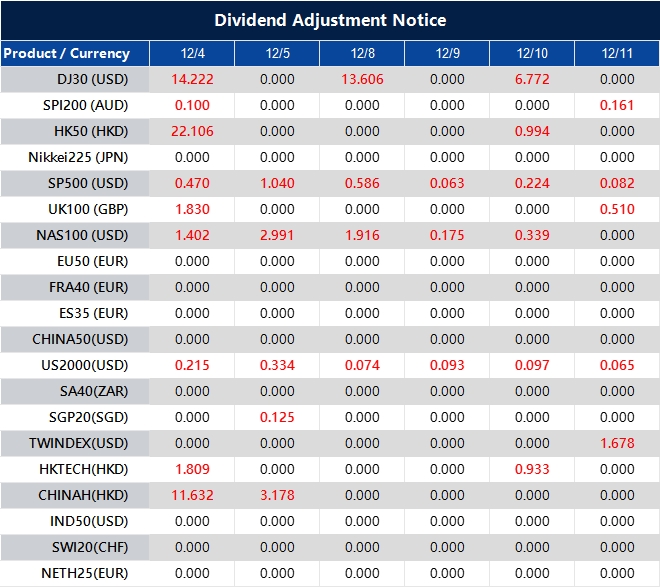
The above data is for reference only, please refer to the MT4/MT5 software for specific data.
If you’d like more information, please don’t hesitate to contact [email protected].
Gold prices in the United Arab Emirates decreased today according to available data.
**Gold As A Safe-Haven Asset**
Gold prices tend to move in the opposite direction of the US Dollar and US Treasuries. When other riskier investments fall, gold prices usually rise. Interest rates also play a role; when rates are low, gold prices often increase, while high rates can decrease them. Essentially, the behavior of the US Dollar greatly influences gold prices.
The recent small decline in gold should not be seen as a sign of weakness. Instead, it offers a chance to buy, as it reflects a short pause in an overall upward trend. We interpret this minor price change as profit-taking at the end of the year, rather than a shift in the fundamental market direction. It’s important to look beyond daily fluctuations and pay attention to the larger economic picture.
**US Federal Reserve And Gold Market**
We think the gold market is mainly responding to recent hints from the US Federal Reserve, which has mentioned a pause in interest rate hikes around early 2026. This news has caused the US Dollar Index (DXY) to drop below 102, a key psychological threshold. A weaker dollar generally boosts gold prices since gold is priced in dollars.
Demand for gold remains strong, which makes any price drop seem temporary. Central banks are still buying gold in large quantities; in Q3 2025, they added another 250 tonnes to global reserves. This consistent buying from official institutions provides solid support for the market.
This situation is similar to what we saw in late 2023 when the market began to anticipate rate cuts for 2024, leading to significant gains in gold prices. That suggests we might soon see another major increase if the Fed confirms a policy shift. At that time, it was a prime opportunity to buy before gold’s strong performance in 2024.
For us, the key metric to monitor now is implied volatility. The CBOE Gold Volatility Index (GVZ) is rising towards 17.5, indicating that traders expect larger price movements ahead. This makes buying options more appealing than trying to time the futures market just right.
We should think about purchasing call options that expire in February and March 2026 to capitalize on the potential gains from a confirmed policy change. A bull call spread is another smart approach, as it lowers the initial costs for positioning ahead of a price rally. These strategies allow us to benefit from a possible price increase while defining our risk clearly.
Create your live VT Markets account and start trading now.







