



NZD/USD hovers near a two-month peak above 0.5800, supported by a weakening USD and positive sentiment
The NZD/USD pair is on the rise, boosted by a weakening USD after the Federal Reserve signaled a more cautious approach. Traders expect additional rate cuts in the US following comments made by Fed Chair Jerome Powell, which have helped increase positive market sentiment and strengthen the Kiwi.
Currently, NZD/USD is stable above 0.5800, reaching a two-month high. The USD has dropped to its lowest point since October 24 after the Fed cut rates and hinted at a pause in rate cuts in January. However, the market remains hopeful for more reductions in 2026, supported by Powell’s comments regarding the US labor market.
Dividend Adjustment Notice – Dec 11 ,2025
Dear Client,
Please note that the dividends of the following products will be adjusted accordingly. Index dividends will be executed separately through a balance statement directly to your trading account, and the comment will be in the following format “Div & Product Name & Net Volume”.
Please refer to the table below for more details:
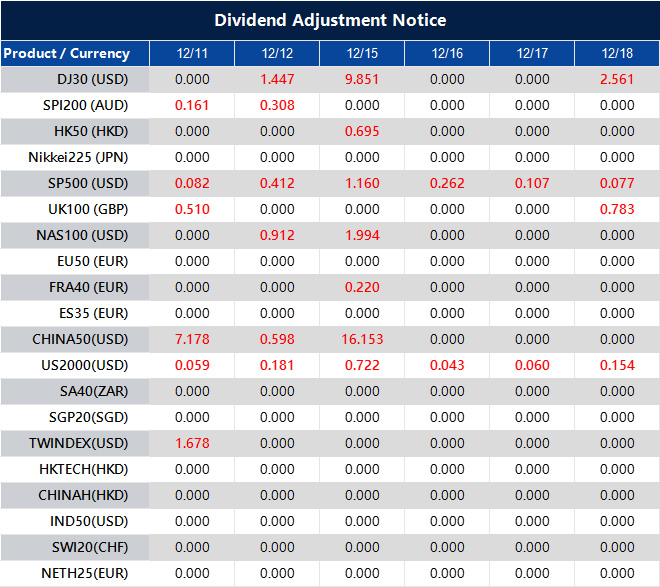
The above data is for reference only, please refer to the MT4/MT5 software for specific data.
If you’d like more information, please don’t hesitate to contact [email protected].
Australia’s participation rate for November was 66.7%, falling short of expectations.
In November, Australia’s participation rate dropped to 66.7%, below the expected 67%.
The participation rate shows the percentage of the population that is part of the workforce. This number helps us understand the country’s economic activity.
This decrease means fewer people are working or looking for work than analysts predicted. It might impact economic forecasts and planning.
A lower participation rate might affect both job and growth predictions. Companies and policymakers may need to rethink their strategies based on this new data.
The November 2025 participation rate of 66.7% points to a softer job market. This could lessen the pressure on the Reserve Bank of Australia (RBA) to raise interest rates further. For traders, this changes the odds for the RBA’s next meeting in February 2026, leaning toward no rate hike or a gentler approach.
Alongside this, other data shows a slight rise in the unemployment rate to 4.1% and stagnant retail sales growth in October 2025. While inflation remains steady at 3.2%, these signs of a slowing economy give the RBA more reason to pause. The central bank will likely focus more on the weakening labor market in its future statements.
As a result, interest rate futures should adjust to remove the chances of a rate hike in the first half of 2026. Traders may want to position themselves for a flatter yield curve as the market begins thinking about when the first rate cut might happen. The focus is shifting from “how high for longer” to “how long until the first cut.”
This scenario could put downward pressure on the Australian dollar. With US interest rates likely to stay high, the difference in policies makes shorting the AUD/USD an appealing strategy. Using put options to manage risk or outright short positions in AUD futures contracts would be advisable.
Looking back, a similar situation occurred in late 2023 when early signs of a weakening labor market led to quick changes in RBA expectations and a weaker AUD. The unexpected November 2025 data will likely increase short-term implied volatility in currency options, presenting opportunities for strategies that thrive on directional moves or the rising volatility itself.
Australia’s employment change in November fell short of expectations, losing 21.3K jobs.
Australia reported a job loss of 21,300 for November, which was a big surprise. Experts had predicted a gain of 20,000 jobs. This drop is a sign of trouble in the job market.
In the financial markets, the US Dollar made a slight recovery, affecting various currency pairs. The USD/JPY climbed above 156.00, but the GBP/USD dropped to about 1.3365 as talks began about a possible rate cut by the Bank of England.
The Federal Reserve’s recent decisions led to changes in the USD, impacting commodities and other assets. Gold pulled back from its weekly high, and Solana fell due to negative market sentiment after the Fed’s announcements.
The Federal Open Market Committee stated that interest rates are expected to average 3.4% by the end of 2026. This forecast follows the September predictions, suggesting a slower pace for rate changes.
In the financial services sector, looking at brokerage options for 2025 remains important. Various analyses highlight brokers with low spreads, high leverage, and adaptability for regions like Mena and Latam. Both CFD and regulated brokers are still central to market participants.
The Australian jobs report for November 2025 was shocking, showing a decrease of 21,300 jobs instead of the expected gain of 20,000. This marks the first major job loss in over a year, indicating a cooling economy. We may see the Australian dollar weaken against its major trading partners as a result.
This unexpected data has caused a spike in implied volatility for AUD/USD options, with the one-month contract indicating larger moves ahead. Considering this, it might be a good idea to buy puts on the AUD/USD or create bear put spreads to manage costs. This strategy could help us profit from a falling exchange rate and increased market uncertainty.
On the other hand, the US Federal Reserve just made a “hawkish cut,” suggesting future rate reductions will happen slowly. This stance is backed by recent strong data, with US Initial Jobless Claims remaining steady at around 215,000—well below recession levels. This policy gap should provide support for the dollar, especially against currencies where central banks might need to adopt a softer approach.
The AUD/USD pair is therefore a strong candidate for short positions in the coming weeks. The clear differences in economic momentum and a stubborn US inflation rate—with core CPI for November 2025 holding at 3.1%—allow the Fed to be patient. We expect this pair may drop below key support levels set earlier this year.
The current situation is reminiscent of the 2022-2023 period when the Fed’s aggressive policies significantly outpaced those of other countries, leading to a sustained rise in the US dollar index. We could be beginning to see a smaller version of that trend as policies diverge again.
For those trading gold, the slightly stronger US dollar is creating resistance, making it difficult to break above the $4,250 per ounce level. As long as the Fed maintains a cautious approach, the opportunity cost of holding non-yielding assets like gold remains high. It would be wise to avoid large long positions until US economic data shows more convincing signs of weakness.
Australia’s unemployment rate recorded at 4.3%, below expectations
Australia’s unemployment rate for November is 4.3%, just below the expected 4.4%. This slight improvement suggests that the job market is doing a bit better.
The labour market is closely monitored as Australia faces economic challenges. Analysts are watching closely for future employment trends based on new economic data and the Reserve Bank of Australia’s monetary policies.
Impact On RBA Policy Choices
Traders and market analysts are keen to see how these job figures will influence the RBA’s decisions. With the unemployment rate at a better-than-expected 4.3%, it’s likely the Reserve Bank of Australia will postpone any interest rate cuts. A stronger job market allows the RBA to maintain tight monetary policy to keep inflation under control. As a result, the chances of an interest rate cut in the first quarter of 2026 have dropped significantly. For traders dealing in interest rate derivatives, this means they will likely exclude near-term easing and possibly add a small chance of a rate hike. The RBA kept the official cash rate at 4.60% in its December 2nd meeting. This strong employment data supports a hawkish stance amid the recent quarterly inflation rate of 3.1%. We can expect yields on three-year government bonds, which rose 8 basis points this morning, to stay high.Implications For Financial Markets
In the currency market, this news is positive for the Australian dollar. Expectations for higher interest rates will attract foreign investment, boosting the AUD against currencies like the U.S. dollar, where the Federal Reserve is signaling a more neutral policy. Traders might start using call options to bet on the AUD reaching $0.6900 in the coming weeks. However, this situation creates a more difficult outlook for equity index derivatives. While a strong economy usually benefits company profits, the possibility of high interest rates can pressure stock valuations. Traders might consider buying put options on the ASX 200 to protect against a potential market drop due to interest rate concerns. Looking back, a similar situation occurred in late 2023 when a tight labor market kept the RBA from moving toward rate cuts. The key point from the November 2025 data is that market volatility may increase as the future of interest rates becomes less clear. We expect options pricing to rise, especially as we approach the next RBA meeting in February 2026. Create your live VT Markets account and start trading now.In November, Australia saw a drop in full-time employment to -56.5K, down from 55.3K.
Australia’s full-time employment dropped sharply by 56,500 in November, down from a gain of 55,300 the month before. This decline puts more pressure on the Australian economy, with mixed employment data affecting currency values and market feelings.
In the currency markets, AUD/JPY fell close to 103.50, showing how traders reacted to Australia’s employment news. Other currency pairs, like GBP/USD, slipped to about 1.3365, while USD/INR increased due to trade uncertainties.
Precious Metals Market
In the precious metals market, gold prices dropped from their weekly highs because the US Dollar rebounded slightly. Investors are keeping an eye on the Federal Reserve’s recent rate cut, which indicates only small adjustments ahead, projecting a 3.4% interest rate by the end of 2026. In the cryptocurrency sector, Solana prices have dropped below $130, influenced by general market trends. However, Hyperliquid is performing well despite a decrease in the overall staking balance in the crypto market. This information is for informational purposes only and comes with risks and uncertainties. It’s essential to do thorough research before making any investment decisions, as markets can be volatile. The large fall in Australian full-time employment is a serious warning sign for the economy. This isn’t just a minor change; it’s a sharp reversal from the previous month’s gains, indicating a quick slowdown in the job market. We believe this suggests further weakness for the Australian dollar (AUD) during the holiday season. This weak jobs report is worsened by new data showing Australian consumer confidence dropped to a 12-month low in November 2025, with retail sales also declining. The market now believes there’s over a 60% chance the Reserve Bank of Australia will cut rates in its first meeting in February 2026. Traders might consider buying AUD put options or shorting AUD/JPY futures, as the yen could gain from any risk-averse sentiment.Federal Reserve Policy Impact
In the United States, the Federal Reserve has sent mixed signals by cutting rates while suggesting fewer cuts in the future and increasing GDP forecasts. This “hawkish cut” adds uncertainty, likely increasing volatility in the US dollar. This environment is good for strategies that benefit from price swings, like long straddles on the EUR/USD pair. We saw similar turbulence in the market after the Fed’s policy changes in late 2023, where initial reactions quickly reversed as investors digested the guidance. Expect the US dollar to be unpredictable as we head into the new year. Using options to manage risk is a smart tactic until a clearer trend appears. With the Bank of England likely to cut rates next week, the British pound (GBP) faces challenges. A dovish BoE could push the GBP/USD pair lower, especially if the US dollar finds support from the Fed’s optimistic long-term outlook. We might explore bearish positions on the pound, like selling GBP futures before the BoE announcement. Gold’s price near $4,250 an ounce shows that anxiety remains high, despite its recent pullback. The precious metal is caught between a dovish present (the rate cut) and a potentially hawkish future from the Fed. Traders in derivatives could take advantage by selling option strangles on gold, betting that it will remain within a certain range as these conflicting forces balance out in the coming weeks. Create your live VT Markets account and start trading now.Gold prices rise to around $4,235 after expected Fed interest rate cut
Gold prices have reached about $4,235 during the early Asian trading session. This rise comes after the US Federal Reserve decided to cut rates by 25 basis points, with only one more reduction expected in 2026. Traders are now looking forward to the US weekly Initial Jobless Claims report.
The Fed’s cut has lowered the key lending rate to a three-year low of 3.50% to 3.75%. Chair Jerome Powell mentioned a cautious approach to assess the effects of this year’s cuts. There is nearly a 78% chance that the Fed will keep rates steady next month.
Geopolitical factors, like President Trump’s proposal to Ukrainian President Zelensky, could influence Gold’s appeal as a safe haven. Any advancements in the Ukraine peace deal might lessen Gold’s traditional attraction in the short term.
Gold is widely regarded as a valuable asset and a safeguard against inflation. Central banks hold a vast amount of Gold and have significantly increased their reserves. Gold prices are affected by the value of the US Dollar, interest rates, and geopolitical situations. These changes highlight Gold’s ongoing role as a financial safety net.
With Gold climbing to $4,235, the market is heavily responding to the Fed’s third consecutive rate cut. This shift in policy provides strong support for Gold. The reduced interest rates lower the opportunity cost of holding non-yielding Gold, making it more appealing.
The Fed’s key rate now stands at a three-year low of 3.50%-3.75%, a major decrease from over 5% in late 2023. This decision followed recent data showing US inflation dropping to 2.8%, while weekly jobless claims slightly increased to 235,000, indicating a softening economy. Markets are now anticipating a high chance of rate stability in January, suggesting that the immediate benefits from rate cuts may be running out.
Yet, a significant geopolitical event is causing uncertainty in the next two weeks. The Christmas deadline for a possible Ukraine peace deal poses a substantial risk for Gold prices. If a deal is reached, there could be a swift sell-off as the demand for safe-haven assets decreases.
For those trading derivatives, this creates a typical volatility scenario before year-end. The tension between supportive monetary policy and a major bearish geopolitical event means that options strategies could be useful. Buying put options might be an effective way to guard against a sudden price drop if a peace deal is announced.
This short-term risk contrasts with strong long-term support from central banks, which have been aggressive buyers for years. In 2022, they added a record 1,136 tonnes to their reserves, creating a solid support level for Gold prices. This consistent demand suggests that any significant dip could be seen as a buying opportunity by major investors.
Considering the high price and the upcoming peace deal deadline, we should brace for increased volatility. Implementing a long straddle strategy—buying both a call and a put option at the same strike price and expiration—could allow for profit from a large price movement in either direction. In the coming days, the focus should be on geopolitical news, as it will likely be the most significant driver for Gold prices.
In November, the actual RICS housing price balance for the UK was -16%, exceeding expectations.
The Royal Institution of Chartered Surveyors (RICS) shared its Housing Price Balance for November, reporting a -16% outcome. This is better than the expected -21%, suggesting a more hopeful outlook for the housing market. Fewer surveyors reported falling house prices than those who noted increases.
In other news, the GBP/USD exchange rate dropped to about 1.3365 during the early European session. The USD/INR increased significantly amid uncertainty in US-India trade talks. Meanwhile, the Japanese Yen weakened against a strengthening US Dollar.
The EUR/USD pair is trading around 1.1690 after the Federal Reserve’s dovish rate cut. The GBP/USD pair remains under pressure, also near 1.3365, due to the US Dollar’s recovery. Gold prices have fallen from a recent high, attributed to a positive risk sentiment and a slight rise in the US Dollar. Solana’s price dipped below $130 after the hawkish rate cut from the Federal Reserve.
The Federal Open Market Committee predicts that interest rates will average 3.4% by the end of 2026. In contrast, Hyperliquid is trading above $28.00, bouncing back from $27.50, even as market losses continue ahead of a Fed monetary policy decision.
The Pound is weakening as the Bank of England is expected to cut rates next week. With UK inflation recently easing, mirroring trends from late 2023 when CPI fell to 3.9%, the market is largely anticipating a 25 basis point reduction. This creates an opportunity for options strategies, like a long strangle on GBP/USD, to take advantage of any surprises from the BoE.
The unexpected result from the UK housing survey, showing a -16% balance instead of the projected -21%, indicates that pessimism in the property market may have peaked. This resembles trends from 2023, when the index began to recover from a low of -67%, historically benefiting domestic sectors. Therefore, buying call options on UK homebuilder stocks or the FTSE 250 index could be a good way to position for a possible short-term rebound.
The US Dollar is gaining ground as the Federal Reserve, although cutting rates, has indicated a slower pace of easing moving forward. The interest rate swaps market now suggests only 50 basis points of cuts for all of 2026, a downgrade from the previous 100 basis points priced in only a month ago. This indicates that selling short-dated call options on EUR/USD might be a smart strategy to take advantage of the renewed strength of the dollar.
Gold has retreated from a weekly high of near $4,250 as the dollar strengthens and the Fed raises its GDP forecasts. This dip might be a buying opportunity, as the broader global trend continues towards central bank easing, a lesson we’ve learned since the post-2008 period. Given the record levels of gold purchases by central banks in 2022 and 2023, selling put options at lower strike prices could allow for a more favorable entry into a long position.
Stock markets rise as interest rates fall and Treasury Bills are purchased
The Federal Reserve has cut interest rates by 25 basis points and plans to buy $40 billion in Treasury Bills over the next month. This move led to the strongest reaction in US stocks after a Fed meeting in nine months.
Positive Market Reaction
Even though the Fed is divided and there’s uncertainty about future policies, stocks went up because of the positive response to the Fed’s actions. The Fed upgraded its growth forecast, surprised the market with Treasury purchases, and maintained its rate-cutting cycle, which all helped boost stock prices. Additionally, the price of gold rose significantly after the Fed’s meeting. This increase may be due to worries about possible economic stagnation or how gold tends to follow stock movements. US stock gains were especially strong in materials and industrial sectors, while tech stocks lagged behind. Oracle’s latest earnings report showed lower revenue than expected, causing its stock to drop by 10%, even though it had strong contract growth and ambitions in AI. Recent events, including the Fed’s actions and Oracle’s results, could indicate a turning point for stocks. The equal-weighted S&P 500 index has started to do better than its market cap-weighted version, showing a shift away from the dominance of big tech. With the Federal Reserve cutting rates and injecting $40 billion into the market this month, we can expect less volatility in the coming weeks. The CBOE Volatility Index, or VIX, has dropped below 14, a level we haven’t consistently seen since the rate hikes began in 2024. This environment favors strategies like selling options premium, such as covered calls or credit spreads on broader market indexes.Impact On The Dollar And Treasurys
The Fed’s actions are putting significant pressure on the US dollar and Treasury yields. The U.S. Dollar Index (DXY) has fallen sharply to around 102.50, while the 10-year Treasury yield has dropped toward 4.10%. Traders might consider options on currency ETFs to bet on further dollar weakness, benefiting multinational corporations and commodity prices. There’s a clear shift away from expensive AI-related tech stocks toward more economically sensitive cyclical stocks. The Russell 2000 index of small-cap stocks recently reached a new record high, outperforming the tech-heavy Nasdaq 100 by over 2% this week. This suggests that buying call options on cyclical sector ETFs like materials (XLB) and financials (XLF) could be a smart investment. The poor performance of market leaders after Oracle’s earnings serves as a warning for the AI sector. Despite significant contract growth, investors are punishing companies for high capital spending, which could impact stocks like Nvidia. We could hedge against a deeper market correction by considering put spreads on specific big tech stocks or the Nasdaq 100 ETF (QQQ). This situation echoes what we observed in late 2019 when the Fed initiated “not-QE” to support money markets. That liquidity boost led to a strong rally in stocks into early 2020. Given this history, selling out-of-the-money puts on the S&P 500 may be a strategy to take advantage of this new wave of liquidity from the Fed. However, uncertainty remains high, as the Fed is still divided, and Fed Chair Powell’s term ends in May 2026. Market expectations, as reflected in Fed funds futures, suggest a slightly more aggressive rate-cutting path than what the Fed has indicated. This divergence could create volatility around future inflation data, making defined-risk options strategies wiser than taking on unlimited risk. Create your live VT Markets account and start trading now.Dollar Slides After Fed Adopts A More Dovish Stance
The US dollar continued to weaken on Thursday after the Federal Open Market Committee (FOMC) delivered a policy message that proved far more dovish than markets had expected.
Although the Fed cut rates by 25 basis points as widely anticipated, it was the accompanying guidance and Chair Jerome Powell’s remarks that set off a fresh wave of dollar selling and renewed appetite for risk-oriented assets.
Markets had already factored in the rate reduction, but many traders had assumed the Fed would strike a firmer, more hawkish tone. Instead, policymakers signalled a shift towards greater accommodation heading into 2026.
This adjustment encouraged markets to rethink the trajectory of monetary policy, with Fed funds futures now pointing to two further cuts in 2026, double the Fed’s median projection of one.
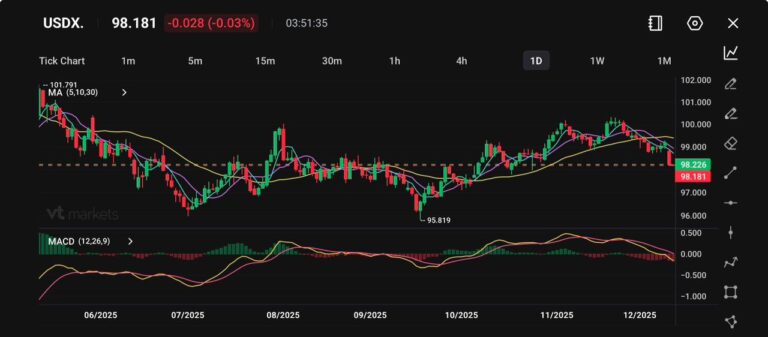
The reaction in currency markets was swift. The US Dollar Index (USDX) fell to an intraday trough of 98.18, its lowest reading since late October. The euro advanced beyond $1.17, the yen strengthened to 155.64, and the pound rallied to a one-and-a-half-month high at $1.3391.
Also weighing on the greenback was the Fed’s announcement of a $40 billion Treasury bill purchase programme starting on 12 December, aimed at easing liquidity strains.
Both the scale and timing of the move surprised traders, reinforcing the perception that the central bank is easing more proactively than previously assumed.
Technical Analysis
The US Dollar Index has retreated to 98.18, extending its steady pullback from the late-November peak near 100.85. Despite remaining within a broader uptrend from the September low at 95.82, recent trading behaviour points to waning momentum.
The index is now approaching support around the 98.00–98.20 region, a key band that served as resistance in October and support at the start of November.
A decisive break beneath this area could pave the way for a decline towards 97.50, or even a revisit of the 96.80–95.80 range if selling pressure intensifies.
The MACD has slipped below its signal line and is moving towards the zero level, signalling strengthening bearish momentum. Short-term moving averages (5, 10, 30) have also turned lower and shifted into a bearish configuration.
Cautious Outlook
With the Fed’s dovish turn now cemented and fresh liquidity measures due to begin next week, the dollar may find it difficult to regain traction in the near term.
A sustained break below the 98.00 threshold would likely reinforce negative sentiment and extend downside momentum heading into the year’s final weeks.







