



In November, Spain’s actual unemployment change was lower than predicted, with a decrease of 18,805.
Spain’s unemployment rate for November decreased by 18,805, which is better than the expected drop of 12,400. This reflects a positive trend in the job market.
The smaller-than-expected decline in unemployment hints that Spain’s economy may be bouncing back faster than thought. This could boost overall confidence in the economy and affect the European Central Bank’s decisions on monetary policy.
EUR/GBP pair holds steady at 0.8785 as traders anticipate Eurozone HICP data
EUR/GBP is steady at around 0.8785 during the early European session on Tuesday. The market is cautious as it awaits the Eurozone’s preliminary Harmonized Index of Consumer Prices (HICP) release.
The UK Autumn budget report has impacted expectations for a rate cut by the Bank of England (BoE) in December. The Chancellor of the Exchequer announced plans to raise taxes by 26 billion pounds by 2029-30. Analysts are predicting that the BoE may cut the rate to 3.75% this month, which could affect the GBP.
Eurozone Monetary Policy
The European Central Bank (ECB) is keeping its interest rate policy unchanged, which supports the Euro. ECB President Christine Lagarde and Governing Council member Joachim Nagel expressed satisfaction with the current monetary policies. The Eurozone HICP report is expected to reveal a 2.1% year-over-year increase for November, with core HICP increasing to 2.5%. If inflation comes in lower than expected, it could exert pressure on the EUR against GBP. The Euro is the currency for 20 Eurozone countries and makes up 31% of global forex transactions. The ECB, based in Frankfurt, manages monetary policy for the Eurozone mainly through interest rates. The ECB’s decisions, along with economic indicators like GDP and trade balance, significantly influence the Euro’s value. In recent weeks, EUR/GBP has traded flat around the 0.8800 level. This reflects a divide between a dovish BoE and a steady ECB, creating clear opportunities as we approach the year’s end.Derivative Trading Strategy
The expectation of a BoE rate cut this month is strong, especially following last month’s Autumn Budget. Recent data from the Office for National Statistics shows UK inflation dropped to 2.5% in November, marking the fifth consecutive monthly decline. With the economy slowing and inflation near target, the market sees over a 90% chance of a 25-basis-point cut at the December 18th meeting. For derivative traders, this suggests positioning for further weakness in the Pound. It would be wise to consider buying EUR/GBP call options with strike prices around 0.8850 and 0.8900, expiring in late December or January. This strategy helps profit from a potential increase in the currency pair while minimizing downside risk. Meanwhile, the ECB appears firm. The preliminary Eurozone HICP inflation data for November came in at 2.3%, slightly above the expected 2.1%. This persistent inflation supports ECB officials’ statements that interest rates are stable, leaving no reason for cuts anytime soon. This growing gap in policy approaches reinforces the view that the Euro will strengthen against the Pound. The unexpected rise in inflation in Europe suggests that the path of least resistance for EUR/GBP is upward. Thus, short-term forward contracts to buy Euros against the Pound could serve as a solid hedge for those exposed to GBP. Looking back, the move toward 0.8800 marks a significant change from the trading range seen throughout most of 2025. Between April and August, the pair struggled to consistently break above 0.8650. The current fundamental context indicates that this recent strength is part of a new trend rather than a temporary spike. Create your live VT Markets account and start trading now.GBP/USD faces challenges around 1.3200 after dropping from a five-week high of 1.3276 in early European trade.
The GBP/USD is having a hard time holding above 1.3200 in early European trading. This comes after a drop from five-week highs of 1.3276. The Pound Sterling is weak due to expectations of a lower interest rate from the Bank of England on December 18, especially when compared to a stronger US Dollar.
On Monday, GBP/USD fell by about 0.25%, moving back from a resistance level, which could lead to more selling. Chancellor Rachel Reeves is under fire for the UK’s budget issues, even though the Office for Budget Responsibility reported an unexpected surplus thanks to high wage growth and tax revenues.
Pound Sterling Outlook
The GBP/USD pair gained slightly, rising over 0.20% as more traders bet on a possible rate cut by the Federal Reserve. This speculation was encouraged by the potential nomination of Kevin Hassett as Jerome Powell’s successor. However, US data revealed a continued decline in business activity for the ninth month in a row, with the ISM Manufacturing PMI dropping to 48.2 and employment figures falling from 46 to 44. Treasury yields decreased as investors considered possible easing actions from central banks. Legal disclaimers emphasize the importance of personal research and the risks involved in trading, with FXStreet sharing information for informational purposes only. At present, the GBP/USD pair is facing conflicting pressures. On one side, high expectations for a Bank of England (BoE) rate cut on December 18 are compounding the pound’s weakness, with markets pricing in an 85% chance of a cut. This is particularly concerning as the pair slips from its recent high of 1.3276. The likelihood of a BoE rate cut is increasing, which will likely put downward pressure on sterling in the short term. Recent data from November 2025 shows UK inflation at 2.5%, with Q3 GDP growth stagnating. This indicates a slowing economy, giving the bank a reason to make a move. Furthermore, ongoing political issues regarding the government’s budget add more risk to the UK economy, which could keep the pound vulnerable.USD Headwinds
Nonetheless, the US Dollar also faces challenges that prevent a rapid decline in GBP/USD. The US ISM Manufacturing data for November was also weak at 48.2, and last month’s Non-Farm Payrolls report indicated a cooling labor market. Consequently, the CME FedWatch Tool now shows a 70% chance that the Federal Reserve will cut rates in its own meeting next week. For derivative traders, this “race to cut” between central banks signals a period of high volatility instead of a clear trend. Implied volatility in GBP/USD options has increased, reflecting market uncertainty ahead of the two important central bank meetings this month. This situation may favor strategies that benefit from price fluctuations, like long straddles, rather than straightforward directional bets. The key events to monitor are the Fed’s decision next week and the BoE’s meeting on December 18. Until we gain more clarity from these meetings, the pair will likely continue to struggle around the 1.3200 mark. Traders should stay alert, as the currency’s direction will depend on which central bank hints at a more aggressive easing cycle. Create your live VT Markets account and start trading now.GBP/USD struggles at 1.3200 after retreating from five-week peak in early European trading
The GBP/USD pair is holding steady around 1.3200 after dropping from its recent high of 1.3276. The British Pound is under pressure due to expectations that the Bank of England may cut interest rates, combined with a stronger US Dollar.
Technical Indicators Overview
The recent UK Autumn Budget provided only a brief lift, as market focus remains on central bank expectations. Technical indicators show a slight increase in the 21-day Simple Moving Average (SMA), while the 50-day SMA is still acting as a resistance level. The Relative Strength Index (RSI) sits at a neutral 51.47, suggesting that momentum is stabilizing. If the price closes above the 50-day SMA at 1.3270, it could lessen downward pressure. However, failing to break this level keeps sellers in charge. In daily trading, the British Pound rose by 0.16% against the Japanese Yen, making it the top performer among major currencies. Overall market conditions continue to be influenced by wider economic trends, affecting the GBP/USD outlook. Traders should keep an eye on any changes in SMAs and RSI levels for hints at potential price shifts. The interaction between technical indicators and economic expectations points to cautious trading behavior.Market Sentiment and Economic Indicators
With the GBP/USD pair struggling to hold above 1.3200, the main catalyst appears to be the increasing expectation of a Bank of England rate cut scheduled for December 18. This sentiment is overshadowing any positive local news, such as the recent UK Autumn Budget, suggesting a downward trend is likely as long as these views persist. Recent economic data supports this bearish outlook. The latest figures from the Office for National Statistics (ONS) revealed that UK inflation fell to 2.1% in October, moving closer to the Bank of England’s target and allowing for easier policy adjustments. Additionally, GDP growth for the third quarter of 2023 was revised down to just 0.1%, strengthening the case for a proactive rate cut to stimulate the economy. Create your live VT Markets account and start trading now.The US Dollar Index hovers around 99.50 as it awaits insights from the ADP employment data.
The US Dollar Index is stable around 99.40 after bouncing back from 99.00 earlier this week. Traders expect the Federal Reserve to cut interest rates in December, with an 87.2% chance of a 25 basis point decrease to a range of 3.50%-3.75%.
This stability in the USD follows disappointing ISM Manufacturing PMI data for November, which came in at 48.2. Now, traders are looking ahead to the US ADP Employment Change and ISM Services PMI reports, which will be released on Wednesday. Economists predict a small increase in jobs by 10,000, down from 42,000 in October, while ISM Services PMI may drop to 52.1 from 52.4 in October.
The US Dollar
The US Dollar is the official currency of the United States and is widely used around the world, featuring in over 88% of foreign exchange transactions. The Federal Reserve influences the dollar through interest rate changes, aiming for price stability and full employment. When crises occur, like the 2008 recession, quantitative easing can weaken the dollar, while quantitative tightening strengthens it by reducing bond purchases. Currently, the US Dollar Index is holding steady around 99.45 after recovering from a monthly low. This calm is due to the market’s strong belief that the Federal Reserve will lower interest rates during its meeting next week. This certainty creates a clear opportunity for trading strategies. With an 87.2% chance of a rate cut already included in prices, traders should think about positions that benefit from a weaker dollar. Buying put options on the US Dollar Index or related ETFs is a defined-risk approach to profit if the dollar weakens. This strategy offers a chance to gain from a drop while limiting potential losses to the cost of the options. The expectation for a weaker dollar is backed by recent economic data. The Bureau of Labor Statistics report showed that the annual inflation rate fell to 3.1% in November 2025, a notable drop from previous highs in 2023. This ongoing decline in inflation allows the Fed to consider easing its monetary policy.Economic Releases
The key upcoming reports are the ADP Employment and ISM Services PMI figures set to be released this Wednesday. We expect these reports to show an economic slowdown, predicting private payrolls will only rise by 10,000 jobs. Poor results here may reinforce negative sentiment towards the dollar ahead of the Fed’s decision. Looking back, after the pandemic in 2020-2021, the Fed’s aggressive easing cycle caused the Dollar Index to drop from over 102 to below 90. Although the current situation is not as drastic, history shows that a shift to expanding policies can impact the dollar negatively. A similar but milder pattern may appear as this new cycle of rate cuts begins. With the scheduled economic reports and the impending Fed meeting, implied volatility in the currency markets is likely to rise. This increase will make options more expensive, so traders might want to set their bearish dollar positions soon to avoid higher premiums. For those expecting significant market movement, regardless of direction, a straddle could be a good trading strategy. Create your live VT Markets account and start trading now.Gold prices decline in the Philippines today, according to recent market data.
Gold prices in the Philippines fell on Tuesday, according to FXStreet. The price per gram decreased to 7,936.99 PHP from 7,973.23 PHP on Monday.
The price for a tola dropped to 92,573.31 PHP, down from 92,998.20 PHP the day before. The cost for 10 grams is now 79,368.31 PHP, while a troy ounce is priced at 246,868.20 PHP.
FXStreet Pricing Method
FXStreet determines these prices by adjusting international rates to match the local currency. They update prices daily based on market conditions. Gold is seen as a safe asset and a way to protect against inflation. Central banks hold the most gold, adding 1,136 tonnes to their reserves in 2022. Gold prices often move in the opposite direction of the US Dollar and riskier assets. Factors like geopolitical issues and interest rates can affect gold prices, which are mainly quoted in USD. Today’s slight decline in gold prices should be taken as a consolidation rather than a reversal. Gold has performed well throughout 2025, and this minor dip appears to be influenced by temporary strength in the stock market. Traders dealing in derivatives might view this as a chance to reassess their positions rather than a reason to be pessimistic.Market Expectations For Interest Rates
A key driver for gold’s price is the market’s expectation of upcoming interest rate cuts from the US Federal Reserve. The latest US inflation report for November 2025 showed that core CPI dropped to 3.1%, leading futures markets to increase the likelihood of a rate cut by March 2026. Lower expected rates make gold, a non-yielding asset, more appealing. However, the recent risk-on sentiment that pushed the S&P 500 to record highs last week is creating challenges for safe-haven assets. The market’s volatility index, the VIX, recently fell to 14, indicating that traders are more comfortable with stocks than gold at the moment. However, any hint of a stock market correction could quickly redirect funds back into gold. We should also consider the steady demand from central banks, which supports gold prices. Following record buying in 2022, the World Gold Council’s Q3 2025 report confirmed that central banks in emerging markets continue to purchase gold at high rates. This strong demand helps counter any selling from short-term traders. For those involved in derivatives trading, this suggests seizing opportunities that could profit from a potential rise in volatility. The implied volatility for gold options is low right now, making this a good time to buy call options for a potential rally in the new year. Traders might also consider put options to protect against a possible downward correction below crucial technical levels. It’s essential to keep an eye on the US Dollar’s performance in the coming weeks. The US Dollar Index (DXY) is struggling to remain above 104 as rate cut expectations grow. A significant drop in the dollar would likely serve as a catalyst for gold to continue its upward movement toward previous highs. Create your live VT Markets account and start trading now.Gold prices decline in the United Arab Emirates, according to collected data
In the United Arab Emirates, gold prices dropped on Tuesday, according to FXStreet. The price fell to 498.07 AED per gram, down from 500.34 AED the day before.
The price for tola also decreased, now at 5,809.39 AED compared to 5,835.88 AED. Current gold prices in AED are 4,980.70 for 10 grams and 15,491.85 for a troy ounce. These prices are based on international rates, adjusted to local currency and units.
The Role of Gold
Gold has always been a safe store of value and is seen as a protective asset during uncertain times. It is often used to guard against inflation and currency decline. Central banks, which hold the most gold, buy it to stabilize their currencies. In 2022, central banks purchased a record 1,136 tonnes of gold, valued at around $70 billion. Price changes in gold depend on geopolitical stability, interest rates, and the value of the US Dollar. When interest rates go down, gold prices usually rise; when they go up, gold prices tend to fall. A stronger Dollar generally puts downward pressure on gold prices. Today’s small price drop in gold should be viewed as just noise and not the start of a new trend. This slight decline could be a buying opportunity, as the overall economic conditions still favor the metal. The main influences on gold lie in larger global economic trends, not daily price swings.Market Outlook
We think the market is anticipating likely interest rate cuts from the Federal Reserve in the first half of 2026. Historically, gold has done well during times when the Fed is easing rates. The high interest rates that limited gold’s appeal in 2024 seem to be ending, making gold—a non-yielding asset—more attractive. Demand from central banks continues to support gold prices. After record purchases in 2022, buying remained strong in 2023 and 2024, with central banks adding 800 tonnes in the first three quarters of 2024 alone. This indicates a shift by emerging market banks to diversify away from the US Dollar. Expectations of lower rates are also affecting the US Dollar. A weaker dollar tends to boost gold prices because it makes gold cheaper for holders of other currencies, increasing global demand. We foresee this pressure on gold turning into a positive force as we head into the new year. For those trading derivatives, now might be a good time to consider buying call options on gold futures that expire in the first and second quarters of 2026. We expect volatility to rise around key economic announcements and central bank meetings, making long-option strategies potentially profitable. These options provide a way to benefit from price increases while managing risk. If you already hold long positions, think about using options to hedge against surprising rate hikes. Buying put options can act as low-cost insurance if data surprises lead central banks to postpone their rate cuts. This approach allows you to participate in potential gains while protecting against short-term dips. Lastly, ongoing geopolitical issues support gold’s status as a safe-haven asset. Any increase in global tensions is likely to lead to a rush toward safety, directing more investment into gold. These unpredictable situations constantly bolster gold prices. Create your live VT Markets account and start trading now.Nvidia’s 15% decline in November raises questions about investment opportunities for buyers
Nvidia experienced a 15% drop in November, making it the worst performer on the Dow Jones Industrial Average for that month. This decline happened as investors worried about a potential bubble in AI and tech stocks. Despite strong returns in past years, tech stock valuations are still very high.
In the last three years, Nvidia had an impressive average annual return of 119% and a 68% return over five years. Even with the 15% decrease in November, Nvidia’s stock has risen 33% this year. The drop wasn’t related to its third-quarter earnings, which were impressive, showing record revenue and profits, along with a predicted 14% revenue increase for Q4.
Worries About Nvidia’s High Valuation
Concerns about Nvidia’s high valuation likely contributed to the selloff. Its price-to-earnings (P/E) ratio fell from 57 to 43. Currently, its forward P/E is 23, and its five-year PEG ratio is below 1, hinting at possible long-term undervaluation. Additional worries include possible trade restrictions with China and Google’s development of AI chips, which could impact Nvidia’s standing in the market. Despite these issues, analysts believe Nvidia’s stock could reach a median price target of $225 per share, suggesting a potential 26% rise from its current value. The stock’s lower valuation and reasonable forward P/E make it appealing in the AI sector. Nvidia’s drop of 15% in November 2025 reflects a clash between short-term fears and long-term fundamentals. The decline is primarily driven by worries about an AI bubble and Nvidia’s high valuation, which has adjusted from 57 to 43 times earnings. This adjustment, despite record earnings in Q3, sets an interesting stage for the weeks ahead.Effects of the Sharp Sell-Off on Options
The sharp sell-off has sent Nvidia’s 30-day implied volatility into the 75th percentile for the year, leading to higher option premiums. This situation makes it wise to consider selling cash-secured puts with January 2026 expiration dates. This approach allows us to collect the high premium and, if the stock falls further, buy shares at a better price. The overall environment for tech stocks appears to be stabilizing. The latest CPI report for October 2025 showed core inflation easing to a 2.8% annual rate, the lowest in over three years. This relief may prevent the Federal Reserve from being too aggressive. With less risk of a market downturn, there is a stronger case for a recovery in quality growth stocks. For those looking to invest directly on a rebound towards the analyst target of $225, a bull call spread is a smart choice. We could buy a January or February 2026 call option while selling another with a higher strike price just above that target. This strategy minimizes our upfront cost while still allowing us to benefit from a potential upside. We saw a similar recovery pattern after the significant tech correction in 2022, where strong-performing companies bounced back more quickly than others. The current forward P/E of 23 and PEG ratio below 1 indicate that Nvidia’s growth story is still strong. This historical context gives us confidence that November’s drop is more of an opportunity than a warning. However, we must remain cautious about potential trade restrictions with China and increasing competition from companies like Google that are developing their own chips. These uncertainties highlight the importance of using defined-risk option strategies rather than assuming unlimited risk. Our goal is to position ourselves for recovery while also safeguarding against another downturn. Create your live VT Markets account and start trading now.EUR/JPY trading at 180.70 seeks momentum from upcoming Eurozone HICP data.
The EUR/JPY pair is currently trending positively around the 180.70 level, ending a three-day losing streak. This rebound is due to traders believing that the European Central Bank (ECB) might stop cutting rates. Additionally, a drop in demand for safe-haven assets is hurting the Yen, which helps boost the EUR/JPY as traders await inflation data from the Eurozone.
The Harmonized Index of Consumer Prices (HICP) in the Eurozone is expected to rise by 2.1% year-on-year for November. Its core measure is projected to increase slightly from 2.4% in October to 2.5%. Higher-than-expected inflation figures from Germany support the idea that the ECB will keep its current policy, which is good news for the Euro and EUR/JPY.
Yen’s Relief Over Lower Safe-Haven Demand
The Yen is showing some relief due to lower demand for safe-haven assets. Additionally, the Bank of Japan’s (BoJ) potential response to this situation might prevent significant depreciation. Comments from Japanese officials regarding market volatility suggest that there could be intervention to stop the Yen from weakening too much, which could limit how high EUR/JPY can go. The Core HICP measures price changes in the European Monetary Union, excluding volatile items, giving valuable insights into inflation and spending habits. A high core HICP reading is generally positive for the Euro, while low readings might indicate problems. The next Core HICP reading is set to be released on December 2, 2025, with expectations at 2.5%. The EUR/JPY pair is showing some strength at around the 180.70 level, breaking a recent losing streak. Market sentiment suggests that the ECB is unlikely to continue cutting interest rates, which supports the Euro. Recent German inflation data, which came out higher than expected for November 2025, bolsters this view. All eyes are on the Eurozone’s HICP inflation data being released today, with a consensus forecast of 2.5% for the core reading. If the actual figure exceeds this expectation, it could further strengthen the Euro and reinforce the belief that the ECB will keep rates steady. One-month risk reversals for EUR/JPY have turned positive for the first time in six weeks, indicating that options traders are anticipating more upside.Bank of Japan’s Plans to Normalize Policy
Meanwhile, the Japanese Yen is being kept in check by the Bank of Japan’s announcement about normalizing their policy. It’s important to consider recent warnings from the Finance Minister about rapid Yen weakness. Authorities had intervened multiple times in late 2022 to support the Yen, and the possibility of intervention could limit how high EUR/JPY can climb in the short term. Given these mixed factors, derivative traders might want to explore strategies that could benefit from potential volatility spikes. One option is to buy a short-dated straddle, which involves at-the-money call and put options. This strategy could capitalize on significant price movements in either direction after the inflation release. For those with a directional bias, if you believe the HICP data will exceed expectations, purchasing near-term EUR/JPY call options with a strike price around 181.50 could provide a low-risk way to profit from a potential rally. However, keep in mind that the premium paid for these options would be your maximum loss if the pair does not move higher or reverses. A key risk remains that Japanese officials might intervene to support the Yen, limiting any major gains. Create your live VT Markets account and start trading now.Dividend Adjustment Notice – Dec 02 ,2025
Dear Client,
Please note that the dividends of the following products will be adjusted accordingly. Index dividends will be executed separately through a balance statement directly to your trading account, and the comment will be in the following format “Div & Product Name & Net Volume”.
Please refer to the table below for more details:
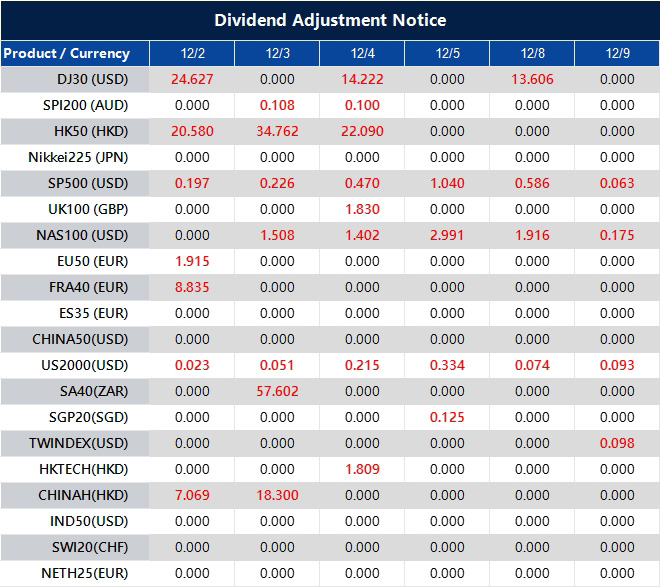
The above data is for reference only, please refer to the MT4/MT5 software for specific data.
If you’d like more information, please don’t hesitate to contact [email protected].







