



Japan’s Takaichi will consider appropriate economic and fiscal measures for interest rates and foreign exchange.
Japanese Prime Minister Sanae Takaichi has committed to making economic and fiscal decisions by looking at various factors like interest rates, foreign exchange, and prices. She highlighted that currency stability should reflect the economy’s fundamentals but did not elaborate on her discussions with Bank of Japan (BoJ) Governor Ueda.
The USD/JPY exchange rate has dipped by 0.01% to 155.95. To understand the Japanese Yen’s behavior, we need to consider the BoJ’s policies, the differences in bond yields between Japan and the US, and trader sentiment.
GBP/USD stays stable above 1.3300 due to a dovish USD outlook
Continued Expectations for BoE Rate Cut
There are rising expectations for a BoE rate cut after UK inflation dropped to 3.6% in October. Traders are looking for strong buying in GBP/USD and are awaiting upcoming US data on ADP Weekly Employment Change and JOLTS Job Openings for guidance. The Pound Sterling, known as the world’s oldest currency, is greatly impacted by the BoE’s monetary policies and is a popular trading choice. Economic indicators like GDP and employment rates can affect the value of the GBP. If these indicators are strong, the Pound may rise. A positive trade balance can also boost GBP by increasing demand for UK exports. As we enter the second week of December 2025, the GBP/USD pair is slightly above the 1.3300 level. The market primarily anticipates a dovish Federal Reserve, which keeps the US dollar weak. However, there’s hesitation to push the Pound higher since a BoE rate cut is expected soon. In the coming days, all eyes will be on the US Federal Reserve’s interest rate decision, scheduled for December 10th. Recent November data shows US Core CPI inflation eased to 2.9%, supporting the idea that the Fed may relax its policies. The CME FedWatch Tool shows that there is over an 85% chance of a rate cut this week, explaining the dollar’s struggles to strengthen.Options Strategies for Market Volatility
Meanwhile, the Bank of England faces challenges as domestic growth slows and inflation eases, which fell to 3.6% in October 2025. Though this rate remains above the 2% target, the downward trend, along with recent GDP figures showing a stalled economy, makes a BoE rate cut next week likely. This situation is limiting any big rally for the Pound Sterling. For traders dealing in derivatives, this clash between the two central banks indicates that market volatility may spike in the next two weeks. We saw similar conditions in late 2023 when uncertainty about central bank changes led to sharp market movements. Traders could consider using option strategies like straddles or strangles on GBP/USD to profit from significant price changes, no matter the direction. A cautiously bullish strategy could be set up with call options, betting that the trend from the Fed will dominate the market. The market might already have accounted for a BoE rate cut, so if the UK central bank takes a less aggressive approach, the Pound could surge against a weakened dollar. This strategy limits risk if the market moves unfavorably. On the other hand, buying put options might serve as a smart hedge or a speculative approach if the pair is expected to drop. If this week’s US jobs data is stronger than expected, or if the Bank of England hints at a more aggressive easing than anticipated, the recent rally from the 1.3000 level in November 2025 could reverse quickly. This strategy provides clear protection against a possible downturn. Create your live VT Markets account and start trading now.RBA Governor Michele Bullock explains reasons for maintaining interest rates at 3.6% during press conference
The Reserve Bank of Australia (RBA) decided to keep its Official Cash Rate (OCR) at 3.6% after its December meeting, which matched what many expected. Governor Michele Bullock emphasized that upcoming inflation and job data will play a big role in the February board meeting. Rate cuts are not expected; the focus is on stability in prices and full employment.
The RBA pointed out that underlying inflation is partly due to temporary causes. The job market is tightening, although a slight easing is expected soon. Recent economic data shows that risks to inflation have grown, and consumer demand is bouncing back, with GDP increasing by 2.1% in the third quarter. The Consumer Price Index (CPI) rose to 3.8% in October, which is higher than forecasts.
After the RBA’s announcement, the Australian Dollar dipped initially but then recovered, trading around 0.6625 against the US Dollar. The Australian Dollar continues to perform well against the US Dollar. Future RBA statements may lead to more market fluctuations, especially if there are hints of tightening monetary policy.
The RBA’s decisions revolve around economic data. Key indicators like GDP, jobs, and inflation affect the currency’s value as they guide interest rate choices. The RBA uses quantitative easing and tightening to maintain economic stability and affect the strength of the Australian Dollar.
Looking back at the December 2024 meeting, the RBA held the cash rate steady at 3.6% while warning about rising risks. Governor Bullock made it clear that rate cuts were unlikely, suggesting an extended pause or potential hikes. This decision was significant, changing market expectations for the following year.
During 2025, the RBA acted on its warnings by raising the cash rate to 4.35% to tackle ongoing inflation. The current market faces a situation similar to last year, but with rates much higher. The latest monthly CPI data for October 2025 showed inflation at 3.1%. While this is an improvement from the 3.8% in late 2024, it remains above the RBA’s target range of 2-3%.
This ongoing inflation suggests that the RBA will keep its strict approach well into 2026, making rate cuts in the first quarter unlikely. The unemployment rate has also risen to 4.5%, indicating that the tighter policy is cooling the job market as intended. This means the RBA is unlikely to raise rates further and will not be in a hurry to relax its policy.
For derivative traders, this signals a time of cautious waiting ahead of the February 2026 meeting. With the RBA still holding steady, implied volatility for Australian dollar options has decreased compared to past highs. This scenario could benefit strategies anticipating a sudden market move, particularly if upcoming inflation or job data turns out to be surprising.
Given the differing policies between Australia and the US, where the Federal Reserve is hinting at potential rate cuts in mid-2026, the interest rate gap may continue to support the AUD/USD. Traders might consider strategies like buying straddles or strangles on AUD/USD, which is currently trading around 0.6850, ahead of important data releases in January. This approach would be profitable if the currency takes a sharp turn in either direction, betting against the current expectation of stability.
The Gold Miners ETF (GDX) forecasts a double correction while prices continue to rise.
The short-term Elliott Wave analysis for the Gold Miners ETF (GDX) shows that a five-swing diagonal structure is forming since the low on October 28, 2025. The cycle began with wave ((i)), which rose to 73.06, followed by a pullback in wave ((ii)) to 68.20. Next, wave ((iii)) advanced to 79.97, and wave ((iv)) found support at 72.45. Finally, wave ((v)) completed the sequence at 84.03, marking the end of wave 1 in a larger structure.
After this, the market entered a corrective phase. Wave 2 formed a complex double three Elliott Wave structure. Wave (a) decreased to 81.48 after wave 1, and wave (b) bounced back to 82.96. The correction continued with wave (c) dropping to 79.30, finishing wave ((w)). Following this, wave ((x)) rose to 83.76. The decline continued, with wave ((y)) unfolding like a zigzag. From wave ((x)), wave (a) fell to 79.07, and the current wave (b) rally is likely temporary before another decline in wave (c) completes wave ((y)) of 2.
Short-Term Perspective
In the short term, dips are likely to attract buying interest as long as the pivot at 71.55 remains secure and the October 28 low of 67.35 holds. This supports the overall bullish trend for GDX. As of December 9, 2025, gold miners appear to be in a healthy consolidation phase following a strong rally. GDX surged over 24% from its low on October 28 to a peak of 84.03 just last week. The current pullback is seen as a complex but normal correction in a larger, sustained uptrend. Derivative traders should exercise caution, as we expect one more leg down to complete this corrective pattern. The ongoing small rally may be a trap before the final decline towards the low 70s. This is a potential short-term bearish opportunity, such as buying puts with January 2026 expirations, targeting the completion of this wave.Longer-Term Outlook
This technical outlook is influenced by broader market uncertainty ahead of next week’s Federal Reserve meeting. The November 2025 Consumer Price Index report showed inflation stubbornly holding at 3.7%, which has dampened expectations for an immediate dovish pivot. This macro-level indecision is creating the choppy, corrective price action we are witnessing in the miners. Despite this, the longer-term outlook remains bullish. This expected dip should be viewed as a significant buying opportunity. The market is pricing in a 70% chance of interest rate cuts starting in Q2 2026, which would strongly benefit gold and gold miners. Traders should consider establishing longer-dated bullish positions, like buying summer 2026 call options, once this correction stabilizes. A “double three” correction is common for GDX in a strong new bull market. We saw a similar multi-week consolidation in the summer of 2020 before the ETF soared to multi-year highs. History suggests these phases help shake out weak hands before the next major advance. Thus, a patient strategy is advisable in the coming weeks. One option is to sell cash-secured puts around the 71.55 pivot point to collect premium while waiting for a lower entry. The main strategy is to use the expected weakness to position for a much larger rally that we believe will begin in the new year. Create your live VT Markets account and start trading now.Gold prices decreased today in Saudi Arabia, according to market data.
Gold prices in Saudi Arabia dropped on Tuesday. The cost of one gram of gold went down to 505.16 Saudi Riyals (SAR) from SAR 505.79 on Monday. The price per tola also fell to SAR 5,892.11 from SAR 5,899.45.
These figures are based on calculations by FXStreet, which adjusts international prices to local currencies and units. For a troy ounce, the price is SAR 15,712.44.
Gold As A Safe Investment
Gold is often viewed as a safe investment during uncertain times. It serves as a protection against inflation and declines in currency value. Central banks hold the most gold, having added 1,136 tonnes to their reserves in 2022. Countries like China, India, and Turkey are quickly increasing their gold holdings. Gold prices tend to move opposite to the US Dollar and US Treasuries. Factors like geopolitical stability and interest rates can influence gold prices. A strong US Dollar usually stabilizes gold prices, while a weaker Dollar can lead to an increase. Various factors impact gold’s value, including its nature as a non-yielding asset, which affects its response to economic shifts.Potential Buying Opportunity
Today’s slight decline in gold prices could present a buying opportunity rather than a sign of weakness. This small dip arrives just before the Federal Reserve’s final monetary policy meeting of 2025. Traders should keep an eye on overall market sentiment in the coming weeks. The main factor is the anticipation of Fed rate cuts in early 2026, a topic that has gained momentum over the months. Recent data shows US inflation fell to 2.5% in November 2025, supporting a more cautious approach from the central bank. Lower interest rates reduce the opportunity cost of holding non-yielding assets like gold, likely driving its price higher. This expectation is also negatively impacting the US Dollar, which moves inversely to gold. The Dollar Index (DXY) has already dropped over 4% in the last quarter of 2025, sitting around 98.50 as the market factors in future rate cuts. A weaker Dollar makes gold more affordable for international buyers, which usually increases demand and supports prices. In addition to monetary policy, strong demand from central banks creates a solid foundation for gold prices. After the record-setting purchases in 2022 and 2023, the World Gold Council reports that central banks are on track to add another 1,000 tonnes to their reserves this year. This strategic buying, along with ongoing worries about potential recessions, reinforces gold’s position as a primary safe-haven asset. Create your live VT Markets account and start trading now.Today’s gold price in the Philippines has decreased, according to recent data.
Gold prices in the Philippines dropped on Tuesday, according to FXStreet data. The price per gram is PHP 7,952.47, down from PHP 7,960.93 on Monday.
The price for Gold per tola also fell, going from PHP 92,854.73 to PHP 92,755.59. A Troy ounce of Gold is now priced at PHP 247,350.20.
Gold Price Calculations
FXStreet calculates Gold prices in the Philippines by converting global prices into PHP, updating them daily. Local rates may differ slightly from these reference prices. Gold is commonly viewed as a safe investment, especially in uncertain times. Central banks hold the most Gold, adding 1,136 tonnes worth $70 billion in 2022—this was the highest annual purchase ever recorded. Gold prices usually go up when the US Dollar weakens and go down when interest rates rise. Factors such as geopolitical issues, economic concerns, and the performance of the US Dollar impact Gold prices. The value of Gold closely follows currency changes and economic conditions.Gold Market Trends
We are experiencing a small daily dip in gold prices, but this should not be seen as a long-term decline. This minor fluctuation seems to reflect a brief pause before prices rise again. The broader market trends are influenced by changing expectations regarding central bank policies for the upcoming year. The main factor driving gold prices is the changing approach of the US Federal Reserve, which has indicated it may have reached the peak of its tightening cycle, lasting through 2025. Recent inflation data showed a rate of 2.8% for November 2025, solidifying market expectations for potential rate cuts starting in the second quarter of 2026. Consequently, the US Dollar Index has dropped by 3% over the past month, boosting gold’s appeal. Central banks continue to buy gold, maintaining the trend we observed in 2022. The latest World Gold Council report for the third quarter of 2025 revealed that central banks worldwide added another 337 tonnes to their reserves. This ongoing demand, especially from emerging market banks, supports gold prices and indicates a shift away from US dollar-denominated assets. A similar situation occurred when the Fed changed its stance in 2019, which led to a substantial increase in gold prices the following year. Therefore, any price drops in the upcoming weeks should be seen as a buying opportunity for traders dealing in derivatives. Call options with expiration dates in March and June 2026 are especially appealing for those positioning for expected rate cuts. In addition, we are noticing increased volatility in the stock markets, with the VIX index recently exceeding 20 for the first time in six months. As recession fears for mid-2026 rise, gold’s role as a safe-haven asset becomes more critical. This defensive demand is likely to limit potential price drops, offering another reason to invest in derivatives. Create your live VT Markets account and start trading now.Dividend Adjustment Notice – Dec 09 ,2025
Dear Client,
Please note that the dividends of the following products will be adjusted accordingly. Index dividends will be executed separately through a balance statement directly to your trading account, and the comment will be in the following format “Div & Product Name & Net Volume”.
Please refer to the table below for more details:
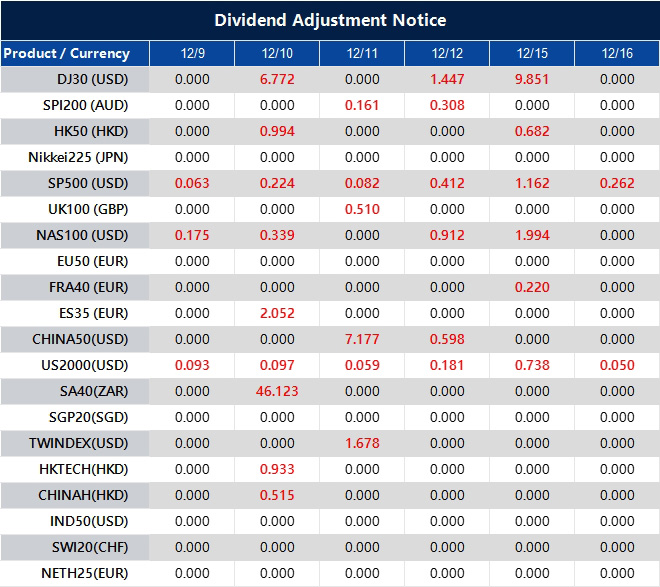
The above data is for reference only, please refer to the MT4/MT5 software for specific data.
If you’d like more information, please don’t hesitate to contact [email protected].
After the December monetary policy announcement, Governor Bullock talked about possible pauses or increases in the outlook.
The Reserve Bank of Australia (RBA) decided to keep its key interest rate at 3.6% during the monetary policy meeting in December. Governor Michele Bullock stated that any changes to the rate will be evaluated “meeting by meeting.” Inflation and job data will play a significant role in the board meeting in February.
At this meeting, the RBA did not consider raising rates and does not expect cuts anytime soon. Bullock indicated that if inflation continues, discussions about adjusting policy may arise. The board is focused on managing risks that now lean toward the upside.
Right now, the Australian Dollar is stable, with the AUD/USD rate staying above 0.6600, showing a daily increase of 0.30%. The RBA affects the value of the AUD through interest rate changes, with higher rates typically strengthening the currency.
Inflation data can influence currency value by increasing demand through rising interest rates. Important economic indicators affecting the AUD include GDP and employment data, which show the economy’s health. Quantitative easing can weaken the AUD by raising the money supply, while quantitative tightening can strengthen it by limiting liquidity.
Given the RBA’s comments today, we should not expect any rate cuts soon. Governor Bullock emphasized that the focus is now on a possible pause or rate hikes. This hawkish stance makes it risky to sell volatility on the Australian dollar in the upcoming weeks.
Recent data supports this view. The latest quarterly CPI figures for Q3 2025 came in at a stubborn 4.1%, well above the RBA’s target range and slightly higher than last quarter. With a tight labor market and an unemployment rate of 3.8% in November, the economy’s strength justifies the board’s concerns about ongoing inflation.
For our strategy, we should prepare for more volatility around key data, especially the next quarterly inflation numbers expected in late January 2026. Derivative traders might consider buying straddles or strangles on the AUD/USD with expiration after the February 2026 RBA meeting. This could allow us to profit from significant price movements in either direction, which seems likely given the board’s data-driven yet hawkish outlook.
Given the potential for rate increases, buying AUD call options with a three-month expiration appears appealing. This provides a defined risk and lets us benefit from a stronger Australian dollar if the inflation data compels the RBA to act. Looking back at the period from 2022 to 2023, we noticed that the AUD strengthened quickly whenever the RBA signaled a more aggressive approach than what the market expected.
Also, keep an eye on the interest rate futures market. Current prices for the February 2026 meeting will likely shift to reflect at least a 25 basis point hike. We should be ready for the front end of the yield curve to rise as the market realizes that rate cuts are off the table.
However, it’s essential to remember that the RBA will not react to just one data point. While we expect a stronger AUD and higher short-term rates, any unexpected weakness in upcoming jobs or inflation reports could change these expectations quickly. Therefore, maintaining some flexibility in our positions is vital.
Australian dollar gains traction after Bullock’s hawkish comments, with potential for further rise
The Australian Dollar (AUD) finds it tough to keep up its gains, even after Reserve Bank of Australia Governor Michele Bullock suggested there’s no need for immediate rate cuts. A weaker US Dollar is helping the AUD/USD pair rise, reaching its highest level since mid-September during the Asian session.
Impact of the Federal Reserve Decision
Traders are cautious as they await a decision from the US Federal Reserve, which many expect will lead to a rate cut. This expected cut is hindering the US Dollar’s recovery, indirectly boosting the Australian Dollar. The Reserve Bank of Australia has set its Official Cash Rate at 3.6%, using upcoming data to shape future decisions. Inflation is still above the RBA’s target, preventing any immediate policy easing and hinting at possible tightening in the future. In the US, the Personal Consumption Expenditures Price Index increased by 2.8% over the year, meeting expectations and supporting a dovish outlook for the Federal Reserve. Traders currently see a 90% chance of a Fed rate cut, which is likely to limit the US Dollar’s strength. The AUD/USD pair is supported around 0.6615-0.6620. If it falls below 0.6600, buying could occur near 0.6560-0.6555. Traders are waiting for US employment data, the FOMC decision, and Australian employment figures for more clarity. Looking back to September and October 2025, the market began to anticipate a large policy divide between the Reserve Bank of Australia and the US Federal Reserve. At that time, RBA Governor Bullock hinted at a possible need for tighter policy, surprising many. This led to the Australian dollar gaining strength, as traders started to expect higher interest rates in Australia.Analysis of the Policy Gap
The expected divergence has largely occurred over the past few months. The Federal Reserve implemented a 25 basis point rate cut in late September but has since remained steady. US labor data for November showed a strong jobs market, adding 195,000 payrolls. In contrast, Australian inflation has stayed stubbornly high, with the latest quarterly CPI data showing a 3.4% annual rate, forcing the RBA to keep a hawkish approach. As a result of this policy gap, the AUD/USD pair has broken through the 0.6700 resistance level, which was a key target in September. It is now settling around 0.6850, reflecting the yield advantage the Australian dollar now holds. This is a direct result of the RBA maintaining its cash rate at 3.60% while US rates have softened. Given this situation, derivative traders may want to prepare for further Australian dollar strength, at least into early 2026. Implied volatility for AUD/USD options is moderate, making strategies like buying call options appealing for potential profit. For example, a call option with a strike price of 0.6950 and a February 2026 expiration would benefit from an upward trend in the pair, driven by the RBA’s next policy meeting. However, it’s important to be aware of the risks, especially regarding a dip in demand from China or unexpected changes in the Fed’s messaging. For those who prefer a more cautious approach, a bull call spread could be a smart choice. This involves buying a call option at a lower strike, like 0.6900, and selling a call at a higher strike, such as 0.7050, to reduce initial costs and clearly define risk. Create your live VT Markets account and start trading now.Gold prices have decreased in the United Arab Emirates, according to recent data analysis.
Gold prices fell in the United Arab Emirates on Tuesday. The price per gram dropped from 494.99 AED on Monday to 494.41 AED.
The price per tola also decreased, going from 5,773.41 AED to 5,766.69 AED. The cost of a troy ounce was recorded at 15,377.88 AED.







