



WTI oil price falls to $58.65 as Iraq boosts production at an oilfield
WTI Oil prices fell to around $58.65 in early Asian trading on Tuesday. This drop is due to Iraq restarting production at the West Qurna 2 oilfield, which increases the global oil supply.
The West Qurna 2 oilfield contributes over 460,000 barrels per day, making up about 0.5% of the worldwide oil supply. Ongoing geopolitical tensions, like the unresolved issues in Ukraine, might offer some support to oil prices.
Trump threatened a 5% tariff on Mexico related to a water supply agreement.
US President Donald Trump has warned that Mexico might face a 5% tariff if it does not supply enough water to US farmers. This warning stems from a potential violation of a 1944 treaty that guarantees US access to water from the Rio Grande. Trump claims that Mexico owes the US 800,000 acre-feet of water under this treaty.
Currently, the USD/MXN exchange rate has risen slightly by 0.07%, reaching 18.27. Tariffs are fees on certain imports, aimed at making domestic products cheaper compared to foreign goods.
Tariffs differ from taxes in that they are paid when goods enter the country, while taxes are paid at the time of purchase. Tariffs affect importers, while taxes apply to individuals and businesses.
Economists have different views on tariffs. Some believe they protect local industries, while others argue they can lead to higher prices and trade conflicts. As the 2024 presidential election approaches, Trump plans to use tariffs to strengthen the US economy. In 2024, Mexico, China, and Canada made up 42% of total US imports, with Mexico being the largest at $466.6 billion. Revenue from tariffs might be used to lower personal income taxes.
With the potential 5% tariff on Mexico, currency markets are reacting. If this situation continues, the peso may weaken further. We should think about buying call options on the USD/MXN to benefit from a possible rise above 18.50 or even 19.00 in the coming weeks.
We’ve seen similar situations before, particularly during the trade disputes of 2018-2019. Those events showed us that tariff announcements or even threats create significant market fluctuations. Therefore, buying call options on the VIX index could be a smart move to profit from increased market uncertainty.
The automotive sector is particularly at risk due to interconnected supply chains. Recent data from the Commerce Department indicates that automotive parts trade between the two countries is set to exceed $150 billion this year. We should consider buying put options on US automakers and parts suppliers with major production operations in Mexico, as their costs are likely to rise.
This situation also threatens the larger Mexican economy, as the US is its biggest export market. By purchasing put options on a broad Mexico-focused ETF like EWW, we can express a bearish outlook on the Mexican market. A larger trade dispute could lead to a 5-10% drop in the Mexican stock index in the short run.
Finally, we need to be alert for possible retaliation from Mexico, which could involve targeting US agricultural exports. In 2018, Mexico enacted retaliatory tariffs on products such as pork and bourbon, causing prices to plummet. It would be wise to monitor futures contracts for agricultural commodities heavily exported to Mexico and be prepared to take short positions if retaliation seems imminent.
PBOC sets USD/CNY reference rate at 7.0773, an increase from 7.0764
The People’s Bank of China has set the USD/CNY exchange rate at 7.0773 for the next trading session, a small change from the previous 7.0764. The bank’s main goals are to keep prices stable and boost economic growth while pushing for financial reforms.
The People’s Bank of China is state-owned and led by the Committee Secretary of the Chinese Communist Party. Currently, Mr. Pan Gongsheng serves as both the Committee Secretary and the Governor.
Distinct Policy Tools
The central bank employs several unique policy tools unlike those in Western countries. Key tools include the seven-day Reverse Repo Rate, the Medium-term Lending Facility, foreign exchange interventions, and the Reserve Requirement Ratio. The Loan Prime Rate is the key interest rate that affects loans and mortgages. In China, there are 19 private banks, including well-known digital lenders WeBank and MYbank, which are linked to tech companies Tencent and Ant Group. In 2014, China allowed private capital to enter the mostly state-owned financial sector. The slight drop in the Yuan to 7.0773 indicates that the central bank is okay with a slow depreciation versus the dollar. This small adjustment suggests a policy that may help exports, given recent economic data. For derivative traders, it hints that the PBOC is not trying to defend a specific exchange rate aggressively right now. It’s important to note that this adjustment follows last week’s trade data from November 2025, showing export growth slowing to just 1.5%, much lower than expected. Added to this, a Caixin Manufacturing PMI dipped to 49.8, giving strong reasons for policymakers to guide the currency lower. These figures suggest a likelihood of further managed depreciation in the weeks ahead.Historical Precedent
This situation brings to mind 2023, when fears over the economy and a strong US dollar pushed the USD/CNY rate above 7.30. While we are not at that level now, history indicates that the PBOC will manage any decline gradually instead of making sudden changes. This makes buying options on USD/CNY calls appealing for those wanting to bet on a similar trend while minimizing risk. Given that the central bank aims for stability, we do not anticipate an abrupt devaluation, keeping implied volatility on USD/CNY options relatively low. Currently, implied volatility for 1-month options is around 4.5%, which is low considering the economic pressures. This situation could make selling out-of-the-money USD/CNY puts or using call spreads a smart strategy for collecting premium while maintaining a bullish stance on the USD. Create your live VT Markets account and start trading now.NZD/USD drops to about 0.5775 as markets expect a hawkish Fed decision
The NZD/USD pair dropped to around 0.5775 early Tuesday as the US Dollar strengthened. Traders expect a hawkish rate cut from the US Federal Reserve on Wednesday and are closely watching the delayed employment data for more information.
The Federal Reserve is anticipated to lower its rate by a quarter point at this meeting. This would be the third cut this year, bringing the federal funds rate between 3.50% and 3.75%, consistent with decisions made in September and October.
China’s Trade Surplus Effect
China’s trade surplus reached a five-month high at 111.68 billion, up from 90.07 billion the previous month. This surge provides support for the New Zealand Dollar, as China is a major trading partner of New Zealand. Upcoming data reports include the US ADP Employment Change average and JOLTS Job Openings for September and October. A surprising increase in these numbers could help limit losses for the US Dollar. The New Zealand Dollar’s value is influenced by several factors, including the health of the New Zealand economy, trade with China, dairy prices, and central bank policies. These elements can cause fluctuations in its value. Currently, with the NZD/USD pair dropping below 0.5800 on December 9, 2025, this week is crucial due to the Federal Reserve’s decisions. The market is expecting a 25-basis-point rate cut, but the focus will be on Fed Chair Powell’s “hawkish” remarks. This indicates that while a cut is coming, the Fed will not rush to make more cuts, which is boosting the US Dollar.Market Response and Strategies
Traders should brace for significant volatility around tomorrow’s Fed announcement, making options strategies appealing. A long straddle, where you buy both a call and a put option at the same strike price and expiration, could be a successful way to profit from major price swings in either direction. We saw similar market movements in late 2023 when uncertainty about the Fed’s decisions led to sharp changes in currency values. Before the Fed meeting, today’s US JOLTS Job Openings and ADP employment data will set the tone. Strong job numbers could support the Fed’s cautious approach, likely pushing the NZD/USD lower. Conversely, disappointing employment figures might challenge the hawkish perspective and trigger a significant rally for the Kiwi dollar. Additionally, China’s trade surplus hitting a five-month high provides solid support for the New Zealand Dollar. A strong Chinese economy benefits New Zealand, which may encourage some traders to sell out-of-the-money puts, believing this strong economic link will prevent the pair from falling below critical support levels. We also need to consider the rate difference between the US and New Zealand, which is a key factor. While the Fed is reducing rates to a range of 3.50%-3.75%, the Reserve Bank of New Zealand (RBNZ) kept its rate at a much higher 5.50% for most of 2024 to combat inflation. This significant yield advantage could attract buyers during major dips, especially if the Fed suggests a long pause after this week’s cut. Create your live VT Markets account and start trading now.Nasdaq futures hold key structure after rejecting 25,855, as intraday projections align within zones
Nasdaq futures hit a roadblock at 25,855, which has become a solid resistance level. During Monday’s U.S. session, attempts to break through this level were unsuccessful, confirming its role as a ceiling.
The market then reversed and fell below 25,805, resulting in a 214-point drop to the lower edge of a 6-day price channel and close to the Monthly Point of Control (POC) at around 25,591. Currently, the Index is above the important pivot level of 25,677, which is crucial for short-term trend analysis.
Intraday Trend
The intraday trend is still technically sound, with prices holding above the lower boundary of the rising channel. As of early Tuesday, the Index is trading around 25,719, focusing on a key area that will help decide future movements. Important structural zones will guide the market’s next steps. The middle structure (25,560–25,677) will be critical for market direction, while the upper structure (25,805–25,936) challenges bullish momentum. If the middle structure fails, the lower zone (25,428–25,297) will become the next support level. The daily chart reflects this trend, showing resistance at 25,855. A drop below 25,560–25,677 could significantly change the trend. The market’s path is clear: holding or breaking these key levels will determine the next significant move.Critical Decision Point
Nasdaq futures signal a crucial moment after failing to break the 25,855 barrier twice. This repeated resistance has formed a strong upper limit, and prices are now consolidating just above the important pivot at 25,677. The Volatility Index (VIX) is hovering around 16, showing market calmness but also potential complacency before the next significant movement. The market seems to be coiling within a narrow range as traders wait for final inflation data coming out next week, just ahead of the Federal Reserve’s last policy meeting of the year. The middle structure between 25,560 and 25,677 is where this tension is building. Until something prompts a breakout, prices will likely stay within this range. For a bullish scenario to emerge, we need a clear break and hold above 25,805. Such a move would likely be supported by a dovish Fed outlook and could spark a “Santa Claus rally,” where the Nasdaq 100 has often gained in December. This would lead to targets near 26,000. On the flip side, if we can’t maintain the 25,560 support level, it would signal that the recent upward momentum has faded. The developing bearish divergence on the daily RSI suggests weakening buying power, and a drop below this pivot could quickly lead to a downturn to the 25,428–25,297 support zone as traders cash in profits. This could be intensified if upcoming jobs data shows any surprises. From an options perspective, this clearly defined range makes strategies like straddles or strangles around the 25,677 pivot particularly effective for the expected volatility. For futures traders, these structural levels offer clear lines for managing risk in short-term plays. The current structure provides well-defined entry and exit points. This price behavior reminds us of the consolidation from late 2023, which preceded a breakout to new highs after the Fed’s dovish turn. The present structure suggests we are in a similar holding phase, waiting for a fundamental trigger to define the trend into early 2026. How the market resolves the situation around the 25,677 pivot in the upcoming sessions will be crucial. Create your live VT Markets account and start trading now.Week Ahead: The Fed’s Rate Cut In Focus

The quiet appearance on the charts hides a growing risk. Should BOJ officials hint at even a slight change in tone, the yen carry trade, one of the major engines behind global market performance could unwind sharply.
With the Fed now in its blackout period, policymakers are unable to guide expectations, leaving markets to lean on a single assumption: easing is coming. Although a policy rate of 3.75% is largely priced in, the Summary of Economic Projections and Powell’s delivery will decide how confidently markets extend their easing outlook into 2026.
The dot plot will be the centrepiece. Traders are looking for clear confirmation that the Fed’s projected path is aligned with what markets have already priced. Any sign of reluctance could trigger a broad repricing across FX and risk-sensitive assets.
QT Ends And Liquidity Shifts
The end of quantitative tightening marks a return to more supportive liquidity dynamics. The Fed’s recent $13.5 billion repo injection, its second-largest since the pandemic, signals strain within the funding system. Historically, when QT concludes during such periods of stress, QE often follows not long after. Although consensus expects a formal move back to QE in 2026, much may hinge on upcoming leadership changes, with Powell’s term ending in May next year.
Prediction markets currently assign Kevin Hassett a 74% chance of becoming the next Fed Chair. Should an early nomination emerge, markets may begin responding more to the anticipated stance of the incoming Chair than to Powell’s current guidance. This shift could pull forward expectations for deeper and earlier easing.
Central Bank Highlights: BOJ, RBA, And BOC
While the US is moving toward a more accommodative stance, several overseas central banks introduce their own layers of uncertainty, with the BOJ representing the most significant swing factor, supported by key signals from Australia’s RBA and Canada’s BOC this week.
If the BOJ raises rates from 0.5% to 0.75% on 19 December, a narrowing yield spread between Japan and the US would make yen-funded carry trades far more expensive to maintain or unwind.
This could force investors to liquidate US assets to settle yen liabilities, potentially triggering a swift, disorderly correction.
Such a scenario would echo previous episodes where carry-trade squeezes produced heightened volatility.
A BOJ-induced shock, however, might also push the Fed towards even more accommodative measures or an earlier re-initiation of QE to stabilise liquidity. Any near-term turbulence could therefore contrast with a more supportive longer-term environment for risk assets.
Beyond Japan, traders should also pay attention to the RBA’s policy messaging and the BOC’s rate decision, as either could influence cross-asset sentiment, particularly if they affirm or challenge the broader global easing trend.
Market Movements Of The Week
USDX
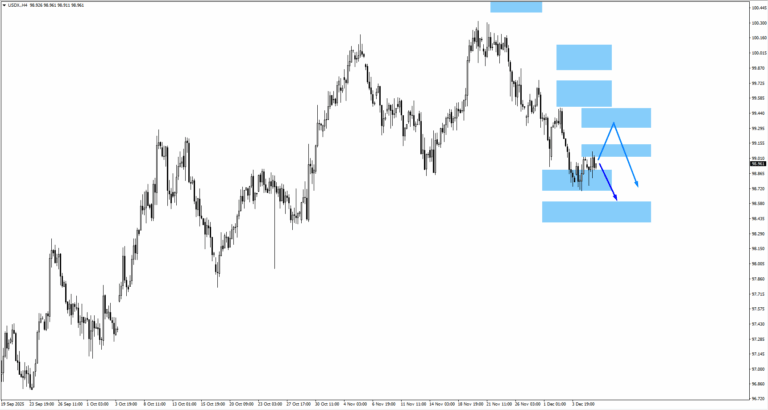
– USDX trades around the 99.10 monitored area where bearish price action is expected.
– If price moves higher, traders should watch 99.40 for renewed bearish structure.
– Downside continuation opens interest at 98.50.
EURUSD
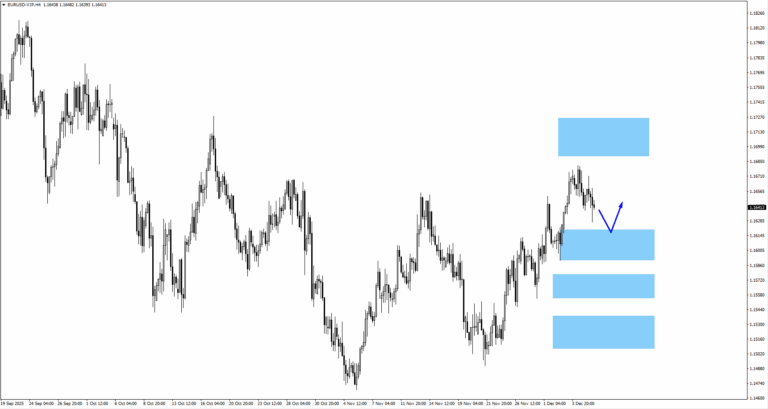
– A move lower into 1.1605 offers a zone to watch for bullish reactions.
– Upside structure may encounter resistance at 1.1710.
GBPUSD
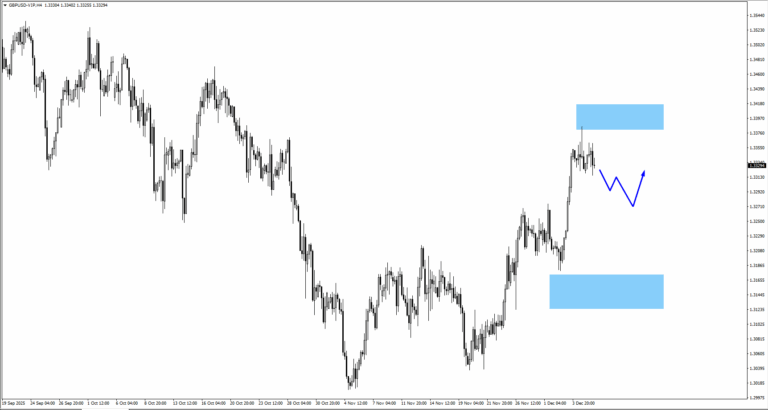
– GBPUSD rejected the 1.3405 monitored area.
– Continued consolidation lower may target 1.3250 for bullish price action.
USDJPY

– USDJPY has traded above the descending trendline.
– If price moves higher, traders should monitor 156.00 for a potential bearish reaction.
Gold (XAUUSD)
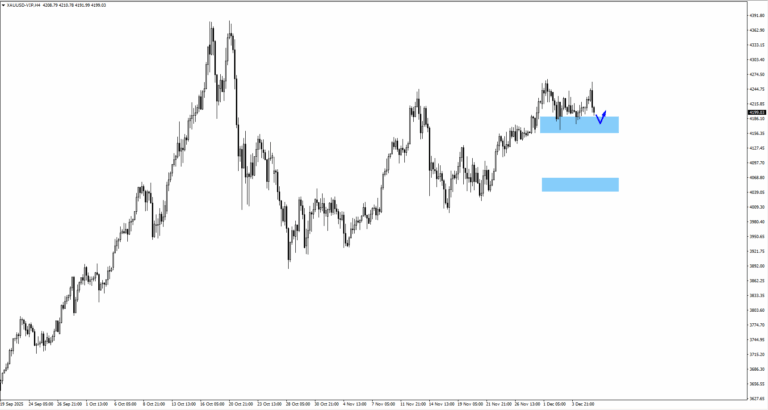
– Gold moved higher before reversing lower.
– Key level remains 4175 for near-term reactions.
– If consolidation deepens, the next bullish zone sits near 4070.
SP500

– SP500 broke above the 6888 swing high.
– Traders should monitor how the price behaves within the ascending channel.
Bitcoin (BTCUSD)
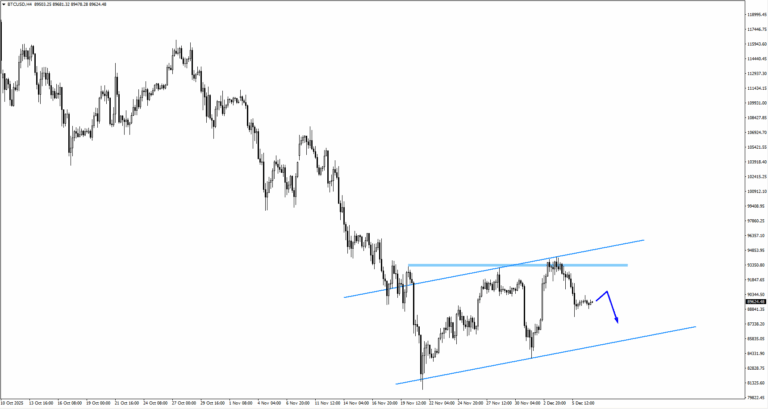
– Bitcoin turned lower after breaching the 93156 swing high.
– If consolidation continues, upside structure is monitored once price retakes 90277.
Key Events Of The Week
9 December
1. JP BOJ Gov Ueda speaks
If BOJ signals continuous hiking or a rate increase beyond expectations, USDJPY could trade lower.
2. US JOLTS Job Openings
A weak reading could spur the Fed to act beyond December and weaken USD.
11 December
1. US Federal Funds Rate, Forecast: 3.75%, Previous: 4.00%
Market has priced in the cut. Powell’s statement will likely move markets.
12 December
1. UK GDP m/m, Forecast: 0.10%, Previous: -0.10%
A rebound from negative growth. Refer to the structure.
Bottom Line
The week ahead lies at the intersection of shifting US policy and a rising wave of overseas risk factors. The anticipated Fed rate cut, combined with the end of QT, places liquidity back at the centre of market dynamics, while the BOJ’s upcoming decision may unsettle positions that have relied for years on cheap yen funding.
As these forces interact, trading conditions could tighten abruptly or open up just as quickly.
With this backdrop, attention turns to the Fed’s communication, signals from deep within the financial system, and market reactions around the key levels mapped across USD pairs, equities, commodities, and cryptocurrencies.
In November, business confidence in Australia dropped to 1, down from the previous 6.
The National Australia Bank’s business confidence index fell to 1 in November, down from 6. This drop shows that Australian businesses are feeling less optimistic about the economy. They have a more cautious view on growth and economic conditions.
Several factors may have caused this decrease, including rising inflation, changes in monetary policy, and global market uncertainties. Lower confidence can affect investment decisions and hiring plans in the near future.
As businesses adjust to changing economic times, this decline could influence Australia’s overall economic performance and growth.
With business confidence dropping sharply, we expect more volatility in the Australian market as we approach the new year. The fall to a reading of 1 indicates significant concern among businesses about the economic conditions expected in early 2026. This suggests preparation for greater volatility in the ASX 200, likely using options strategies designed to benefit from larger price movements.
This weak data makes it unlikely for the Reserve Bank of Australia to raise interest rates anytime soon. After the RBA kept rates steady at 4.60% last week, this report strengthens the belief that the tightening cycle has paused for now. We will be monitoring interest rate futures to see if the market starts to anticipate rate cuts in the second half of 2026.
The outlook is also affecting the Australian dollar, which has struggled to maintain value above 0.6500 against the US dollar. A less aggressive RBA, compared to other central banks, tends to make the currency less attractive. We see this as a chance to consider put options on the AUD/USD, betting on further declines.
We recall similar drops in confidence leading to the economic slowdown seen in late 2022 and early 2023. During that time, cyclical sectors like banking and mining performed poorly. This trend suggests it may be wise to take defensive positions or buy puts on major resource stocks like BHP.
In November, the National Australia Bank’s business conditions in Australia dropped from 9 to 7.
The National Australia Bank (NAB) reported that business conditions have decreased, dropping the index from 9 to 7 in November. This change points to less business activity and lower confidence in the Australian economy.
The survey shows a drop in demand, lower sales, and shrinking profit margins. Reasons for this decline include rising operational costs, supply chain problems, and uncertainty in economic policies.
Potential Challenges Amid Rising Inflation
We need to keep an eye on this trend due to possible challenges for the Australian economy, especially with inflation rising and global uncertainties. This situation raises concerns about the strength of Australia’s economic recovery after the pandemic, which could affect monetary policies and support measures. With business conditions at 7 in November, it appears that the Australian economy is losing momentum as we approach the new year. Recent data shows quarterly inflation has eased to 3.1%, and retail sales growth in October was just 0.1%, suggesting consumers are slowing down. This trend makes it more likely that the Reserve Bank of Australia may adopt a more cautious approach early in 2026. We suggest that traders take defensive positions on the ASX 200 index. Buying put options on the XJO or taking short positions with SPI 200 futures could help protect against a potential market decline. This approach is based on the expectation that weaker business activity will eventually impact corporate earnings and investor confidence.Market Volatility And Currency Strategies
Economic uncertainty often leads to market volatility. Australia’s volatility index, the A-VIX, has increased to 15, and it could rise even more in the coming weeks. For comparison, it shot up above 20 during uncertain economic times in 2023. Therefore, options that benefit from rising volatility may be appealing now. The weakening economic outlook is also affecting the Australian dollar. The AUD/USD currency pair has already dropped to around 0.65, and we expect it to weaken further if the market continues to anticipate future rate cuts by the RBA. Traders might consider using currency options, such as buying AUD/USD puts, to prepare for further declines. In the interest rate market, the possibility of a rate cut by mid-2026 is now being taken more seriously than a few months ago. This is evident in the rise of Australian 3-year government bond futures. Positioning for lower rates via interest rate derivatives could be a key trading strategy as we move through the first quarter of 2026. Create your live VT Markets account and start trading now.Japan’s Money Supply M2+CD increases to 1.8% (YoY) from 1.6%
Japan’s money supply, which includes currency in circulation and various deposits (M2+CD), grew by 1.8% in November compared to last year, up from 1.6% in October. This growth shows that there is a steady demand for money within the economy.
The Bank of Japan is maintaining a supportive monetary policy aimed at fostering economic growth and tackling low inflation. Meanwhile, market activity is fluctuating as investors keep an eye on global economic trends and upcoming decisions from major central banks.
Japan’s Economic Policy
The increase in Japan’s M2 money supply to 1.8% suggests that the Bank of Japan will continue its easy-money approach. This indicates that Japanese interest rates are likely to stay close to zero for a while. Traders should prepare for this ongoing policy into the next year. In contrast, the United States Federal Reserve is keeping its key interest rate around 4.5% to control inflation, which was last reported at 3.1% in November 2025. This big difference in yield is putting pressure on the Japanese Yen. There are opportunities in strategies that profit from a strong dollar against the yen, like buying USD/JPY call options or futures contracts. For stock traders, the Bank of Japan’s relaxed stance is beneficial for Japanese shares. The Nikkei 225 has already increased by over 15% this year, and the continued availability of money suggests this trend may continue. We are looking at buying call options on the Nikkei 225 index to take advantage of further potential gains.Monitoring Economic Indicators
The Bank of Japan’s caution is evident from recent data. Japan’s GDP growth in Q3 2025 was a modest 0.4%, and core inflation remains just below the 2% target. This weak economic landscape makes it unlikely for any tightening of policy in the near future. The steady policies help make long equity and short yen positions more predictable. However, we need to stay alert for volatility, particularly with the USD/JPY pair testing multi-decade highs around 158 throughout the autumn of 2025. While the underlying reasons are strong, there is a heightened risk of intervention from Japanese authorities to support the yen. This suggests that using options to manage risk could be a wise strategy for these trades. Create your live VT Markets account and start trading now.Concerns about the Fed’s hawkish stance lead to gold prices falling below $4,200
Gold prices are currently around $4,195 during the early Asian trading session. This reflects concerns about a more aggressive stance from the US Federal Reserve, even though a rate cut is expected. Markets see a 90% chance of a 25-basis point rate cut at the December FOMC meeting, up from 66% in November. Upcoming reports from ADP Employment Change and JOLTS Job Openings could affect these expectations.
Gold’s value moves inversely to the US Dollar and US Treasuries, which are major reserve assets. In 2022, central banks added 1,136 tonnes of gold, worth $70 billion, to their reserves, marking their highest annual purchase ever. Gold is often viewed as a safe asset during times of geopolitical tension or recession, typically rising as interest rates fall. Heightened tensions between the US and Ukraine may further drive interest in gold as a safe haven.







