



GBP/JPY declines below 207.00 after rising in the Asian session and reaching a new high
The GBP/JPY has pulled back slightly after hitting a new yearly high, with concerns about government intervention and potential rate changes from the Bank of Japan (BoJ) affecting the trend. While this affects the upward momentum of GBP/JPY, the end of uncertainty surrounding the UK budget helps support the currency pair, which goes against forecasts of a rate cut from the Bank of England (BoE).
After a rise to 207.20 during the Asian session, GBP/JPY declined for the second day in a row on Friday. However, this downward trend lacks strength, as prices remain above the mid-206.00s, setting the stage for strong weekly gains.
Japan’s construction orders fell 10.1% year-on-year, in contrast to the previous 34.7% increase.
Japan’s construction orders fell by 10.1% in October, down from a previously reported growth of 34.7%. This significant decline points to difficulties in the construction industry for that month.
In other economic news, Canada’s GDP is expected to grow in the third quarter after shrinking in the previous quarter. In Germany, retail sales rose by 0.9% year-on-year in October, a slight increase from the previous 0.8%.
The Yen’s Movement
The Japanese yen remains stable against the US dollar, with limited risks of further decline. Gold prices have stayed steady below $4,200, buoyed by expectations of a Federal Reserve rate cut in December. Zcash, a privacy-focused cryptocurrency, may face troubles with a potential 30% drop due to increasing retail trading volume. It has already seen over a 17% loss this week as demand in shielded pools remains weak. US financial markets had reduced hours on Black Friday after Thanksgiving. Investors were left to consider the impact of the UK budget and stock market trends, with various insights offered to guide traders for 2025.Japan’s Economic Indicators
The sharp decline in Japan’s construction orders raises alarms for the coming weeks. A drop to -10.1% year-over-year, particularly after a significant 34.7% gain the month before, indicates a serious contraction in an important sector. This trend may signal a broader slowdown for Japan. This disappointing data supports continued yen weakness. The Bank of Japan is unlikely to tighten its policy, which has persisted since the high inflation period of 2023-2024. Thus, there is potential to use derivatives to short the yen against the U.S. dollar. Purchasing call options on USD/JPY might yield significant benefits if this economic weakness extends into the new year. In the US, expectations for a Federal Reserve rate cut in December remain strong, supporting gold and other assets. Recent inflation data indicates a steady decline, with the Core PCE Price Index, the Fed’s favored measure, at 2.5% for the last quarter. For traders, going long on gold futures or purchasing call options on gold ETFs could be appealing, especially as gold prices stabilize below $4,200. Concerns about a global slowdown are reflected in the bearish outlook for WTI crude oil. Weaker data from major economies like Japan and Germany has caused global oil demand growth to slow to about 1.1 million barrels per day in 2025, down significantly from earlier post-pandemic rates. In this context, buying put options on major oil producers or energy ETFs could provide a good hedge. Meanwhile, Europe is also facing challenges, with German retail sales slowing and the EUR/USD struggling to stay above 1.1600. The European Central Bank is stuck between persistent inflation and a stagnating economy. This situation may result in poor performance in European equities, making short positions on the DAX index through futures a sensible strategy. Create your live VT Markets account and start trading now.Dollar Falters As Rate-Cut Expectations Strengthen
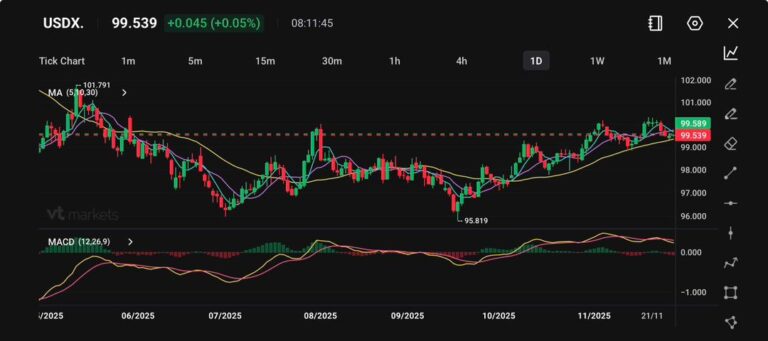
The US Dollar Index (USDX) managed a modest recovery on Friday, edging up to 99.599 and reclaiming part of the heavy losses accumulated earlier in the week. Even so, the uptick did little to offset the broader decline, with the greenback still heading for its weakest weekly showing since 21 July, having fallen nearly 1.4% at its lowest point.
The dramatic shift in sentiment came as traders sharply increased their expectations for monetary easing, following a run of disappointing US data, including softer retail sales and weakening consumer sentimen, which collectively bolstered the dovish outlook.
Fed Funds futures are now assigning an 87% probability to a 25-basis-point cut at the 10 December FOMC meeting, a substantial jump from just 39% a week earlier, according to CME’s FedWatch tool.
Further adding to the turbulence was an unexpected outage at CME Group, which briefly suspended trading in major FX pairs during the thin Thanksgiving session. The disruption intensified already-fragile liquidity conditions, leaving markets susceptible to exaggerated swings across the currency complex.
Technical Analysis
The US Dollar Index remains in consolidation just below the 100 threshold, maintaining a gentle upward bias after rebounding from September’s 95.81 low.
The chart reflects a gradual ascent over the past two months, with the index holding above the 30-day moving average, which continues to function as dynamic support.
However, momentum is beginning to soften near the important resistance band around 100–101, a region that has repeatedly curtailed rallies since May.
The MACD indicator is flattening out just above the zero line, with the histogram showing slight bearish divergence. This suggests the rally may be losing strength, even though the broader trend remains constructive.
If USDX can break and close above 100.8, it would likely spark further bullish interest, targeting 101.5 next. But if the index dips below 99 or the 30-day average, short-term sentiment may shift toward consolidation or a mild pullback. For now, markets appear cautious, awaiting a decisive trigger.
Cautious Outlook
Although the dollar may find short-term support within the 99.00–99.60 region, the wider trend is starting to show signs of strain. With markets heavily skewed towards expecting a December rate cut and liquidity likely to remain uneven into the end of the year, conviction on the upside remains limited.
Unless US economic data markedly outperforms or Federal Reserve officials push back forcefully against the dovish pricing, the dollar may continue to drift lower into December, particularly against higher-yielding and commodity-driven currencies.
Gold prices rise in the Philippines today based on recent market data
Gold prices in the Philippines went up on Friday. According to FXStreet data, the price per gram reached 7,880.74 Philippine Pesos (PHP), an increase from PHP 7,821.48 on Thursday. The price per tola also rose to PHP 91,919.34, up from PHP 91,228.17.
FXStreet converts international gold prices to local currency using current exchange rates. Prices can vary slightly each day. Gold is priced in different units, including grams, tolas, and troy ounces, with the current troy ounce price at 245,119.90 PHP.
Gold as a Store of Value
Gold has a long history as a store of value, especially during times of financial trouble. Central banks are major buyers of gold, having added 1,136 tonnes in 2022 to help stabilize their economies. This boosts resilience and confidence in a country’s financial stability. Gold’s value often moves in the opposite direction of assets like the US Dollar and US Treasuries. When the Dollar weakens, gold’s value usually rises. Geopolitical tensions and changes in interest rates also affect gold prices. A weaker US Dollar typically increases gold prices because gold is priced in USD (XAU/USD). As of November 28, 2025, the increase in gold to 7,880.74 PHP per gram reflects a weaker US dollar. This aligns with the usual trend of gold rising as the dollar falls, which has been happening for several weeks. This trend should be viewed as part of a larger pattern, not just a one-day change. Expectations in the market suggest a softer approach from the US Federal Reserve. Recent economic data from October 2025 indicates slower growth. Looking back at the 2023-2024 rate hike cycle, any hint of future rate cuts makes gold, which doesn’t yield interest, more appealing. This could mean that holding long positions in gold derivatives may be profitable.Gold as a Hedge
Gold also serves as a hedge against currency depreciation and inflation. The Philippine Peso is currently weaker against the dollar compared to earlier this year, making gold a good buffer for local investments. The memory of high inflation over the past few years supports this perspective. Strong underlying demand for gold comes from central bank purchases. Recent data from the third quarter of 2025 shows that central banks, especially in emerging markets, added another 260 tonnes to their reserves. This consistent buying helps keep prices steady and lowers the chances of a major sell-off. Ongoing geopolitical tensions in various regions make gold an attractive safe-haven asset. Any sudden conflicts are likely to push investors out of stocks and into the safer option of gold. Therefore, using gold derivatives can be an effective way to protect against volatility in riskier investments. A simple strategy for the upcoming weeks is to buy call options on gold futures. This lets us take advantage of potential price increases while clearly defining our maximum risk to the premium we pay for those options. Create your live VT Markets account and start trading now.Gold prices rise in the United Arab Emirates based on recent data
Gold prices in the United Arab Emirates went up on Friday, according to FXStreet data. The price per gram rose to AED 494.56 from AED 490.84 on Thursday.
The price per tola also increased, reaching AED 5,768.23 compared to AED 5,725.05 the day before. FXStreet adjusts international gold prices to the local UAE currency and units, updating these daily based on market rates.
Gold as a Safe Haven Asset
Gold is highly regarded because it has historically been a reliable store of value. It’s often seen as a safe-haven asset, providing protection during inflation or when currencies lose value. Central banks are the largest buyers of gold, purchasing 1,136 tonnes worth about $70 billion in 2022—the highest on record for a single year. This buying helps stabilize economies by diversifying their reserves and supporting currency strength. Gold prices often move in the opposite direction from the US Dollar and US Treasuries, and they typically have a negative relationship with riskier assets like stocks. Key factors that affect gold prices include global political instability and interest rates. A weaker US Dollar usually drives gold prices higher, while a stronger Dollar keeps them steady. As gold shows renewed strength, we need to keep in mind its inverse connection with the US Dollar. The Dollar Index (DXY) has recently weakened, dropping below the 102 level after being strong earlier this year. This makes gold cheaper for those using other currencies, which could increase demand in the coming weeks. We think interest rate expectations are a big driver for gold right now. After significant rate hikes through 2023 and 2024, markets now expect a pause or even cuts from the Federal Reserve by mid-2026. Lower interest rates make holding non-yielding assets like gold more appealing.Central Bank Impact on Gold Prices
The steady buying by central banks provides a strong support for gold prices. This trend has continued since the record purchase of 1,136 tonnes in 2022, with emerging economies taking the lead. Our analysis shows that central banks have added over 850 tonnes to their reserves in the first three quarters of 2025, indicating ongoing confidence in gold. Given the ongoing global uncertainty, gold’s role as a safe-haven asset remains crucial. Any increase in global conflicts could lead to a rush to safety, driving prices up sharply. Derivative traders might want to use call options to prepare for potential price surges while minimizing downside risk. We are also seeing higher implied volatility in gold options, suggesting that the market is expecting bigger price changes. This environment is good for strategies that benefit from volatility, not just directional bets. Look for chances where option prices seem unfavorable compared to the potential for a big move. Finally, keep an eye on the relationship between gold and equities. The S&P 500 has been mostly flat for the last quarter, and there are concerns about slowing economic growth. If a significant shift out of stocks occurs, we expect some of that money will flow into gold as a defensive measure. Create your live VT Markets account and start trading now.Gold prices in Pakistan have risen according to compiled market data.
Gold prices in Pakistan rose on Friday, as reported by FXStreet. The price for a gram of gold reached 38,033.10 Pakistani Rupees (PKR), up from 37,769.22 PKR on Thursday.
The cost for a tola also increased to 443,610.70 PKR from 440,532.80 PKR the day before. FXStreet calculates gold prices in Pakistan by matching international rates (USD/PKR) with the local currency.
Gold As A Hedge Against Inflation
Gold is viewed as a safe investment during economic uncertainty. It acts as a hedge against inflation and currency decline. Central banks hold the most gold, purchasing 1,136 tonnes in 2022, worth about $70 billion, according to the World Gold Council. This was the highest annual amount recorded. Countries like China, India, and Turkey are quickly increasing their gold reserves. Gold prices often move in the opposite direction of the US Dollar and US Treasuries. A falling Dollar typically drives up gold prices, while rising stock markets can pull them down. Price changes can also result from global tensions or fears of a recession. Interest rates and the strength of the Dollar are important factors since gold is priced in dollars (XAU/USD).Traders And Market Trends
The recent rise in gold prices in Pakistan mirrors a broader global trend. With ongoing concerns about a worldwide economic slowdown extending into 2026, gold’s status as a safe-haven investment becomes even more crucial. Traders should keep in mind the steady demand from investors seeking security amid market instability. We are witnessing a major shift in expectations around monetary policy, which affects gold prices directly. The CME FedWatch tool indicates over a 70% chance of a rate cut by the U.S. Federal Reserve in the first quarter of 2026, prompted by slowing economic data. Historically, lower interest rates reduce the cost of holding non-yielding gold, making it more appealing. Traders should note the inverse relationship between gold and the US Dollar. Expectations of lower U.S. interest rates have driven the DXY index down nearly 4% over the past quarter. A weaker Dollar makes gold, which is priced in USD, more affordable for buyers using other currencies, potentially increasing international demand. We must also consider the strong demand from central banks. This trend has picked up since the record purchases in 2022. The World Gold Council reported that central banks, especially in emerging markets, added another 250 tonnes to their reserves in the third quarter of 2025. This consistent buying helps support gold prices and indicates a long-term shift away from relying solely on the Dollar. In this context, traders might explore strategies designed to profit from upward price movements and potential volatility. Purchasing call options on gold futures or ETFs could provide a way to benefit while limiting downside risk to the premium paid. We have noticed that implied volatility for gold options has reached a 6-month high, suggesting that the market is anticipating larger price fluctuations in the coming weeks. Create your live VT Markets account and start trading now.Gold prices in India have increased, according to recent data analysis.
Gold prices in India rose on Friday, based on FXStreet data. The price per gram was 12,028.43 Indian Rupees (INR), up from 11,954.88 INR the day before.
The price per tola went up to INR 140,297.20 from INR 139,439.40. For reference, 10 grams of gold now costs 120,284.30 INR, while a troy ounce is priced at 374,126.20 INR.
How Gold Rates Are Calculated
FXStreet calculates gold rates by converting international prices to local currency and units, like USD/INR. Prices are updated daily based on current market conditions, though there may be local variations. Central banks hold the biggest gold reserves. In 2022, they added 1,136 tonnes of gold, worth about $70 billion, which is the highest annual purchase recorded by the World Gold Council. Most of this activity has come from emerging economies including China, India, and Turkey. Gold prices often move in the opposite direction of the US Dollar and US Treasuries. This means gold tends to rise when these assets lose value, acting as a safe-haven during tough economic times. Factors like geopolitical tensions, interest rates, and the strength of the US Dollar influence gold prices. Currently, as of November 28, 2025, the increasing gold price presents a clear opportunity. There are rising expectations for a Federal Reserve rate cut in December, especially since the latest US jobs report for October showed weaker hiring than anticipated. This dovish outlook weakens the US dollar, which benefits gold.Trading Opportunities and Market Trends
We suggest that traders consider taking long positions in gold derivatives, such as call options or futures contracts. The CME FedWatch Tool now indicates over 70% probability of a rate cut next month, marking a significant change from a few weeks ago. This trend makes bullish positions on non-yielding assets like gold more appealing as the cost of holding decreases. Ongoing demand from central banks helps create a solid price floor, reducing the risk of price drops. Recent data from the World Gold Council for the third quarter of 2025 shows that emerging market central banks added another 200 tonnes to their reserves, continuing the record purchasing seen in 2022. This strong institutional buying suggests that if prices dip, they won’t last long. The expected inverse relationship between gold and the US dollar is happening as anticipated. With the US Dollar Index staying below 99.50 and showing further weakness, gold is becoming cheaper for foreign buyers. This situation is further driving the upward momentum we are currently experiencing. Looking back, a similar scenario unfolded during 2023-2024 when the market began anticipating the end of the Fed’s rate-hiking cycle. Gold initially rallied and then entered a sustained upward trend once the first rate cut was confirmed. A similar pattern may happen as we move toward early 2026. Considering the slight rise in geopolitical tensions around trade and an overextended stock market, holding some gold is a smart hedge. Derivatives provide a cost-effective way to gain this exposure or to speculate on further price increases. The key strategy for the next few weeks should be to buy on dips while keeping a close eye on Fed communications. Create your live VT Markets account and start trading now.Recent market data indicates an increase in gold prices in Malaysia.
Gold prices in Malaysia rose on Friday, according to FXStreet. The price reached 554.97 Malaysian Ringgits (MYR) per gram, up from 551.85 MYR the day before.
The price for a tola increased from MYR 6,436.68 to MYR 6,473.13. In other terms, 10 grams now cost 5,549.81 MYR, while a troy ounce is priced at 17,261.59 MYR.
Gold Price Calculation
Gold prices are determined by adjusting international rates to local currency and measurement units. FXStreet updates these prices daily, reflecting current market conditions at the time of publication. Local rates might vary slightly from these numbers. Gold has long been valued as a safe asset and currency. Today, it serves as a safe-haven investment, shielding against inflation and currency decline. Central banks, especially in emerging economies, hold large amounts of gold. Gold’s value typically moves in the opposite direction of the US Dollar and Treasury bonds. When stock markets decline, gold’s price usually rises. It is mainly influenced by geopolitical instability, concerns about recessions, and interest rate changes. Generally, gold prices rise when the Dollar weakens. The recent increase in gold prices, now at MYR 554.97 per gram, is noteworthy. This upward trend reflects not just local conditions but also global market shifts, particularly regarding the US Dollar. Traders should prepare for more market fluctuations as these worldwide factors unfold in the coming weeks.Central Bank Demand and Market Strategy
The current strength in gold is driven by expectations of a shift from the US Federal Reserve. With US inflation falling to 2.4% last month, the high-interest rate period that began in early 2020 seems to be ending. This brings to mind the Fed’s policy change in 2019, which led to a significant rise in precious metals, as lower rates made gold more appealing. Central bank demand is providing strong support for gold prices. In both 2023 and 2024, central banks added over 1,000 tonnes to their reserves, keeping up with the historic buying trend seen in 2022. This consistent purchase activity, particularly from emerging markets, aims to diversify away from the Dollar and enhances gold’s stability moving forward. For derivative traders, this situation suggests that buying call options on gold futures may be a wise strategy. Implied volatility has not yet surged, so option prices are fairly reasonable. This presents a cost-effective way to prepare for a potential price increase if gold maintains its upward momentum through the end of the year. At the same time, it’s important to remember gold’s role as a safe asset in light of ongoing concerns about a global economic slowdown. Using gold futures or options to hedge against equity investments is a smart choice, as gold typically moves inversely to riskier assets. This balanced strategy allows us to benefit from possible gains while protecting ourselves from market instability. Create your live VT Markets account and start trading now.Silver faced challenges in the $54.40-$54.45 range and declined after reaching an earlier peak.
Silver faced a setback after hitting its highest price in over a month during Friday’s Asian session. Despite this pullback, it remains around the mid-$53.00s, up by 0.20% for the day and showing strong weekly gains.
From a technical standpoint, silver has struggled to break through the $54.40-$54.50 range, forming multiple tops on the daily chart. Oscillators suggest we should be cautious about confirming a near-term peak. If the price drops below $53.25, new buyers are likely to step in around $53.00, limiting further drops to around $52.70-$52.65.
If silver continues to decline and falls significantly below its recent low, it could drop to the $52.00 level. On the other hand, if it surpasses the $54.20-$54.25 area, it could test its October peak of $54.70-$54.75. Strong buying could drive silver past $55.00, giving bulls new momentum and potential for further gains.
Currently, silver is pulling back after failing to break the $54.50 resistance zone, a level it hasn’t cleared since mid-October. This ongoing failure is forming a short-term top on the charts, making this a crucial decision point for the coming weeks.
Any dip towards $53.00 should be seen as a potential buying opportunity. The overall outlook remains strong, as recent industry reports indicate global industrial demand for silver is set to hit a record 650 million ounces in 2025, largely driven by a 20% year-over-year increase in solar panel manufacturing. This growing physical demand provides solid support for prices.
For those expecting a breakout, buying call options with strike prices of $55.00 or higher could be a smart move. This strategy allows participation in a significant rally while limiting downside risk to the premium paid. A similar situation occurred in early 2024 when prices surged nearly 15% in one quarter.
However, we cannot overlook the strong resistance near $54.50. Traders who believe this ceiling will hold might consider buying put options with strike prices below $53.00 to benefit from a possible decline. This strategy is backed by the recent Federal Reserve minutes, which reaffirmed a “higher-for-longer” policy on interest rates, keeping the US Dollar strong.
Historically, silver’s price tends to become very volatile near all-time highs, as seen during the run-up to nearly $50 in 2011. With the mixed signals between strong industrial demand and a strict monetary policy, we can expect increased price swings. This environment is ideal for strategies like long straddles, which profit from significant price movements in either direction.
USD/CAD pair rises slightly above 1.4000 during Asian trading hours as crude oil prices decline
USD/CAD shows slight growth, trading around 1.4030 during the Asian session on Friday. The Greenback may face some limitations as traders anticipate more monetary easing from the US Federal Reserve (Fed) next month.
Comments from Fed officials have increased expectations for a rate cut in December. The San Francisco Fed President expressed support for lowering rates, citing concerns about the labor market. Another official mentioned the weakness in the employment market might justify another cut, depending on upcoming data affected by the US government shutdown.







