



Australian dollar strengthens against stable US dollar following positive employment data
The Australian Dollar has strengthened due to better job market data. In October, Australia’s unemployment rate fell to 4.3%, which was an improvement over predictions. In the US, President Trump ended a 43-day government shutdown that had impacted financial markets.
For the second consecutive day, the AUD increased against the USD, supported by positive employment statistics. According to the Australian Bureau of Statistics, employment rose by 42.2K, surpassing market expectations. Full-Time Employment grew by 55.3K, while Part-Time Employment decreased by 13.1K. The Reserve Bank of Australia’s (RBA) policy outlook continues to attract attention, with ongoing discussions about possible monetary restrictions.
The Indian rupee weakens against the US dollar because of foreign stock market outflows and speculation about the RBI.
The Indian Rupee is currently losing ground against the US Dollar, primarily due to anticipated interest rate cuts by the Reserve Bank of India (RBI) in December. The USD/INR exchange rate has climbed to around 88.85, as speculation about the RBI’s monetary policy puts additional pressure on the Rupee.
On Wednesday, the Retail Consumer Price Index data revealed that inflation dropped to 0.25% annually. This decline was driven by lower food prices and cuts to consumer goods taxes. Additionally, Foreign Institutional Investors (FIIs) have been selling off stocks in the Indian market this week, which further impacts the Rupee negatively.
Moody’s Economic Growth Prediction
Moody’s forecasts that the Indian economy will grow by 6.5% through 2027, supported by infrastructure spending, although business capital spending remains uncertain. Investors are looking forward to the release of the Wholesale Price Index data for October, set to come out on Friday. The US Dollar Index, which measures the dollar’s strength, is trading slightly above a 10-day low due to expectations of a Federal Reserve rate cut in December. The likelihood of a rate cut has increased to 67%, amid reports of private employers laying off workers weekly. The USD/INR exchange rate is showing a bullish trend, remaining above the 20-day Exponential Moving Average, with the potential to reach the all-time high near 89.10. Meanwhile, President Trump has signed a bill to reopen the US government after a prolonged shutdown.Rupee’s Future Outlook
We anticipate that the Rupee will weaken further against the dollar in the coming weeks. The primary factors contributing to this are strong expectations of an RBI rate cut in December and ongoing selling by foreign institutional investors. This situation creates upward pressure on the USD/INR pair. The outflow of capital from foreign investors poses a serious risk to the stability of the Rupee. In November 2025 alone, FIIs have withdrawn over $2.5 billion from Indian equities, confirming the trend of heavy selling we’ve observed this week. This consistent demand for dollars to repatriate funds is weakening the local currency. The case for an RBI rate cut is becoming increasingly compelling, especially with October’s inflation at just 0.25%. It’s worth noting that two years ago, during late 2023, inflation was over 5%. This sharp decline provides the RBI with a strong reason to act. A rate cut of 25 to 50 basis points seems highly likely in the upcoming December meeting. While the Rupee faces significant challenges, the outlook for the US Dollar is less clear. Markets are expecting a Fed rate cut, but officials like Susan Collins are publicly refuting this idea. This divergence in policy—where the RBI seems ready to lower rates while the Fed hesitates—favors a higher USD/INR rate. Given these developments, buying USD/INR call options appears to be a smart move to capitalize on the anticipated rise toward the 89.12 all-time high. Traders willing to take on more risk might consider purchasing USD/INR futures, while importers should quickly look into forward contracts to protect against dollar payments. With volatility likely to stay high, option premiums could be valuable. Create your live VT Markets account and start trading now.During early European trading, the USD/CHF pair approaches 0.7990 with a bearish sentiment.
The USD/CHF has climbed to about 0.7990 early on Thursday during the European session. The pair is still in a downward trend, staying below the 100-day Exponential Moving Average (EMA) and supported by a bearish Relative Strength Index (RSI).
Initial support is at 0.7946, with a potential drop past 0.7909 if it breaks this level. On the other hand, resistance is at 0.8007, which may rise to 0.8065 if surpassed, with another resistance point at 0.8115.
The Role of the Swiss Franc
The Swiss Franc (CHF) ranks among the top ten most traded currencies, with its value linked to Switzerland’s economy and actions by the Swiss National Bank (SNB). After the removal of its peg to the Euro, the CHF saw a 20% increase because of its dependence on Eurozone stability. As a safe-haven currency, the CHF usually gains value during times of global market stress, thanks to Switzerland’s stable economic and political environment. The SNB’s decisions greatly affect the CHF’s value; higher interest rates make it more appealing, while lower rates could weaken it. Switzerland’s economy, closely tied to the Eurozone, also impacts the CHF through macroeconomic data and Eurozone policies. Changes in indicators such as growth or inflation can cause movements in the CHF. The bearish outlook from previous years, when USD/CHF traded near 0.8000, has changed. As of November 13, 2025, the pair is stabilizing around 0.9150, indicating a shift in the global economic situation. The current tension is between the Federal Reserve, which is contemplating its next steps, and the SNB, which is concerned about a slowing Eurozone.Trading Implications and Strategies
The US Dollar’s strength is being questioned as recent data shows headline inflation has eased to 2.8% in October 2025, while wage growth stays strong. This puts the Federal Reserve in a holding pattern, with markets anticipating a possible rate cut in the second quarter of 2026. This dovish shift suggests limited upside for the dollar. Meanwhile, the Swiss Franc isn’t the reliable safe haven it used to be, especially when compared to the 2011-2015 peg era. With the latest Swiss manufacturing PMI dropping to 48.5, indicating contraction, the SNB is cautious about tightening its policy. The economic health of the Eurozone, its key trading partner, remains crucial for the SNB. For those trading derivatives, a strategy of selling volatility may be wise in the weeks ahead. We think the opposing pressures from both central banks will likely keep the pair within a defined range, probably between 0.9000 and 0.9250. Buying strangles or straddles might be risky, as there doesn’t appear to be a major catalyst for a breakout right now. Those who are bearish on USD/CHF might consider purchasing put options with a strike price below 0.9050, which provides a defined-risk way to bet on a dollar decline. However, since the CHF has its own vulnerabilities, we recommend using any strength toward the 0.9200 level as an opportunity to enter these positions. This situation is a significant improvement from the sub-0.8000 levels discussed during past US government shutdowns, highlighting a fundamentally stronger dollar today. Create your live VT Markets account and start trading now.After positive Australian employment figures, the AUD/JPY pair nears its yearly peak at around 101.60.
The AUD/JPY pair touched its yearly high of about 101.60 during late Asian trading. The Australian Dollar gained strength after positive labor data from Australia. It also performed well against major currencies, especially the Swiss Franc.
The Australian Bureau of Statistics reported the creation of 42.2K jobs, much higher than the expected 20K. The unemployment rate decreased to 4.3%, lower than the anticipated 4.4% and down from 4.5% in previous data.
Improved Labor Conditions
Better labor conditions often lead traders to rethink their expectations for rate cuts by the Reserve Bank of Australia (RBA). Inflation pressures continue, with the Consumer Price Index (CPI) rising by 1.3% in the third quarter, compared to 0.7% in the second quarter. At the same time, the Japanese Yen remains stable, as the Bank of Japan (BoJ) is not expected to change its loose monetary policy. This aligns with Japan’s new Prime Minister Sanae Takaichi’s focus on fiscal expansion. Typically, an increase in employment boosts consumer spending and economic growth, helping the Australian Dollar. A drop in these numbers would be a negative sign. Currently, the AUD/JPY pair is nearing its 2025 highs around 101.60, supported by a surprisingly strong Australian jobs report for October. The addition of 42,200 jobs, more than double the forecast, strengthens our view that the Reserve Bank of Australia will keep its cash rate steady at 4.35%. The tight labor market resembles conditions from late 2023, keeping expectations of rate cuts off the table for now.Monetary Policy Divergence
In contrast, the Japanese Yen remains weak as the Bank of Japan shows no immediate plans to tighten policy. After ending its negative interest rate policy in March 2024, the BoJ has taken a cautious approach, citing the need for sustainable wage growth. With core inflation in Japan around 2.5% for much of this year, a level similar to late 2024, the central bank feels justified in maintaining its accommodative stance. For those in the derivatives market, this growing policy gap makes the AUD/JPY carry trade more appealing. The strategy of borrowing in low-yielding Yen to invest in the higher-yielding Australian Dollar looks set to continue being profitable. We should consider buying call options on AUD/JPY for potential upside, or selling out-of-the-money puts to earn premium while remaining bullish to neutral. As we look ahead, the upcoming key data to watch will be Australia’s next monthly CPI report and Japan’s wage growth figures. If inflation begins to rise again in Australia, it could solidify expectations for another RBA rate hike, driving the pair higher. Conversely, a surprising increase in Japanese wage growth or a hawkish shift in BoJ communication could quickly change this outlook. Create your live VT Markets account and start trading now.After six straight days of gains, EUR/USD stays around 1.1590 after the US shutdown ends.
The EUR/USD pair is holding steady near 1.1600 after the US government reopened following a 43-day shutdown. Traders are being cautious due to lingering uncertainties about the US economy and the Federal Reserve’s policies. Isabel Schnabel of the ECB believes current interest rates are appropriate, indicating a stable approach from the European Central Bank (ECB).
Recent US job reports, including ADP’s announcement of 11,250 weekly job losses, have led to speculation about possible easing from the Federal Reserve. However, the chances of a rate cut in December have fallen from 67% to 60%. Atlanta Fed’s Raphael Bostic and Boston Fed’s Susan Collins have shared mixed signals about future policy, advising against hasty easing due to inflation concerns.
The Eurozone Stance
The Euro remains strong despite the US situation, thanks to the ECB’s likely stable interest rate policy. The ECB is focused on core inflation, and Schnabel has indicated that current rates are well-suited. With steady inflation and economic performance, rate changes are not expected. The Euro is the currency for 20 Eurozone countries and is the second-most traded currency after the US Dollar. In 2022, it accounted for 31% of foreign exchange transactions. The ECB in Frankfurt sets monetary policy and influences the Euro mainly through interest rate changes. Economic indicators from the Eurozone, like GDP, PMIs, and trade balance, also impact the Euro’s value, particularly from major economies such as Germany and France. With the government shutdown behind us, the EUR/USD pair is stable around 1.1600. The focus now shifts to the economic consequences of the 43-day shutdown and its impact on central bank policy. The market is evaluating whether the recent weakness of the US dollar will persist amid these uncertainties. The US economic outlook seems fragile, suggesting a weaker dollar could be on the horizon. The disappointing October jobs report, which showed only a gain of 95,000 non-farm payrolls, confirms the weakness indicated by preliminary data. Looking back at the Congressional Budget Office’s analysis of the 2019 shutdown, which estimated a 0.2% GDP reduction in the first quarter, adds to concerns about the current economic effects.Federal Reserve Dilemma
Federal Reserve officials are in a tough spot, balancing slowing growth with ongoing inflation. While the job market is cooling, the core Consumer Price Index (CPI) for October 2025 remains high at 3.2% year-over-year, explaining the cautious stance from Fed presidents Bostic and Collins. This conflict is significant for options traders, as it creates potential for market volatility based on which priority the Fed chooses to focus on. On the other side of the Atlantic, the European situation contrasts sharply and supports the Euro. The ECB appears to be maintaining its stance, backed by recent Eurostat data showing steady, albeit slow, Q3 GDP growth of 0.2% and core HICP inflation remaining high at 3.9%. Schnabel’s comments indicate that the ECB is in no hurry to cut rates, leading to a policy divergence that favors an increase in the EUR/USD. For derivative traders, this environment suggests that buying volatility may be wise. The uncertainty surrounding the Fed’s next decisions could keep implied volatility high for EUR/USD options. Long call options or bull call spreads are appealing strategies to position for potential upward movement while managing risks. We should target call options with strike prices above the current range, around 1.1700 or 1.1750, for contracts expiring in late December or January. This timing allows the market to fully factor in the economic data after the shutdown. The decreased likelihood of a December rate cut, now at 60%, still offers a chance for a market shift if upcoming data prompts action from the Fed. Looking ahead, key data points will include the next US inflation and retail sales figures. A surprisingly low inflation report could significantly increase the odds of a rate cut and drive the EUR/USD higher. Conversely, strong consumer spending might confirm the Fed’s hawkish view and trigger a sharp downturn. Create your live VT Markets account and start trading now.Japan’s finance minister expresses confidence in debt security due to domestic investors dominating JGB holdings
Japan’s Finance Minister has said that most Japanese Government Bonds are owned domestically, making a debt default unlikely. The government aims for a 2% inflation target, which it has not yet met. There are worries that a rapid drop in the yen’s value might raise import costs and drive inflation higher. To address this, a responsible fiscal policy is being planned, including possible tax cuts.
The USD/JPY exchange rate increased by 0.07% to 154.83. The Japanese Yen is highly traded, with its value affected by Japan’s economic performance, the Bank of Japan’s (BoJ) policies, differences in bond yields compared to the US, and traders’ risk sentiment. The BoJ influences the yen’s value by adjusting its policies. Past policies of low interest rates weakened the yen, but recent changes have helped stabilize it.
Bond Yield Impact
The difference between Japanese and US bond yields has historically impacted the yen. The BoJ’s past policies widened this gap, but recent shifts have started to narrow it. The yen is considered a safe-haven currency, gaining value during times of market stress as investors seek stability. The minister’s remarks indicate that Japan does not plan to quickly raise interest rates, suggesting that the gap in policies with other countries will stay wide. With the USD/JPY exchange rate near 158.50, the yen’s fundamental weakness continues. This signals that carry trades, where traders borrow yen to invest in higher-yield currencies, will remain profitable. We believe the BoJ will stay cautious, especially since core inflation, recorded at 2.2% last month, hasn’t been labeled as “sustainably” stable by officials. The current BoJ interest rate of 0.25% is much lower than the US Federal Reserve’s rate of 4.0%, providing a strong incentive to sell the yen. This major interest rate difference is a key driver of the currency’s direction.Interest Rate Disparities
The policy gap is evident in the bond markets, where 10-year Japanese government bonds yield around 1.15% compared to about 3.9% for 10-year US Treasuries. This difference makes US dollar assets much more attractive than Japanese yen assets. As long as this gap remains wide, it’s unlikely that the yen will strengthen significantly. However, the minister’s warning about a “free fall” in the yen acts as a soft floor for its value. There were interventions in 2022 and 2024 when the yen weakened past 150 and 160. Traders should be cautious about aggressively shorting the yen. The potential for sudden intervention suggests that buying short-term call options on USD/JPY could be a smart way to manage risks of sudden policy shifts. The mention of a possible tax cut adds more uncertainty, often leading to increased volatility. A fiscal stimulus could weaken the yen further if it raises government debt without generating significant growth. Derivative traders may want to consider strategies like straddles or strangles to benefit from increased price movements, regardless of the direction. Lastly, while the yen has been seen as a safe-haven currency, this status is now being challenged. Japan’s debt-to-GDP ratio is the highest in the developed world at over 260%. As a result, global market stress may not lead to the usual flight to the yen we’ve seen in the past. Investors may prefer the US dollar, making the yen’s response to global risk events less predictable. Create your live VT Markets account and start trading now.Japan’s Prime Minister Takaichi emphasizes building a strong economy to increase tax revenues without raising taxes
Japan’s Prime Minister aims to strengthen the economy and increase tax revenue without raising taxes. The government may adjust its primary balance target to evaluate it over several years rather than just annually.
The current exchange rate is USD/JPY at 154.83, increasing by 0.07%.
Factors Influencing The Yen
The value of the Japanese Yen depends on several factors, including Japan’s economy, the Bank of Japan’s policies, differences in bond yields between Japan and the US, and traders’ risk sentiment. The Bank of Japan sometimes intervenes in the currency markets to affect the Yen’s value, though it doesn’t do so frequently. From 2013 to 2024, the Yen weakened as the Bank maintained an ultra-loose monetary policy, unlike other central banks. The recent shift towards tightening has helped support the Yen’s value. Historically, the yield difference between Japanese and US bonds has favored the US Dollar due to Japan’s low-interest rates. However, the shift in 2024 and interest rate cuts from other central banks are closing this gap. During market stress, the Yen tends to strengthen because it is viewed as a safe-haven currency. This perception makes the Yen more attractive in uncertain times.Government’s Fiscal and Monetary Policies
The Prime Minister’s statements suggest that fiscal policy will focus on growth rather than immediate budget cuts, indicating that the government likely won’t aid the Yen’s strength in the short term. This situation keeps pressure on the currency. This contrasts with the Bank of Japan’s gradual monetary tightening that has been ongoing since 2024. Japan’s national core CPI for October 2025 was 2.7%, exceeding the Bank’s 2% target for the 19th consecutive month, justifying continued tightening. The mismatch between government and central bank policies contributes to market uncertainty. Additionally, the interest rate gap that has weakened the Yen is becoming smaller. The difference between US 10-year Treasury bonds and Japanese 10-year government bonds (JGBs) has narrowed to 310 basis points, down from over 450 in late 2023. This trend makes borrowing Yen to invest in US assets less appealing. For derivative traders, this indicates a need to prepare for higher volatility rather than a clear direction. The USD/JPY remains at 154.83, with implied volatility on 3-month options rising to 11.2% as the market processes these conflicting dynamics. Strategies like long straddles, which profit from significant price moves in either direction, are worth considering. We should also be aware of the risk of direct market intervention, especially if the currency continues to weaken. Recall that the Ministry of Finance intervened decisively when the pair neared 160 in 2024, causing a swift reversal. This history creates a psychological barrier around the USD/JPY rate, making it risky to bet heavily against the Yen at current levels. Create your live VT Markets account and start trading now.Australia sees a decline in part-time jobs, dropping from 6.3K to -13.1K
In October, part-time jobs in Australia dropped by 13.1K, a sharp decline from a previous rise of 6.3K. This change shows a shift in employment trends across the nation.
European markets had a positive day, with most indices gaining ground. The FTSE 100 was the exception, experiencing a slight loss. Optimism remains in the market despite these mixed outcomes.
Trading Environment and Currency Performance
In trading, USD/CAD is stable around 1.4000. The EUR/USD is under 1.1600, influenced by a stronger US Dollar. Gold reached a three-week high, trading at about $4,213 as expectations grow for a more lenient Federal Reserve. Stellar’s price appears poised for a breakout, trading close to $0.297, thanks to new partnerships supporting renewable energy projects. On the other hand, Hyperliquid (HYPE) has faced its third week of losses, remaining above $38. Brokers are continuously assessed for offering competitive services. Investment advisors caution that financial instruments and market movements carry inherent risks. The recent drop in Australian part-time jobs is a major indicator. The figure slipped to -13.1K, rather than a small gain, hinting at a potential weakness in the labor market. This could weaken the Australian dollar and lead us to consider short positions on AUD/USD futures or purchasing put options expiring in 30 to 60 days.Impact of Australian Economic Indicators
This disappointing jobs data is part of a wider trend. Recent data from the Australian Bureau of Statistics shows quarterly retail sales growth has slowed to only 0.2%, and the latest CPI figures reveal inflation has dropped to 2.8%, below the RBA’s target. These factors raise the likelihood of the Reserve Bank of Australia adopting a more dovish stance, potentially considering rate cuts in early 2026. However, the value of the Aussie dollar is influenced by the performance of the US dollar. The market appears to anticipate continued weakness for the greenback, partly because of expectations that the Federal Reserve will lower borrowing costs. This situation reminds us of the prolonged US government shutdown in 2019, which led to similar economic uncertainty and a dovish Fed. With expectations of a dovish Fed, gold becomes a compelling hedge. Gold has surpassed the $4,200 mark, and the CME FedWatch tool shows a high chance of a rate cut in the first quarter of 2026. For derivative traders, this could mean exploring long-dated call options on gold ETFs like GLD to benefit from this potential rise without taking on the full risk of futures contracts. Create your live VT Markets account and start trading now.Australia’s participation rate remains steady at 67%, showing consistent workforce engagement.
Australia’s participation rate remained steady at 67% in October. This means the percentage of the working-age population, either employed or unemployed, has not changed.
The price of WTI crude oil is rising as European markets open. The Australian Dollar is also strong, thanks to a stabilizing US Dollar now that the recent government shutdown has ended.
The USD/CAD rate is holding above the lower boundary of an upward channel near 1.4000. Gold prices jumped to a three-week high due to expectations of a more lenient Federal Reserve following the reopening of the US government.
The Japanese Yen
The NZD/USD could not continue its three-day winning streak. The Japanese Yen is under pressure, approaching a nine-month low due to ongoing uncertainty surrounding the Bank of Japan. The EUR/USD remains below 1.1600, influenced by the rebound of the US Dollar after the government shutdown came to an end. The GBP/USD is struggling near 1.3100, as the UK GDP data disappointed. Stellar’s price is looking positive, nearing key resistance at $0.297, thanks to a new project partnership. Hyperliquid stays above $38, even with recent losses from a $4.9 million market decline.Trading Strategies in 2025
In 2025, we will share various insights into trading strategies, including Forex, CFD, and gold trading, with a focus on what different brokers offer. The steady Australian participation rate at 67% highlights a tight labor market, a trend we have observed for a while. This economic strength supports the Reserve Bank of Australia’s hawkish stance compared to global counterparts. We see it as beneficial to use options for building long positions in the Australian Dollar against currencies with a less aggressive central bank. We are noticing familiar patterns with the US Dollar, similar to the sentiment after the major government shutdown in 2019. Recent US inflation data has cooled, with the latest Consumer Price Index showing an annual rate of 3.1%. This fuels expectations that the Federal Reserve may cut rates soon. In this climate, it might be wise to consider strategies that benefit from a weaker dollar, like buying puts on the US Dollar Index (DXY). Gold prices are rising due to this dovish view on the Fed. Lower interest rate expectations reduce the cost of holding non-yielding gold. Historically, gold has done well before a Fed easing cycle, and it seems to be following that pattern again. We suggest buying call options on gold futures to take advantage of potential price increases as the year ends. At the same time, we continue to see weakness in the British Pound, driven by slow growth figures reminiscent of previous economic challenges. The UK’s latest quarterly GDP growth was just 0.2%, confirming the ongoing struggles facing the economy. This situation suggests that shorting GBP against the stronger Australian Dollar could be an effective trade in the coming weeks. Create your live VT Markets account and start trading now.Dividend Adjustment Notice – Nov 13 ,2025
Dear Client,
Please note that the dividends of the following products will be adjusted accordingly. Index dividends will be executed separately through a balance statement directly to your trading account, and the comment will be in the following format “Div & Product Name & Net Volume”.
Please refer to the table below for more details:
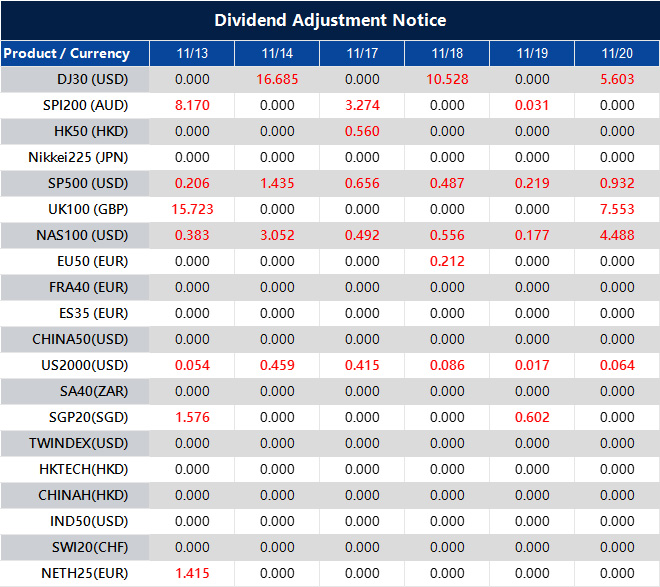
The above data is for reference only, please refer to the MT4/MT5 software for specific data.
If you’d like more information, please don’t hesitate to contact [email protected].







